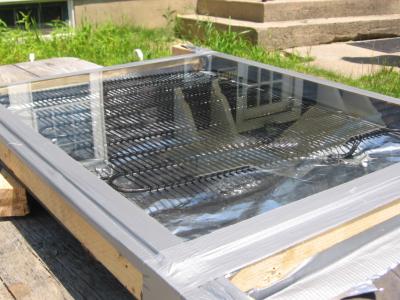
I just added a new solar thermal panel project to the project section of the main site. It works a lot better than the first one did. Check it out and leave a comment here.
269 thoughts on “New Solar Thermal Panel Project”
Comments are closed.
I just added a new solar thermal panel project to the project section of the main site. It works a lot better than the first one did. Check it out and leave a comment here.
Comments are closed.
You could probably fit in a few old refrigerator coils and increase the flow. And how about a piece of blue styrofoam for the back so that it will work well in winter? Also for the glass, a theropane window may work best (two layers of glass with a vacuum space). These are expensive, but I have seen them thrown out.
Why put a reflector on the back?
In Israel we have many sun-heated hot water tanks. The idea is that the large area of black surface absorbs the sunlight radiation, heating up, and transfers the heat to the pipes via conduction (either directly, or using the air inside).
The glass prevents heat from escaping by conduction, but permits heat to enter (and leave) by radiation.
By making the back aluminium foil, you are refleccting much of the heat back outside before it’s absorbed into the pipes.
I should note that for that to work you need the back to be conductive, and the rubber is probably not a good idea.
Insulation would for sure increase flow in the winter. We ended up insulating the bucket the water flowed into, but insulation on the panel would also help. We will incorporate these suggestions into the next one.
We only found the one pain of glass, but i would have killed to find a nice insulated window frame at the dump, that would have been a real find.
yea that was the problem we had, the rubber backing was just sucking up all the heat, the backing got very hot but the pipes didn’t. With the foil in place, we found a significant increase in the amount of heat the pipes picked up. If the backing was metal and the pipes were attached it with metal brackets it might work well.
If you build one without a reflector inside let me know what your mileage was as we were debating foil vs no foil.
Thanks for all the comments, keep them coming.
I really enjoyed the article on the 2nd solar panel. It was so well written and the visuals and instructions make me confident that I can do it. That being said, as a New Yorker, I don’t understand the need for this. Is it for camping? Why would you need hot water like this & why wouldn’t you just leave the a bucket of water in the sun & wait for it to heat up on a hot sunny day. Any insights?
Thank you for your interest in the solar panel project, let me answer your questions as you asked them.
The project was done as a way for people to have a project they can do at home that will demonstrate the principles involved in solar thermal technology. The idea was to show people that the technology works so well that even a little home brew project works well. If you wanted to do solar thermal panels for your home you would buy one of the many commercially available packages.
This project could be used for camping to heat up a batch of water for a warm shower while in the woods.
As far as waiting for a bucket of water to heat up in the sun, if its a cool day say 50 out, your bucket is never going to get hotter than 50. If you have a panel like this you can create 100+ water on a 50 degree day. This would make for a much nicer bath.
The panel is sort of a “proof of concept” project, but it does have useful applications. It also is a fun project to use to teach science principles of solar energy to students. Its more of a learning project, and a way to educate people that these sort of technologies are available.
I hope this helps.
Thanks for getting back to me. This definitely helps
me understand the intention of the project better.
Tara –
The real point is that if you want hot water in your house, you (or your landlord) have to spend energy to heat it up. The energy you have to use is proportional to the temperature difference between the water in the pipes from the utility and the hot water you want (ie, if the water coming in is cold, you have to spend more energy to heat it up.)
So, if you can harness the power of the sun to pre-heat the water before it gets to the hot water heater, you can have hot water in your house, but spend a lot less energy to do it. People sell pre-heating panels to put on your roof and do this for you, but this project has managed to make a pre-heater for 5 bucks.
Heating water accounts for a significant percentage of home energy use, and if we all installed one of these, home energy use would be cut dramatically.
I bet it would thermo-siphon if you flipped the whole panel over so the lines came out the top. Of course, hot air in the chamber would escape through the slit for the pipes, which would reduce efficiency, although you could pack the holes with something (spray foam, caulk, or just tinfoil; the point is to stop the flow of air). If you make those holes airtight you would have to let the air expand some other way, though, and probably a vent hole on the bottom would be best, unless the whole thing isn’t airtight, in which it won’t matter.
Also, you don’t have to siphon the water through to prime it. Just fill it with a funnel.
I like the idea, and it’s simplicity. I can see many areas to use this. But what about the left over refrigerant in the tubing, are you safe to wash/drink with this water? Can something be done to clean the tubing thoroughly if it’s not already?
What about using an old car radiator? You would have to clean it very well, but it is already black metal and has more metal fins to transfer the heat to the water. It also seem more readily available.
I thought of creating two of these and linking them together or making my own with copper pipes. The real trick for me Iis that I want to use it for my pool How does anyone suggest I hook-it up so that the pump can feed the panels and then it will be forced back through into the pool.
If i get two linked together then the waterflow speed will be counteracted by the length and flow capacity of the system. Plus i think 110 is a little warm for my pool, g-d forbid i let it stand and get to 170 EEEEEKKK
@Lee:
Generally the water in a system like this is not directly used. The tubes of a pre-heating system like this are generally run through another water storage as a heat exchanger system.
This is about the best picture I could find in a few seconds:
http://www.malignani.ud.it/WebEnis/NorthWind-SouthSun/power/images/water_heater.jpg
Hopefully this answers your question :)
Its great to see you experimenting, but you really should do some research how the best solar panels work.
Think about it…. first, roughly 1m sq is about 1kw of energy.
So you need to get as much of that energy as you can.
The 1st type of solar panel is the flat plate collector and is
the cheapest to construct…. note it is called the flat plate.This is because you want the biggest surface area. you can runyour pipes over the flat plate, they must be connected to the plate.
So first you want your
1.wooden frame
2.Insulation – to stop heat escaping from the back
3.foil, this reflects back heat (note its not reflecting light as it is hidden!!)
4.collector plate – sheet of copper or alu or even steel if you have to.
5.tubes, these need to have a good connection to the plate -plumbing solder?
could be behind the plate, but nice to see them.
6.Paint, matt black high temprature (like engine paint) there are other options also. this paint goes onto the metal plate and pipes
7.Glass – possibly double glazed
The other type of common solar pannel is the evacuated tube, which work pretty well even in cold weather – but they have to be specially constructed – you can buy the tubes on there own of course..
Very interesting project, over here in the UK there alot going with the cost of energy (oil, gas, electic) shooting up that people are thinking of cheaper greener energy creation method.
Recently there was a programme on tv in the uk called ‘It’s Not Easy Being Green” where a family attempted (pretty well) to be as self relieant as possible. Is this series they manages to :-
Build a water wheel that generated electricity to power their lighting,
Installed a small wind turbine to run a water pump to take water from a spring into there house for the toilet,bath,shower,wash (saving on water bills),
Installed a larger wind turbine to reduce electic bill more
Installed a solar thermal system – give heated water 6mths per yr, (they did a tester using a old raditor they painted black but had limited success),
Had a system that kept a greenhouse hot all day and night – like this one so simple a cost nothing to run.
http://www.itsnoteasybeinggreen.org/
Nice project. Just a couple of comments.
You brought the connections out of the same corner. One stub is really long and comes from the other end of the coil. I’d have cut that short. Cool water flows into the bottom, hot out the top. It would make filling simple too.
With this configuration you can go with a single tank, above the coil. Connect the bottom of the tank to the bottom of the coil, and top to top. It will siphon freely.
Check out a book called “A Golden Thread: Twenty five Hundred Years of Solar Architecture and Technology”. You will be amazed at how we are reinventing the wheel.
BTW the “large coolant holder” in the article is the compressor.
Best,
Tom
OK, but how will it work when it’s, say, 30 degrees outside? Will it get hot -that 100 degrees or more?
Then, can we extends the exit line into to 25 feet of tubing, wrap it around the back of a fan for a space heater?
( The AC version of this works great, by the way. I’ve had one in my garage for months. Let’s me tinker away in 75 degrees when it’s been 90+ outside!)
Take care,
Joe
one of the better thermal energy usage i have seen blogged.
i would really like to see someone to put up a step by step of actually installing it into the water system in their house.
the these low costs, it isn;t worth getting a commercial unit, just to get the IRS tax credit.
Thanks for all the comments let me try and answer a couple of questions all in one comment.
This was never meant to be a commercial system, or to be used in a real home. There are many commercial systems available for this that work much much much better than mine.
For pools, you would not want to use copper pipes, as chlorine would tear them up pretty fast. Most pool heating systems use a heat exchange system, or black plastic contraptions.
I actually work for a company that builds and installs renewable energy systems on homes. We do solar thermal, pv, and wind turbines. We would NEVER install something as DIY as this on any home, it is not meant for winter use, or anything like that.
Commercial solar thermal systems are designed to work in the winter.
The reason this panel is not “perfect” or “optimized” is because I wanted to see what was the absolute cheapest panel that could be built that would still work really well.
Thank you so much for all of your interest.
If any of you have DIY projects that you have done, and would like to put them on The Sietch, let me know, we are always looking for more people to add projects.
Thanks.
That. is really cool! I’ve always wanted to do some DIY stuff too, but they take so much time!
Using the refrigerator part was brilliant….well done
Could you possibly give some specific instructions for these projects ? I can invision most of this, but accuracy would be nice. Please post specific instructions for the dummies…. Thanks and keep up the good work.
I guess its kind of hard to give “exact” instructions on this project as it really depends on what materials you found, basically build a small box to hold your collector with glass on one side, and backing on the other.
The finished project as shown is about 3 feet by 2 feet and about 5 inches thick, i used about 10 feet of air hose, and the refrigerator grill was off of a smaller “half fridge” model.
Other than that the wood was 1 inch by 1 inch framing from an old couch. I used long wood screws to hold them together, and the door mat was cut to size by holding the fridge grill over it and making sure it would be large enough to hold the frame and the grill.
Hope this helps.
Thanks again to everyone for all the comments.
Don’t use tinfoil. You are reflecting much potential heat back out. make the box insulated and line the inside with something black. Roofing materials work the best as they can handle the heat. You will find you will get much hotter water as it will increase the internal air temp.
http://www.flickr.com/photos/nitroburn/175266083/
Check out the solar water heater I made for my pool. Works great. That 77L holding tank gets very warm and the pipes average a 10c difference in tempeature up their length. You can feel the warmer water come out of the hot water inlet from the inside of the tank.
What would happen if you ran another fridge grill in line with the first one? would it increase the temp of the water or give it a more even temp? would it make any difference at all? I am asking because i really like this project.
In theory you should be able to get hotter water by running these kind of panels in series jason…that is how commercial solar thermal systems work.
Nitro: I will try it without the foil, but our testing showed the foil actualy made it hotter. More testing is needed obviously. Cool pool heater.
I think what may be happening is that the foil is bouncing the light onto the back of the refrigerator grill. Light is therefore hitting both the front and back of the grill and turning to heat. This may heat the grill faster than relying on the heated air around the grill, which is what would be produced with a black backing.
It would be neat if you arranged a few cheap mirrors around this thing to see how much of an increase you could get.
Marcus/Nitro I do talk about that in the article, it seems that the foil is in fact getting the sun onto both sides of the grill. We are going to be adding some mirror (which i just found on http://www.freecycle.org ) and see if we can get this bad boy smokin.
I just purchased a box of 1″ mirror tiles for my solar concentrator.
Have fun!
Also, the black backing might be more effective if the box was insulated. It could be transfering the heat through the backing rather then to the collector and thus making the reflective surface more efficent for transfer in this case.
The goal of this panel was to make it work well for the least amount of money, if i can find some old foil house wrap i will coat the back with it and see if that would work to keep heat in.
Nirto could you please contact me using the contact form, I really want to talk to you about teaming up on some stuff. Your projects are great. I too have a bunch of 1″ mirror panels and am thinking of using it to concentrate more sun on this panel, or a future design.
You really do need to understand more about heat and light
Nice project, but heat can pass through glass too, FYI. That’s actually the principle you are using.
Perhaps my wording in the project was poor, what I mean to say is that infrared radiation (heat) has a hard time passing through glass, the principle I am using is the same as what happens in a green house. The light (most of the spectrum) passes through the glass and is absorbed by things within.
These things then begin to heat up and emit infrared radiation, this radiation has a much harder time passing through the glass (glass is an insulator) and thus the green house heats up.
In the thermal panel, the fridge grill is the thing absorbing the light (its black) and the glass keeps the heat from escaping too fast thus the water inside the tube gets hot.
Perhaps a re-wording of the project is needed…
I haven’t read all of the comments, so I may be addressing a question that has already been answered. Joshua, you asked about the problems of heating the water to about 170 degrees for your pool. We have an indoor pool – so it never gets really hot because it’s shaded even in 100 degree weather. At this point we have just snaked some hoses around in an old tire and covered it with glass. We can get the water coming out of this to about 120 degrees but are still only heating the pool to about 84 degrees. The reasons being, among other things, that the water is constantly moving, we aren’t picking up any heat during the night, and we’re heating about 15,000 gallons of water so it will take a long time to raise the temperature in the pool each degree that we gain. We just hooked one end of the hose into the hose from the pool vac( where it attaches to a hole in the wall of the pool), ran that end of the hose out the patio door, then ran the water through all those hoses and in the patio door to the pool water again. The pump to run the filter circulation system is moving the water. Have taped up the edge of the patio door to keep the heat in the pool room (because we need to keep the temp in the room a few degrees above the temp of the water to avoid condensation). It’s very crude, but sort of working. We’re in the planning stages of a better system. We are looking into using old water heater tanks inside black boxes. We’re wondering if an old propane tank would work as well and make a much larger holding tank. Or is there such a thing as too large? Too much of a good thing? I’m cautious about just how well we could clean out a used propane tank and whether I want any of that residue running through my pool, even with a filter system. Also, we are debating the black vs. foil lining in the box that will hold the tank – and I assume hoses. My husband wonders if two panes of glass are good, would three be better? Would two panes be OK even if they are just double layers and not thermo panes? What about rocks on the “floor” of the black box to absorb heat and let it off slowly over the evening hours? We live in Missouri so we have plenty of rocks! In this case I am thinking the rocks should be laid on something black. I am pushing for a very dark brown metal box made of the same sheet metal as the trim of our house for cosmetic reasons. Will this absorb heat about as well as flat black paint? We could always go with the brown on the ourside and still a flat black inside the boxes. These last questions are to anyone who has an answer or opinion. Thanks a bunch for your help.
I would stay away from the rocks, people have been trying the old heat rocks thing for a long time, it seems like such a good idea, but in reality they almost never add anything to the project. I would say try to trap as much heat as possible in the water from the pool itself as water is a very good storage medium for heat.
Also the tube through tire idea is brilliant. Some things to think about, two panes of glass are better than one because they are insulators and tend to help keep the heat in, but they also block out the sun rays, so as you add more pains of glass they start to block more and more. Its a good idea to keep the pains to no more than two.
Also if you want more heat you can always just create more of your tire/glass creations and hook them up in a series. In this way the first one heats the water a bit, sends it to the second which heats it more, and so on and so forth. In essence adding more solar thermal “panels.” This should get you more heat.
You can use tanks as storage but if the tank is large it will take a long time to heat up the water inside, thin tubes or pipes exposed to maximum solar radiation will heat up the fastest. But thin tubes will not carry much water, a compromise is to have tubes of around 3/4-1 inch. This allows a lot of water to flow but also a lot of surface area for the water to warm up.
The better you insulate the system the more efficient it will be. I imagine if you made the system too large, it would heat your pool to a temp that was not fun for swimming in, perhaps you can have a large solar sauna :) But I would not worry 15,000 gallons is hard to get that hot.
I would suggest that before you go building anything else you try a couple of your tire heaters in series, they are simple to make and its always easy to find tires. If one gets you to 120 try three.
I’m not particularly worried about heating our pool too much. But would like to be able to heat it enough so that the lines don’t freeze in the winter and keep the pool water and pool room above freezing, too. May have to turn on the wall space heater to keep the room above the water temp, but it would be nice not to have to use up a lot of propane to heat the water. We have been closing the pool down and just keeping it cold but running the filter system from Thanksgiving through April, depending upon weather.
Our idea is to heat the water through the hoses ( we have a lot of black hose) and mostly use the tank for storage so that we can continue to pump warm water into the pool for a while after the sun goes down. I think you’ve talked us out of the large (500 gal) tank. Dave found an old heater tank that he says is larger than the 50 gal we have in the house and I think we still have an old 50 gal one laying around. So if one tank is good we will do it again and run them in tandem for more and hotter water storage. The black hose we have is a little smaller than garden hose so restricts the flow somewhat because the yellow and green ones are regular garden hoses. Don’t know if that would be 1/2 in and 5/8 in or 5/8 in and 3/4 in. Probably won’t do the lots of metal tubing thing because you all seem to be into copper tubing and that’s way too expensive to buy and we don’t have any layring around here. We are thinking of about a 3 ft by 6 ft box and trying to find an old patio door to lay on the top. That would make it all one piece of glass and easier to seal. Plus if we’re lucky it will still have the thermal seal intact. Otherwise we have a lot of tempered glass in about 3X4 ft pieces but that will be a little more work to fashion into a lid and to seal. Also wondering about just one layer of that glass and in the winter covering the glass with insulation at night so we can capture heat during the day and hopefully hold some of it all night in ase we have to build something out of the smaller tempered glass pieces. Not sure about the coiled hose – whether it will go in the box with the tank or have it’s own box and run the hose from there to the next box that has the tank. We will butt these boxes up against the back wall of the house and against each other – run in a row along the back wall ( south side) so there won’t be much or any hose exposed to the elements.
Oh, also… I am not going to encourage Dave to line a bunch of old tractor tires up in our back yard ( OK, so I almost said “MY” back yard). I am trying for something with a little more eye appeal.
Now we’re just waiting to see how the debate of black interior vs. foil or mirror comes out (he’s leaning toward the reflective idea). Will keep you informed as we progress with this project. If anyone has any more suggestions, throw them out there. We will listen and process everything and anything that anyone comes up with. Thanks. You’ve helped us get several steps along with our solar heat system.
By the way, I really liked your refrigerator solar panel. And since you’re thinking just an experiment or something to take camping I think you’ve got it pretty well where you want it. You don’t need to try to haul something too large and unwieldly on a camping trip. Great idea – and I can’t fault the cost factor at all!
Hey ‘Naib’, glad to see you’re still working on your solar thermal panel. It’s been a while since I assisted you (limitedly) with the first draft. Hope you’re doing well.
Still working on that solar pool heater. Got a larger tank and painted it flat black – bu no box built yet. Will take some pictures and keep track for you, but right now we have some health issues with my 83 year old parents in Iowa so I will be making a trip up there and will be a bit before I get back to you. Pool is now holding at 86 degrees and I don’t really want it any warmer, but if we can harness more energy and more heat it will be great to have this winter. Back attcha soon.
Judy and Dave
Another parting of the minds. Dave wants to make the lid and the front of this solar box out of glass. I am thinking just the lid with the front being a solid, well-insulated wall. Anyone have any suggestions here? Has anyone done a solar box with one wall also glass? Would this let out more heat or let in enough more heat to even things out or actually gain some heat ? He is also thinking reflective insulation on the interior walls. The tank is flat black and will take up most of the box. I think he is planning to make it large enough to coil the black hose inside the box, too. So, I guess what I’m getting at is that the reflctive insulation might normally just reflect the light and heat right back out the front of the box, but with a lot of the interior being taken up with the flat black tank the relfection probably wouldn’t get past the tank – except maybe where the hose is coiled. Help! We’re up for suggestions. Thanks.
Judy and Dave
Hello: Great idea! I’m not the best at building something,but you show how in a simple way. My question is, how do I hook this up to heat my pool water. It is some were around 12,000 gals of water. Thanks Thomas
I wonder whether the one-way glass like the police use in interview rooms would work better — obviously harder to get hold of scrap. The idea would be to reflect all the light and hopefully heat back in towards the heat collector.
Thomas: If you wanted to heat a pool you would have to build a much larger version of something like this, probly out of black plastic tubing, and then hook that up to your pool this small test design is not large enough to heat that much water.
Mark: good idea, but the foil that they put on that glass would as likely bounce as much light away from the panel as trap it inside. It is a fine balance between letting light in, and letting light out.
Good work. So many people on the web TALK about projects. So few do. And, two projects, the heater one and 2, even better.
Ignore that Mikie guy, he does nothing, and, one of his comment was factually wrong.
I look forward to your future work. I nitroburn is also a prolific worker, hopefully you two will corroborate in the future
Hi, do you know of any commercial kit set units you can assemble yourself for your own roof to heat your house water? I live in NZ and solar water panels are really expensive…would like to build my own but lack the confidence…could maybe assemble a kitset.
I am sorry Kiwi I do not know of any kits that you can buy, however you could easily take the instructions on our site (and others) and create a low cost solar thermal option. After having worked for a company that installs the commercial stuff I can tell you they are worth the money.
Many places have rebates and incentive programs that help consumers pay for solar thermal panels, I would find someone in your area that installs solar thermal panels and ask them if they know of any such rebates or grants.
Has anyone tried this with tubing other than copper?
I have access to plenty of thin walled plastic tubing and was wondering how less efficient this would be.
e.g if the panel was say 25% bigger would this balance out the use of less conductive tubing?
Or am I missing a significant point?
Thanks
Mick
So long as the tube is of a dark color it would work just fine. You may want to check out our most recent entry for solar thermal projects
http://www.thesietch.org/projects/solarthermalpanel3/index.htm
It uses plastic tubing and works very well.
making the panel 25% bigger would just make it work better.
Another problem with copper lines and chlorinated water – the chemical reaction will cause copper to dissolve into the pool water with the result being a lovely head of green hair!
I’m currently weighing options for constructing a swimming pool heater along the lines of the water heater illustrated here. My plan is to use an automotive radiator encased in a glazed, insulated box. The inlet and outlet are about the same size as the pool pump supply and return lines which would minimize flow restriction, but would tend to cause the water to heat less… multiple passes or multiple panels connected in parallel (parallel creates less flow restriction but will be more difficult with the auto radiator design). I like the 3rd generation panel design too… my dad and I came up with that idea about 35 years ago! :)
NIce project, though I wonder what use the water is given it’s possible contamination by passing through an old used freon coil.
I think I’d make a few modifications.
– Use multiple coils, stacked for more flow and capacity. Probably 4 in series parallel. 2×2
– Use a black backing. Maybe roof paper or black shingles.
– go to a sealed system with a heat exchanger and (solar powered?) pump.
– A heat exchanger could be as simple as some copper tubing wrapped around some water pipe and wrapped in high temp insulation, to a commercial model like http://www.sunearthinc.com/suntherm.htm
– Add an old water heater for a storage tank. out from the bottom, return to the top.
Tachyon: The only thing that would be inside an old freon coil is mineral oil (freon is lighter than air and any left would instantly vent out). Mineral oil is non-toxic and wont hurt you.
as for the modifications that sounds like a lot of great things, it seems there is some debate as to the most effective backing black or foil.
I was trying to make this project as dirt cheap as possible, so doing a lot of the things that you suggest would increase the price a lot. They are all good suggestions, I just wanted to keep it as cheap as possible.
I think you should have used the fridge door to avoid build a box around your panel… reusing more parts is a good idea and a gain of time
Thank you for your projects
Wow! what a great idea, the door is already insulated as well…Perhaps I will try this out as soon as i can get my hands on another fridge.
Thanks for the tip :)
I have just discovered this site and this project. Lots of good advice here to apply as well. I can’t wait to build.
Reuse as always is the best recycling.
My wife and I have a small agricultural interest in which I intend to apply a variety of alternative and renewable energy techniques to take it off the grid and maybe even give a little back. Energy independance combined with healthy food for people is the goal.
Excellent concept model. Will experiment with an indirect system, eg; an indirect hot water cylinder using its coil to transfer the heat to raw water, which can then be used. When I trained as a plumber, gravity circulations were taught. This information can still be found in old books. You can then calculate circulating pressure, resistance of pipework and if it will work, before you spend hours making something. Good Luck.
Since the rubber mat you found had a metal plate in it, it might have been an anti-static mat that is used by people who work on electronics/computers.
It removes static electricity from the person so they do not fry electronic components by touching them
excellent articles
thank you
I would think thermo pane (double glazed) windows would be a bad idea because it often is coated to reduce the amount of infrared light entering a house (the rooms stay cooler and upholstry does not fade as much).
this would keep the heat from entering the collector in the first place.
I think the glass is also to keep heat from leaving through convection or conduction (a cool breeze flowing across a hot collector removes some heat.
I would like to try it by covering the collector with something like roofing tar so as to try to convert as much light as possible into heat by absorbtion.
ya know, with a measuring tape and a skill saw, that there could be a super collector, maybe a nice black sheet of metal, or even corrugated tin aligned to center the curve into a focal point at the center of your carrier lines (that would super heat the water concentrating the energy directly into the line). ever seen any old scraps of good paintable tin around your neighborhood? Plus, you are getting the most expensive piece of hardware, the coil, for pennies, pre bent and pre braced with addition of the fins that actually help reduce heat loss. hmmm… now that rocks, and cleaning up the dump, and thats that much more ore that isnt melted with fossil fuels… not bad. kudos
another note, tar melts… solar heat gets very hot on black… use metal, the more reflective the better, glass traps the heating rays to a great extent (not heat)
wow, should have read more before posting, all critique. well, for the money spent, you did great and for the purposes, perfect. I know there are alot that can improve on this idea, but the very best thing i see is the recycling of the refrig coil. awesome and simple. for the price, you can connect alot of these before touching the cost of making one 24 x 36 . i am guessing that is close to the size. and the loss between units wont be much, insulate em… just keep that “heat goes up” happening as much as possible and the pressure will do the rest. there are of course two real good ways to get the heat into the pipes. using the flat metal collector directly attached, or even hotter, centering the pipe into a convex reflector. but for all the critique. its still talk, this here is action and doing anything is better than nothing… get busy everyone else
What about using a fresnel lens under a pane of glass?
Dave: That might work…if i can get my hands on one I will check it out. I have another plan that I have been working on and should be ready some time this summer (its 20 F outside right now, not the most fun for outdoor projects) that might use something like that.
This gives me an idea. Does anybody think they could build a solar refigerator. If you can or already have post a link up here, please. Thank you.
i think this is great please email mail me updates on this email is den610@hotmail.co.uk
Hi
This is awesome. ‘eco’ mentioned using the fridge door – but what about using the whole fridge? Mount a water cylinder in there (eg black plastic) and the panel below, arranged to thermosyphon. The fridge should provide a great insulated box for the hot water. (If it was a bar-type beer fridge, with a glass door, you could heat it directly too!)
I love this message board. I have a few ideas to contribute. There has been some debate as to whether a black background or a reflective background would be better. Well, the whole point is to maximize the surface area that is being heated by radiation. A painted flat black aluminum plate should could be the best option here, but only when the copper coils are resting in contact with it. If there is no contact, then a reflective back is best. Aluminum has great thermal conductance, although black steel would be fine too. Reflective backing is used when you are trying to reflect solar radiation back onto an object, however, evaporator tubes have little surfac area, so you are better off heating a large conductive area in full contact with the evap. coils. Just my two cents. I am a mechanical engineer, but no expert by any means.
Somebody else suggested using coils in series, this would make it difficult for thermal syphoning (assuming the the coils were all ‘spooning’). I would think you want them in parallel, that way you would get a greater flow also. I love this project, i am going to try this myself. I have two old fridges that don’t work.
thank you for your kind words fing, just remember to have the freon removed from your fridges before you use them for any projects, don’t want to make the hole in the ozone any bigger.
If you have any luck send me some pics I will post them on the site.
good luck!
just saw this project a few days ago and cannot stop thinking about it. I’m definatlet gonna have a go at it, if only to wash my hands in warm water while at my allotment. Great work and explained in laymens terms which is also great….. Lol….I’m confident in my abilities to get one of these up and running in a few weeks, as i have loads of other things to do at my allotment first so it can wait, while i collect all the bits i need…. Thanks man..
“My very basic understanding of solar heating is that we want lots of surface, and a mass that would absorb the energy quickly. How about if you cast the cooling tubes and fins in a thin (one inch) layer of concrete and paint it black? Lots of surface area and it is in direct contact with the tubes and fins for more effient transfer of energy.
Then use a solar powered pump to circulate the water, they are redially available from the artificial pond companies. I would wire it direct…only runs when the sun is shining.
Bob, You are right in having a black background, it is the collector surface area that matters most. However, I don’t think concrete is an ideal conductor to transfer the heat to the coil. A metal (preferably copper) plate painted black would be best I think. The solar pump is a novel idea. What if you also linked the pump to an old thermostat that would only allow the pump to run when the water is at a set temp, that way the water is being allowed time to get hot enough in the coils. How much are those pumps?
I have had a go at this with some amazing success. What I have done is built a metal tray on top of my shed roof the same size as a double clazed window I have. The tray is 6ft x 5ft and 5 inch deep. The coil is made of copper tubing and fills the tray with each end of the coil through two drilled holes in the side of the tray.. I then encased the coil in road surface tar that fills up to one inch below the rim of the tray. The double glazed window is then screwed to the top of the tray. Water is pumped in from a large rain water collector through a modified pond and UV filter into the solar heater and out the other side when the water gets to 60 degrees. On the outlet I have an old thermostat linked to a outlet valve which is also linked to a switch on the solar powered pump that contains a backup battery. I have probably not fully explained how it all works together. But it does work extremely well. It has a few quirks that need sorting out but once I have it working 100% I am going to build one on a larger scale on top of my house roof and use along side my main heating system in the house.
Dave, take some pictures and post them!!h
Es una grán idea, además de que al leer los comentarios que te han hecho, se mejora la idea.
Estoy tratando de utilizar un sistema de calefacción de agua para la labadora en una zona rural, asi que esta puede ser una buena idea.
Gracias, y si tienes alguna sugerencia o proyecto más adecuado te lo agradecere mucho
las dudas que tengo es sobre el tanque que recomiendes.
cual es la diferencia de nivel que tienen que tener el panel con respecto al tanque.
gracias.
Gracias por compartir los proyectos!
Es una grán idea, además de que al leer los comentarios que te han hecho, se mejora la idea.
Estoy tratando de utilizar un sistema de calefacción de agua para la labadora en una zona rural, asi que esta puede ser una buena idea.
Gracias, y si tienes alguna sugerencia o proyecto más adecuado te lo agradecere mucho
las dudas que tengo es sobre el tanque que recomiendes.
cual es la diferencia de nivel que tienen que tener el panel con respecto al tanque.
gracias.
Approx translation for those without Spanish:
Thanks for sharing your projects!
It’s a great idea, that gets even better on reading the posted comments.
I’m trying to set up a hot water system for a washing machine in a rural area, so this could be a good idea.
Thanks, and if you have other appropriate suggestions or projects, I would be grateful.
The doubts I have are about the tank you describe. What is the difference in level does the panel need with respect to the tank?
Thanks
Nice project and presentation, thanks very much.
I really like the old refrigerator coil idea as cheap and convenient metal tubing, already shaped into a neat, flat rectangular area and painted black.
I also like how the originial function of the fridge coil is now reversed – formerly to lose heat, now its being used to gain heat.
Perhaps for safety sake you should edit your article to make the point about the unkown toxicity of the water flowing through an old fridge coil much larger, bolder, and red! There have been cases of poisoning and birth defects traced back to fridge coolant contaminated water.
Rubber is a reasonably good insulator, but black rubber will tend to heat on the inside of the box and release it on the outside – more so than if the rubber is a light colour. A cheap solution might be to stick a layer of foil onto the back of the rubber.
For colder, cloudier weather, your reflector foil would be better painted a matt black (only on the sun-facing side) to absorb all that light energy rather than reflect it off. To conduct heat from the blackened foil to the tubing it must be pressed up against it so that they are in close contact. Doesn’t matter if the blackened foil gets a bit crumpled doing this.
Or, perhaps even better would be to leave the reflective foil as you have it and just lay blackened foil (but blackened on both sides) on top of the tubing. This blackened foil layer would do all the work of capturing the solar energy and then conduct it as heat into the tubing behind it. The reflective foil left in place would then become an insulator and reduce heat lost through back of the unit (as long as that one is not touching the tubing).
If black paint is too expensive, you could try blackening the foil with soot (just an idea, don’t know how it would be best done).
Fingallion
I was figuring on the thermal mass of the thin layer of concrete. The concrete would hold heat not transfered to the water. Using the refridgerator coil as the tubing I would strip the paint they put on to improve contact. Fluid contact would be good …how about immersing the coils in used oil?
I wonder if pulsing the water would have a benifit. Maybe use a slow piston pump, on it’s intake cycle it would not push water through the tube, then if it is sized right it would empty the tube by forcing a new batch of water in. Water sitting in the tube could absorb more heat than just passing through, although I am sure there is a fine line between long enough and too long.
I agree the copper plate would be better but copper is way expensive now and not many people have soldering experience…there would be some wierd things (stresses) happening to the plate as you soldered the coiled tube to it.
And the Naib is trying to develop this wiht low costs.
I think used motor oil is probably a bad idea seeing as you can’t tilt it to the sun, also I am guessing oil is a pretty bad thermal conductor.
As far as I can see, all commercial flat plate collectors have a black copper or aluminum sheet attached to the pipes. I saw on some DIY site that you can simply tie-wire the coils or risers to the plate and get almost as good a thermal connection as if you welded them or soldered them. 18 gauge aluminum sheeting is not too expensive.
Here’s an interesting idea, use a single panel hot water domestic radiator painted black as your complete collector!!! You can buy used ones for next to nothing!! Essentially you are using it in reverse.
Nevermind the radiator idea, it would work but they are not cheap like I thought. Also flat panel rads are hard to find in US.
Hi Could this system be adapted to heat pipes, perhaps in some sort of a circular system?
Paul: I am not sure what you mean, but the heated water output can be used to heat just about anything you want to make hot. Either by simply putting the hot water over what you want heated, or using a heat exchanger system.
Could anyone comment on the A/C version mentioned above in post #17? How would this work?
I’m sure a lot of people would be interested in cutting their summer cooling bills. Or at least experimenting with it.
If you are interested in cooling, then maybe something a little off topic. When you dig a hole a couple of feet in the ground, the temperature is pretty constant all year round, 40 to 70 nationwide. I am guessing the midwest is 40is all year round. You could bury some pvc or copper coils a few feet down in your back yard and have water pumped through them to some kind of heat exchanger (possibly an old non working window AC) and let the fan blow air across the earth cooled coils. I don’t know if this would really work well, but something to think about though. The earth is an excellent heat sink. Anyway I reallise it is off topic but it is an answer to post 84. I also think we are all on the same page if we watch this blog.
Thanks for the reply Fin.
Yeah, there are commercial systems like this. I think they’re called geothermal. They go several hundred feet down into the water table. 40F sounds a bit extreme…I’d be curious of any place that gets that cold…I’ve only ever heard of 60-ish.
Anyway, I was just curious about someone running this experment in reverse for cooling, or what the poster did to cool his garage. My garage I have no problem with…my basement never gets above 70.
Yeah, it is geothermal I guess, but the comercial units essentially are substituting the ground for air for the purpose of condensing refrigerant with huge efficiency… either by going deep to wells or using long shallow trenches 48″ deep (approx frost line). I was just considering a low budget way of cooling water by a few degrees.
Has anybody made any progress with the solar collectors?
wow you guys are amazing, how do you think of using that much unwanted stuff and turn it into cool things
im building this for my science project
thankyou
If I take the piece off of a larger refrigerator and cut it into six equal sections, then take a 12 volt marine battery , use the six sections in one panel each section having in and out tubes, and run each section to one cell of the 12 volt battery. Will the heat from the acid running through the thermal panels charge the battery? And how fast would it charge and by connecting other batteries to the posts of that battery how many other batteries would the first battery keep charged. Keep the battery hooked to the thermal panel well ventilated to reduce explosive gases.
Gary: This system will only produce warm or hot water. It in no way was designed to charge a battery. If you want to charge a battery from the sun, start here.
If I seal my windows with black plastic will it help keep the house cooler in summer?
Great work!! Okay, so how would you modify this design to create a solar-powered “hotbox” for my backyard vegetable garden so I can grow vegetables in the dead of winter. I need to heat the soil, not necessarily water it.
Great work!! Okay, so how would you modify this design to create a solar-powered “hotbox” for my backyard vegetable garden so I can grow vegetables in the dead of winter? I need to heat the soil, not necessarily water it. I’ve heard of such a thing being incorporated into radiant heating systems by commercial manufacturers such as http://www.radiantsolar.com, but I want to try to do this myself.
Hi,
Thanks for the nice idea of using a fridge radtiator in a solar collector!
I am at the moment in a small city in Peru, Abancay, where I am helping to build a new school. We like to work as ecological as possible, but there is of course not much money.
Therefor, I used your idea to build a small demonstrator of a solar collector. The result can be seen in these pictures:
http://www.muzes.be/zon/zon1.jpg
http://www.muzes.be/zon/zon2.jpg
http://www.muzes.be/zon/zon3.jpg
http://www.muzes.be/zon/zon4.jpg
Here, everybody is used to taking showers with cold water, brrr! It would be ideal if we can include a simple solar colector in the school construction plans.
As you can see in the pictures, everything was build from costless material. Total bill: zero nuevos soles! The glass plate was a little small, but I found some bubble wrap to solve that.
In the future, I also would like to make it thermosyphoning. But I think the tubes are a bit narrow for that…
Greetings,
Toon
PS: Comments are welcome!
Very nice. you should make the backing black if ou can (metal if possible, possibly an old baking tray or fridge door as a source for flat metal), the whole plate and coils are the collector so try not to reflect any heat off them. The notion of using silver foil or white is no help to you whatsoever.
tash and I used this design for our science project with slight changes. it was out there for at least three hours in cloudy conditions and the water went up to 25 degrees celcius.
hiw do you think up these things?
You could avoid getting durty fenol rich water in your mouth, if you installed a small pumb like the one we use for Japanese min towers with stones and water in our rooms. You could also avoid the buckets if you connected the panel with the water supply by a bit of a garden hose. That would not add much to the cost, but make it really useful. I will build one in my summer hut for outdoor showers!
Nobody answered the fella earlier about using a old car rad for the solar collector. It is copper usually black hopefully water proof. Just enclose it in a solar oven box like the copper tubing. In this case you don’t want the sun to get all the way through the rad so would place it at a angle so light shines to almost the end of the rad fins. The insulated box and glass on top would keep the radiant heat in. I can’t believe nobody has not tried it. Maybe used car rads are more money than I think.
Very good project… Impressive… Though hard to believe that water could heat up to a boiling state – until you build the project yourself. One more problem is that some towns do not have a local rubbish dump. But hen again, you look for the closest one.
A black box with a glass front will heat the interior and air to about 250 f even in the middle of winter. How you transfer the heat to water or other medium is up to you. You get about 50,000 btu per day useable heat from a 4 x 8 foot panel. Solar gain is all about surface area, the more the better.
About the infrared and glass thing. Infrared is light that you can’t see. It goes right through regular glass almost unaffected. That’s both in and out. What you have to do to trap it is absorb it and make something hot. Black is good, but foil will bounce it right out which does nothing. Thermopane is fine as long as it’s not low-e thermopane which has a infrared reflective coating.
Hi
Very interesting information! Thanks!
Bye
Hi there,
As suggested by one commenter, you might want to do some more basic research. A very basic panel is a black plate with water lines attached. There must be excellent thermal conduction between the collector (black plate) and the water lines. The black plate is the collector, not the water lines.
Energy from the sun in the form of visible light is absorbed by the collector, turned into heat (the collector gets hot), and is transferred to the attached water lines. Many black surfaces are great at absorbing visble light and turning it to heat but also are great radiators of infrared waves (heat). This is where the glass helps. Glass is often reflective or opaque to infrared radiation so it traps it in the panel (reducing losses). The glass keeps the wind and cold air off the panel, too, which can rob heat as well.
Your foil, placed as it is, will reflect much of the visible light right back out the glass panel. This is very inefficient. Try making your coolector panel black and be sure to make a good thermal connection between your water lines and the panel. No tape! Its best if its welded, but lots of metal straps might be a cheap way out.
The foil should be behind your collector plate to reflect infrared radiation leaving the back of the panel. Behind the foil is the insulation. A popular technique is to used foil backed rigid insulation (foil towards the back of the panel). It needs to be high temperature!
Excellent use of recycled materials! Kudos!
Brian
hi, Tony from Hunucma Yucatan Mexico,
Your just what I was looking for:cheap, practical and investigative.
I´m gonna do it (the hot water tank). Also, I enjoyed your light sense of humor and honesty about your trials and tribulations.
You definitely have my attention. Oh, I almost forgot, here in Hunucma, this could turn into a community project.
Thanks a lot and keep up the good work.
Your student,
Tony
Tony: Thats great, please keep me updated on how it goes. You can make a solar thermal panel out a million different things. If you come up with something cool please send pictures in and I will highlight it on the site.
You mention you “already had screws” but at some point you did purchase them! But that is a good simple project. I live in Florida and recently purchased a portable spa and intend on using solar to heat it. My intent is to purchase a solar dc pump with a solar panel ($49.95) to run it and an automobile raditator to heat the water. I have already obtained a solid glass window and plan on building a wood frame using pressure treated wood for the box. It should prove to be a very simple task since I am the handy man sort.
My comment will be the umpteenth, but you need a black metal pannel, thermical coupled with the serpentine, in order to make it work decently. Moreover try to get a boiler with internal serpentine, make a dress of isolant material all around and feed the internal serpentine with the water coming from one or more panels, remember to add a pressure valvle to prevent breaks as the temperature increase over 100 degres centigrade, due to the pressure. Add a small DC pump supplied by a small fotoelectric panel, so water will flow only when there will be the sun. If you have a heater, supply its cold water input with the water coming from the boiler. Add an automatic mix (those for shower) before entering the heater in order to prevent the heater components from too hot temperature demages. With this system you will have all the confortable of the gas heater, your wife happy, and a considerable save in your gas bill.
I loved the idea of using old parts and saving money. I do animal rescue and have been looking for a CHEAP DIY project where I can dig up junk to make heat for shelters. I care for about 30 homeless cats a day (YES, I spay /neuter like crazy).
I did see the article for solar powered heat but need something portable (very), cheap and easy.
I am trying to think of a way to use your idea!
Any advice?
The question that was posed about the use of coils that previously had freon is legit. The system circulates lubricating oils that need to be flushed if the solar system is used for potable water. Acetone is perfect, followed by blowing air thru the lines. Acetone evaporates quickly, leaving no residue. Also, using aluminum foil or other reflective material is defeating the purpose. Fasten the coils to a thin sheet of black-painted plywood (preferably copper or aluminum) with the back insulated would do the trick.
I have revised my plans from a used radiator (chlorine in my spa would quickly make it unusable) to the use of CPVC which is for high temps, painted black and mounted as stated above. Will take photos when I start the project, and send them in upon completion.
To answer Joshuas question about his pool, simply tap the inlet of your pool pump and again after the filter with an inline valve to control flow thru your solar heater. Adjust the flow down until you can feel the warmer water coming into the inlet. Be sure to seal all fittings well or you will suck air in the inlet and your pool pump may slow down or stop pumping at all. If you are fearful that this might happen, put the low pressure side BEFORE the filter and the pressure differential will still give you flow thru your solar heater, just not as much.
To Gary Smith: You are spoofing us aren’t you? If there were any facts to heating a battery to charge it, no one in the summertime would ever have a discharged battery! The desert heat, coupled with engine heat would keep it charged fully!!!!
great job this is just want i need
Hi,
Some of you need to do a little more research into the laws of physics.
Brian wrote that glass is opaque to infrared. It is not and visible light produces very little heat when absorbed. Actually 52% of the suns energy is infrared radiation which is also light the same as visible light except we can’t see it. That is where almost all of your heat comes from. If glass where opaque to it the panel would never let any heat in.
Black is the best absorber and transmitter of heat. The trick is to collect the heat after it is absorbed but before it is transmitted back out.
Anything that is opaque to infrared (like low-e glass) will also prevent the heat from getting in. It will just bounce of the glass back into space.
So remember the heat you are collecting is infrared light before it gets to your panel. When it hits the black in the panel it’s energy causes the atoms in the collector material to vibrate faster. Now and only now is it heat. Before it got to your panel it was light energy and not heat energy. That is critical to good panel design.
Also good job to all of you. Solar is the future for us all.
Bill
Thanks Bill,
I always liked this blog as a positive concept for people to consider renewable energies, but at the same time a little surprised at the lack of basic understanding of how a solar panel actually works. The Naib has made a solar panel that probably heats water but should have used a black conductive backing instead of reflecting almost all of the heat out of the box with foil. The box and the coil are the collectors and should be both be exchanging heat with the water.
Reallistically this should lead to another discussion. These systems are very affordable to buy especially if you have any plumbing know-how. The actual panels are quite cheap. I know this is all about doing things from scrap and low cost materials, however, if we want to do anything meaningful we will have to spend a little bit.
Great Ideals, I need something at my cabin like this, but if its left for a week at a time without useing the water, what will happen, a boil over. And if not I would like to make this a closed system and a value on it so I can use it to wask dishes.
If I use you system and just have both hoses go back into the same barrel will that work??
Anchorage
<>
is it possible to have 1 bucket of water where the waters flows OUT from the bottom to the thermal panel where the water is heated and EXPANDS and then the water flows out from the top of the panel into the bucket of water but it just plunges from the top?? I do not know if this is can be done with thermo-siphon but if I do this it would be great! Anyone??
On June 24, 2006 Tom wrote:
“You brought the connections out of the same corner. One stub is really long and comes from the other end of the coil. I’d have cut that short. Cool water flows into the bottom, hot out the top. It would make filling simple too.”
is it possible to have 1 bucket of water where the waters flows OUT from the bottom to the thermal panel where the water is heated and EXPANDS and then the water flows out from the top of the panel into the bucket of water but it just plunges from the top?? I do not know if this is can be done with thermo-siphon but if I do this it would be great! Anyone??
OK I found a way to do it…it can be done with a waterram pump that needs no external power whatsoever ;)
(See below the section on Water Ram Pumps for additional comments regarding the original thread topic of solar thermal water heating panels).
In response to post # 118, here is a link to a site with a quick description of what a Water Ram Pump is along with several additional links to useful resources about Water Ram Pumps (the short answer: a pump that uses pressure within the system itself to pump water with no external power source):
http://journeytoforever.org/at_waterpump.html
And here is a link to a very technical site detailing how to build your own Water Ram Pump (they estimate $120 to build but looking at the photo I can’t imagine it really costs that much unless brass swing check valves are super expensive; the remaining 16 parts all look to be a couple bucks or less apiece at your local hardware store):
http://www.clemson.edu/irrig/equip/ram.htm
Now for my comments regarding the solar thermal water heating panel:
Heating water using recycled parts – great idea.
Heating water using recycled parts for less than $5? – priceless!!!
Yes, there are plenty of things that can be done to improve it as many of the previous critiques have pointed out. But as proof-of-concept, it’s an A+.
As far as the backing plate, and knowing how expensive copper and aluminum can be, my suggestions are:
1) Use aluminum roofing flashing (or even steel if you want to go cheaper without sacrificing too much efficiency). It’s very thin gauge metal usually found in a roll (but sometimes in sheets) at the hardware store. It’s thin so it can be easily bent into shape but not so thin that it will crumple, tear, and wrinkle like aluminum foil. If you’re lucky, you can sometimes find it pre-painted a dark brown to match flashing on homes; not black, but getting close. You might even be able to scrounge some from a construction site or contractor who has unuseable scraps leftover from a project. My concept is to adhere it or staple it (staple gun; not paper stapler) to a sheet of thin plywood on the backside for rigidity, then nail through it when nailing your frame together. Then just paint it black.
2) Check metal supply yards. Aside from being able to buy a clean sheet of aluminum or copper at a much cheaper price than a namebrand hardware store, many will often have a recycled/used scrap yard. If you’re lucky, you might be able to find a sheet of metal that can be used for your backing plate. You might also find a lot of other useful fittings, tubes, etc. that can be used in projects and purchased for pennies on the dollar. Just depends on how handy you are and if they happen to have what you’re looking for when you stop in. Just wandering around one of these places will give you great ideas.
3) Use a tin snips and a few aluminum cans. Cut the tops and bottoms off, make a cut down the long axis of the now open-ended cylinder, unroll it, and tack, staple, or nail it onto a backing of thin plywood. Then spray paint black.
4) I worked as a stage hand for a theatre group at one point. Sometimes we used a matte black, very heavy gauge aluminum foil for masking off stage lights. I don’t remember the trade name or the cost, but Google searches will find it for you I’m sure. It’s not heavy enough to stand up on it’s own in this application and would need a backing of some sort like the thin plywood I suggested earlier. But once attached to the plywood, it’s (a) aluminum and (b) black already. So no having to use messy, eco-unfriendly spray paint cans. And, since it’s meant to be put on the business end of a theatre stage light (a couple hundred degrees at least), you know it will hold up to high temperatures.
As for the insulation ideas, what about leaving an air pocket between your backing plate and the insulation? Do you think this would add even better insulating properties? So, going from the sun-side of the solar panel to the backside facing the ground, roof, etc. it would look like this in cross-section (apologies if the alignment is a little off):
SUNSHINE
||
V
__________________________ <– Glass
o o o o <– Tubes carrying H2O to heat
================ <– Backing plate
~~~~~~~~~~~~~~~~~~~~ <– Air Pocket
— ——————— <– Foil (or Foil Faced Insulation)
*************************** <– Insulation (if not using Foil Face)
^
||
REAR OF PANEL
The space would be accomplished by simply adding an additional shim layer in your frame. So instead of two frames (front and back) like in the original design, this concept has 3 frames:
1) One frame on the outer sun-side holding the glass above the tubes and backing plate.
2) Another frame (thinner than the rest perhaps) between the backing plate and the insulation layer to create the air pocket.
3) The last frame on the back of the entire panel behind the insulation layer.
Or perhaps dispense with the 3rd frame idea and simply make the back frame deeper than your insulation layer so there’s a gap between the backing plate and the insulation to further reduce conductive heat loss (as air will be the best insulator of all within the confines of the materials we have to work with and given that we can’t economically create a vacuum space behind the backing plate).
I live in Belgium so I think I can make use of this system to hot water in the month June – July – August. I have a water storage tank of about 100 liters and with the pressure provided solely by the water tank I make this water circulate in my solar heat collector I have built (and isolated very well). This system will be a closed system where I make use of the thermo siphon to make the water come back in the tank from the upper side. My problem now is that this water storage tank will be at a height of 1 meter from the ground and I at the same time I want to use this heated waterto take a shower. Is it possible to connect this water directly to my home so I can take a dhower? My problem is the pressure; is it necessary to set this water higher then my shower or will the how water be pressurized when it is mixed with cold tap water when showering??
If the hot water is clean you can simply put it right into the water intake for your other water heater…If it isn’t then you will need a heat exchange coil and you can run water from your cold water line through the coil, then into your current water heater.
I will use clean tap water to heat the water so that I can use it afterwards to take a shower or just for washing or drinking. Like you said ‘the naib’ I want to connect the water coming out of my collector to my water heater at home and so when the temperature drops below 60°C my boiler will have to heat it up. The temperature can drop when the collector as heated up the water till the evening and you haven’t used the water till the next day so the water cools of inside your storage tank or boiler. I want to constantly run the water during summer and warm days but in colder days I want to turn the tap so there is no water going to my solar collector. Instead I then want to use tap water to fill my boiler. I want a system that checks if the solar system is being used and if not, automatically turns on the tap water going to my boiler.
…but for this I need my boiler to give me a visual of how much water is in it; for example if I have showered and the boiler is empty I can turn on the system using my solar collector to heat water
yes yes. brilliant, i am down in mexico and we need a really simple system like this to avoid buying cylinders of propane.
my water heater is 40 litres, so i want to suggest an indirect system from yours which can then heat the water in an insulated tank. guess this can work?
also someone suggested rocks to retain heat for when the sun is not shining. interesting that the super super high tech solar plants in the usa (see solar thermal on wiki) are using molten sand. there must be ways to retain the heat when the sun is not shining.
can you progress this to an indirect system, maybe without the use of pumps?
i feel sure that a simple system like this can replace the gas water heaters here in my small town. sun is not a problem but commercial solar heaters will still cost too much for most people down here. no grants or rebates either, but no rules and regulations either – well not that many : )
you have helped really inspire me and we are looking for old refrigerators. thanks a million. jonathan
I live in Italy where this sort of technology is still ‘space age’ and I’ve found this article fascinating!
We’ve finished having a pool built in our garden and I’m thinking about making some simple panels to warm the water faster in the spring.
A few points and questions:
I think the insulation in the panel is extremely important and I’d like to use a slab of polystyrene or similar as backing. This should improve efficiency. True?
Any idea how important the gap is that’s between the glass and the tubing? i.e. making the panel deeper?
Since I’d like to keep it as simple as possible and have the pool water pass through the panel, could I just use a black rubber hose and avoid the need for a separate heat exchanger? I assume that the chlorine would corrode any metal.
Steve
Wow, good job. i will attempt to make one of these soon and will probably document it on my website.
My sister lives in a small off-grid home, and I recently installed a small solar powered system for her. I think making some of these will be my next project !
( http://www.techienation.com/?p=21 )
take it from a physicist ( although this is pretty straightforward ), the back should be conductive ( a couple of layers of aluminum foil should do ) and the backing behind the foil should be thermally non-conductive so that the heat wont escape out of the back of the panel, so good choice on the rubber. Also, it would help a lot if the conductive back was painted black ( so spraypaint the aluminum foil black, basically ), keeping in mind that you want matte black NOT SHINE-Y! so re-spray the ‘frige coils. Lastly, I would advise staying away from the mirrors, you’re better off just building a bigger box ( even if you use the same coil as before ). If you use flat mirrors then your efficiency will be low and change greatly as the sun moves across the sky. You have to use a parabolic mirror-based design (as is done industrially).
Very Well said!! thank you!! its freakin’ awesome!!
Can i get your Email so that i can ask some questions, since i alrdy decided to create it for our project thankss!!! or please mail me ur email at jjad16@yahoo.com
thank you!!!
very well said!! its freakin awesome!!!
Please can i have ur email so that i can ask some important mattes regarding ur Project!! please since i decided to make that one!!! plz let me know also ur name so that ur name will be greatly appreciated thank you!!
plz mail me jjad16@yahoo.com
You’ve inspired me with this article and I intend to have a go at building a similar, but larger system around October (I’ll have cash then).
I live on a narrowboat in the uk and having recently installed a PV panel would like to heat one of our two 12 gall calorifiers with a similar system, I’ve got access to all the materials -kids like throwing fridges in the canals here- and will just need a pump (it’ll be laying pretty much flat so no thermosyphon) and expansion vessel.
One thing of note is that we travel through urban areas sometimes and get bricks thrown at us so we’d rather use plastic (i’ve a supplier of 2mm acrylic sheeting) for at least one layer, I intend to “double glaze” it. Would I be better using glass or another sheet of acrylic underneath it?
Also there’s some details around the switching gear I intend to use for the pump here… http://www.canalworld.net/forums/index.php?showtopic=16590&st=20&gopid=260601&#entry260601
Hello Smelly
I would suggest that this system might not be the best for use in a home (even one on a boat) simply because it is pretty flimsy, and could break easy. You would most likely get better results with a commercial system, or one made from more robust parts.
As far as people throwing bricks, perhaps you could put up some sort of netting to catch debris before it hits your panels, as a brick is going to go through just about anything plastic or glass.
The plan is to de-flimsy it as I’m installing. Although I’ll use the fridge matrices I’ve got loads of plumbing kit as I’m fitting the boat out myself so it’ll certainly be a lot more robust!
The commercial systems seem to use evacuated tubes that’d be even flimsier and they’re fixed. I don’t know whether you know the Uk canal/river system but some bridges are very low so it’ll need to be quite quickly removable and this won’t be amenable to a net over the top. At least the acrylic’s pretty flexi and should take most of the energy out of any projectiles, other than those that’ll otherwise kill my PV panel as well.
I built one! bad summer in the uk but I am confused as to the backing? silver or black? I assumed the silver backing reflected heat back onto the refridgerator back panel? I would have thought a black backing would draw heat from the box(out the back by making the back hotter) Well in a brief moment of sun it thermo syphoned when the bucket was nearly higher than the panel. The glass cracked though! It was pushing out steam and HOT water. When I pulled the pond airline pipe off the inlet(top) of the bucket and lowered it to syphon out it raised the water temp by 30C.
Water in at 27 out at 57c and it was about 28c air temp that day.
If left in the collector for a while it was 40c higher.
Although I made this for nothing but materials I had, it only flows a small amount due to the thin pipe so will make one from 10-15mm plastic pipe, gravity fed from pond filter and back to settlement tank(not pond directly)
Also gonna make the space heater out of cans for the shed or greenhouse!!!
awsome thnx man i did this as my school project and i wiped every one and got full marks on ma assignment thnxz man
OK so from what I have read, I will make mark 2 for my pond, gravity feeding water continuously from filter tank back down to settlement tank. So it will cost nothing to run as the filter is pumped anyway. The amount that it gravity feeds will just be a small loss in the pond circulation.
Due to the fact that there are fish in the pond I will use plastic not metal pipes and keep a close eye on not raising it too much.
I will use black matt pipes and a black backing to the box to retain the heat and insulate the box to stop the heat escaping and warming the pipes more. Hopefully with the water being continuous it will not freeze in winter. A fast flow will only raise the temp by perhaps a tenth of a degree but as long as it is warmer by ANY amount then it is increasing the pond temp slightly.
a slow flow as in my first one with the fridge back on a 20c day raised the temp by 50C just gravity feeding out slowley, I couldn`t get it to thermo syphon apart from chucking out a bit of steam and small amount of water.
After this is built I intend to have a flat panel at the allotment on top of the compo heap. It will have a tap on the exit and a header tank.
I will leave it drained so it doesn`t freeze but when I go over there I will fill the header bucket, open tap to bleed the air then shut the tap. The pipes will hold enough water for a quick hand wash. when used the pipes will be heating if the sun is out for another wash. At end of the day I will drain it.
Even if it only raises it to a warm temp, it will be better than washing hands from freezing water. Would have done it sooner but was unsure if box should be siler or black as I could see both side of the arguement, now I believe that all black inside to absorb heat and the air in the box to be the solution. with insulation behind the black to stop it leaking out the box.
Can we get ppictures on here???
thank you very much!
It help`s a lot!!
I`will try in Portugal! :)
Hi, I liked your ideas and I was wondering if this would work do you think?
Take a hose pipe and thread old clear 2L Coke bottles onto it – say about 25 of them. If you left the hose out in the sun, say on a garage roof, would you have free hot water on tap?
Mark I am not sure that idea would work unless you found some way to insulate the bottles and trap the heat inside of them, also remember that that is a lot of water to have on the roof. Also it could freeze in the winter.
Danger!
You can and will reach a point where the wooden parts and tape become fire hazards. Check out the nature of wood in relation to fires. Your local fire department may be able to give you precise information on combustibility of dry wood and wood gases.
If you seek real efficiency get aluminum shavings from a lath operator and soak them in black paint. This can increase the surface of the heat absorbing areas 1000 times. Also under the back of the coils some designs use asphalt or asphalt patching material to hold heat.
I dont really think fire is a hazzard in the uk if water is running through it constantly like mine is.
By the way, most unheated uk ponds are about 5 or 6c now and mine has crept up over this month from 9c and today it is 17.4c and that is 2000 gallons!
Excellent project idea. Already got some fridge radiators and all gung ho on this. I’m using a heat exchanger ‘wand’ that fits right down into my existing water heater.
What I need is an electric pump 110V. preferably that will pump the water/glycol mix very slowly through the fridge radiators.
Anybody out there with some suggestions?
Thanks in advance.
just brain storming here, im from the way south, Way down the bottom of new zealand, our hottest day is usually about 20.C ..we have central heating on a coal burner. is there any way this would work to keep the radiators warm during the day an crank up the fire at night?
(i understand i would have to do it on a much bigger scale)
I now stop my new version for the pond as it is causing cooling at night when the temps drop. Maybe you could use a solar pump so it pumps when the sun comes out and stops pumping at night.
One old time method is to use dry way patching asphalt to cover the tubing. It absorbs and holds heat very well. In a somewhat insulated situation it could hold tremendous heat.
Also if you really want extreme heat simply take aluminum shavings from a machine shop, wash them and paint them black by dipping the mess into a pail of black paint. Then cost the asphalt with this layer of shavings. It will extend the surface area a thousand times if not more and the heat taken in can be really great. Beware! Use metal framing, not wood, as in certain climates wood may actually combust from absorption of this much heat inside the box,
I live in Belgium and even I can heat up water substantially with a similar panel (of course much more insulated and so on) but I can’t use the water that is heated for washing or drinking. This has to do with safety (legionalle etc) so I was thinking about other ways to use this hot water. Is there something else I can do with hot water? Is there a way to utilize the energy somewhere else or transform the energy to electricity?
At the moment I have hot water but no use for it…help me make something out of this project. Thank you all in advance!
Cheers.
Yavuz:
Since you live in a country that has it’s fair share of chilly days, you could use the hot water to heat your home, you could run it through a radiator, or use it through plastic pipes under the floor to heat a room.
You could also use it to incubate chickens, you could use it to heat up soil so you could grow a garden inside during the winter, you could use it to cook with (using a heat exchanger, basically run the non-drinkable water through a copper coil that you insert into drinkable water, the heat will transfer to the cooler drinkable water). Using a heat exchanger you could prepare bath water, the possibilities are endless!
Naib: Since it has to be a cheap construction the possibilities are not endless I’m afraid. If I was building a new house or had a lot of money to renovate my house I’d go with the idea of heating my house in the summer. I have thought about this, this would be better with using a second fluid with a lower boiling temperature and the idea is moving heat from outside to inside the house during the winter and moving heat out of the house in the summer. To come back to what I need NOW I’d go with the idea of cooking but then my problem is HOW. Think of a pot I have and I need to heat it (I don’t need an oven or so) so how to do this? Bare in mind that I cannot submerge this pot in the hotter water or vice versa.
Yauz:
You could run a copper pipe with the heated dirty water into a insualted box and use it like an oven, or you could run the coil of copper pipe full of the heated dirty water through clean water and the heat will transfer from the coil into the water, you can then cook with this.
Google heat exchanger.
And what in the hell are you going to do with that contraption?
Your neighbors are going to love looking at that every day.
Your wife is going to wonder why she sent you for groceries and you came back with that mess (and the need for a box of band-aids).
Your insurance agent will probably want to re-rate your policy if you attach it to anything on the house.
And best of all, it’s useless!
Why not just learn how to do it right by taking a couple of certified courses? There’s a reason why IREC Certifies equipment, and you are one of the biggest!!!
Can’t Stop: You are not a DIY kind of person huh? Never just wanted to build something to see how things work? Never wanted to do a science project to learn about something new? Guess you laugh too much, and don’t think enough.
You guess wrong.
But then again, the same lesson can be learned and with actual, confirmed FACTS, by simply spending a fraction of what you spent on all that crap for one good book written by those who have been doing solar hot water for 20+ years. Then again, if you THINK a little, you can probably find one in the library for FREE. But then again, you don’t strike me as one of those that does much reading.
My comment is that doing what you are doing does nothing but spread the wrong message about solar water heating. It depicts it as some primative, not yet ready for primetime, technology.
Get a clue and bone up on where the industry is, and get with the current technology; and quit relegating it to the Mr. Wizard category.
Cant: You know somewhere in there you almost make a decent point, but you do so in such a dickish manner that I just can’t seem to take you seriously.
You need to work on your people skills a bit, might make people more apt to listen to you instead of just write you off as one of many internet jerks.
You set the tone as negative from the get go, mostly only going to get you negative back. But I am guessing that is ok with you.
What a rude person, obviously a cut above and all that crap, my heater works for free, 3L/min raise of 2C
Great fun experimenting but for those that dont like too then just type in the answer and contribute or go away and fine another website.
My apologies.
My intent is to have people increase their knowledge, and do so by using all the available information.
Solar is having a very difficult time in getting acceptance and there are many examples of DIY on the web that are not flattering to the science and the value it provides. To suggest that projects are a “cheaper” alternative as you did is to say that it can be done in a way that is done with spare parts and that it is a viable alternative for a fully-functional, well-researched, well-sized, and practically usable system. It is that reason that I take offense.
I hope you pursue you interest, but please, do not state that it is a ‘cheaper’ alternative to a functional hot water system. We have to provide the right message, and safe projects (which you need to have tempered glass, the heat possible in what you have could very easily crack or even explode regular glass).
Thats better thanks, the trouble is, MOST people who want to save money by making something cheap to save a bit of money are the ones who couldn`t afford the prices of a proper system. However, there are those of us that like to make things(Too much time on hands etc).
I would suggest that those with the knowledge could easily build something that saves a lot of money at a much cheaper price than commercial appliances which I would reckon was the main reason for this blog site.
If you want a shortcut system to learn how to build your own solar panel, I highly recommend the video and manual course here: http://budurl.com/6adg.
Their are illustrated instructions and videos that help non-techy people. You should definitely check it out if you are interested in saving money on electricity and don’t have a lot of time: http://budurl.com/6adg
This is my idea:
I think that it would work better if you put a black back foil instead of a aluminium reflecting foil. Because the mecanism of heating the water is because of trapping the heat inside the glass volume, then what you want is to trap as much heat as you can, thing that you get with a black surface and not with a reflecting surface. Aluminium foil would work properly rear the black foil to reflect the heat dissiped back.
—————–Glass
Heat
—————–Black foil (it warms up taking light)
—————–Aluminium foil (pervents back heat lossings)
matt black background pulls in more heat into the box, silver would stop so much heat coming in, insulated back behind the black background and the pipes absorb as much as they can.
Mine have water passing throuh at 3 L/min. The area over the pipes is always cold but the rest of the glass is hot
A great Idea using the fridge thingy however don’t attempt to boil the water as it will convert to steam expanding and increasing pressure as well as a very high risk of scalding stop at 90 degrees celcius (I dont do farenheight) I am going to make this myself well done!
¿Maybe you can avoid the steam increassing pressure with a overpressure valve? Really, I don’t know so much about that sistem, but I think that it should work
The best way to utilize this system domesticly is to plumb it to a water storage cylinder which would act as a battery. This can then be used as a primary hot water system for either heating hot water in a secondary hot water storage cylinder (a high efficiency plate heat exchanger for instanteanous water heating) or circulating through a central heating system or both. steam is definatly not adviseable as in the above setup it may explode the storage vessel. however as a safety precaution a 3 bar safety valve can be fitted to the solar panel circuit so if it did create steam the valve would open and dump the excess volume.
how would you even plumb this to a central heating system? would you use a heat exchanger or direct plumb it, during a cold night it obviously would not work so you light the boiler, then you would be pumping hot water throught the system therefor making it very uneconomical??//?
Hi tubbs a simple answer to your query is to have an electrical element in the first storage cylinder (the primary) when the sun don’t shine and the temperature of the primary stored water (the one heated by the panels) drops you can switch over to the grid to run the show untill the big yellow ball in the sky reappears! simples
I think this is simply an experiment, not something that could be employed practically. On a clear day, you would maybe get near a KW per square metre in the tropics. Now considering the foil backing is reflecting at least 90 % of the energy back out of the panel (should all be black) and the the heat loss to the air would be huge also, you are probably at max output going to get about 10 – 20 watts, probably enough to warm a cup of water in a few hours.
Mine did well in the sun yesterday! Generally raising the pond water by 2c at 3 litres a minute flow.
Back of fridge first experiment produced boiling water and steam!
Leave a bucket of water in the sun as long as you like and it won`t do that!
ok i just went thru all the post on this build and not one (at least not one that I could find) said anything about the fact that you used the refrigerant line from a refrigerator, which normally carries freon and is toxic, I did not see anywhere a warning to not use this for potable water heating as the water would be poisonous to drink. Yes this does work I have built similar but with copper tubing as the manifold, yes this is a very inexpensive way to create a heat exchange system, but you have to make sure that someone doesn’t see this and try to drink, or shower in the water that comes from it.
Hello dude, is there any way the freon residue could adequtely be rinsed out? Maybe acetone or parafin?
The pond one I use is made from irrigation pipe from B & Q (uk)
The fridge one was just an experiment but i wash my hands over the allotment by it. Rust is more a problem when I start it up.
Burnt my hands though lol!
I am a physicist and mechanical and electrical engineer who ran a solal design company in the late 70s and early 80s, and I am starting another solar design company now. It is admirable that you are trying to find ways of recyling old materials into a solar collector, but the design you present here is extremely inefficient. A solar collector is essentially nothing but a device to convert solar energy in the visible spectrum into thermal energy, and then transfer that thermal energy into some useful medium. Though efficiency in the commonly accepted scientific sense is not really important for most solar collectors (because solar energy is free), the efficiency of a collector will dramatically effect it’s ability to make useful heat with a large temperature differential (hot water on a cold day).
The efficiency of a solar thermal collector is a relatively simple matter to analize. You look at each component in the collector and calculate (or just think about) how much energy will flow into or out of that component, and whether that adds to the energy collected or takes away from the energy collected. If we start at the front of the collector and work our way back we will see these components: 1. Cover, the cover must allow as much visible light as possible to pass through but block air flow from getting into or out of the collector. Virtually no collector cover is an effective insulator in itself. Most collectors designed for use in all seasons (not just for heating a pool in summer for instance) use two or three layers of glazing on the front of the collector (or one layer and vacuum insulation, but that is far beyond the scope of your idea of a recycled materials collector). The reason for the multiple layers of glazing is to create layers of air that will not mix with each other. These layers of air provide the only significant insulation on the front of the collector. 2. the absorber, this is what you were trying to create with your refridgerator heat exchanger. The absorber needs to absorb as much solar radiation as possible, by having the largest possible area and a coating that effectively absorbs visible light. The heat exchanger that you used from a refridgerator was designed to transfer heat from the liquid freon to air, not from visible light to water. It could be effectively used if you were to thermally attach a sheet of something that is good conductor of heat to the heat exchanger. If this sheet of material was then coated with something that effectively absorbs visible sunlight (flat black paint will absorb well over 90% of the light that hits it), you would have a fairly effective absorber. The only problem with simple black paint as an absorber coating is that it is just as effective at radiating in the thermal infrared band as it is at absorbing solar energy (visible spectrum). Most commercial solar collectors use so called “selective coatings” (high emissivity in the visible spectrum, low emissivity in the thermal infrared spectrum), but these coatings would be outside of the scope of what you are trying to do (simple collector built of recycled materials). If you apply your flat black spray paint over polished copper, and in a very thin layer (where you are almost able to see through the black paint) you can get a somewhat effective selective coating. 3. some sort of heat exchanger to move the heat from the absorber to the fluid that you are trying to heat. The refridgerator heat exchanger could work quite well in this capacity but it needs to be thermally attached to the absorber (which you seem to have left out, almost entirely, the heat exchanger would absorb a small portion of the solar energy hitting the collector, but only in proportion to how much solar radiation the heat exchanger actually sees). A fairly thin layer of aluminum or copper, or a somewhat thicker layer of steel, coated with black paint, attached with solder or even silicone caulk, to the heat exchanger would be reasonable effective. In most commercial collectors the heat exchanger and absorber plate are made as a single unit. 4. the insulation on the back of the absorber/ heat exchanger. You need to provide as much insulation as practicle on the back of the absorber so that heat does not conduct out the back of the solar panel.
The overall efficiency of the collector will be based on the amount of solar radiation lost passing through the glazing (typically you lose about 5-10% for each layer of glazing, although some plastic films can be as low as 1% loss), the amount of radiation not absorbed by the absorber (about 5-10% for flat balck spray paint.) the amount of thermal infrared radiated by the absorber (related to the temperature of the absorber) the amount of energy lost by conduction (convection and conduction through the front of the panel, conduction through the back on the panel). As the temperature of the panel rises the amount of heat lost through radiation, convection and conduction will rise, until a temperature is reached (stagnation temp) where the collector will no longer collect any useful heat.
I wonder if one could simply make this work for their home by adding a pump to the drain valve of their hot water heater “(electric/gas) should all work equally the same in theory” having the pump on an automated timer (which are fairly inexpensive really – a simple home thermostat for 20 at walmart with time sets would work i bet) it would force the water back through the panel then out into the (input) on the water heater creating a cycle that would save KILLER costs in Nat Gas bills!
The main concern “big one” is getting the input to the water heater right enough that it can be resupplied with the “correct” mixture of tap water and pre heated panel water. “maybe a smaller connection from the tap source would do the trick well”? (then you would need an over flow tube bypassing the forcing pump to refill the panel “only if the pump would not auto pass through). Even then, would it be a large enough amount to keep up with the demands of a shower or Washer dish or clothes?.. I think this is a great ideal. However, I would have made it right the first time and actually pushed myself to install panel on full working size! It is cheap enough so why not? Tempered Glass would work well – Better being for those days of storms with hail and limbs hitting the glass! Use I would say 5 (all linked together with copper wire) of the fridge heat coils with a 1/4” space between ea. one. times 3 sections. It would have to be all black. personally I would line the entire inside “excluding the glass of course” with tar or some equivalent such as the black tar paper that is placed down before shingles on a new roof? That would CERTAINLY conduct and reflect the most heat into the coils. The wood frame was a good ideal as it is really a much better insulator than any other material regardless what anyone else has told you! 4″ of wood is better than 3′ of concrete! The only main setback of using wood is the fire hazard you may have on a larger scale model with 5′ or more surface area. The tar paper would cut it down quite a bit yes, but backing the tar paper or tar with a few sheets of aluminum foil over the wood could possibly save you from being burned a fiery death! Probably be best to really not use the duct tape. Pick up a cheap tube of thermal glue for 5 or 6 bucks!
Would definately be cheap and only take a few hours to build.
The tar / tar paper is cheap.
Aluminum foil for the heat protection between the tar and wood is REALLY cheap.
The wood is pretty cheap. I would guess 3 $6 8′ 2*4s would do more than the trick. I would Get the good ones so to have less prep making them straight!.
The pump? Not really sure? I would honestly think that a small pool pump would work wonders? I am certain it would then have the external power source regulated on a cheapo timer to start the cycle during the day every 1-2 hours. At night keep it shut off and let the gas or electric do the trick if it is even needed.
I would definately give this all a try and excluding the water pump buying ALL new equipment about 50 bucks! I know that a large pump is anywhere from 100 to 150 but on the scale of a normal 40 gal heater a small 50 dollar pump should be very sufficient? And I am sure it could easily handle the heat (it would only need to be running for approx 3 to 5 mins at a time if that) just enough time to resupply the coils with the cooler water. Easily could be tested after you build the panels just connect the pump with a cold source into it and time how long it takes for water to turn cool again – use a thermostat held under the drain tube to test not your fingers!!!
I think if you had the KNOW how to install a good 10′ of piping from the panel through your roof – could even use a pre-vented spot – in the room where the water heater is located, and then back around again! It would save someone 4K!! And then the gas bill later?? Holly SHIT SPIDERMAN! We only use a hot water heater for our gas NOTHING else and spend close to 85 per month. I am certain that bill would drop to the minimal 25 we have to pay regardless if this was implemented and for what 100 bucks???? More than pay for itself in 2 months!
If you knew anything about flooring at all you could make it large scale with large copper tubing throughout your home floorboards and help heat your house during the friggin winter months! For that matter you could possibly conduce a way to help cool a home in the summer months by bassing the heat panels and cooling the water in copper tubes under ground about 8 foot deep! And best yet you could probably make your own solar panel with the know how by using a few cases of cheap solar lights engineered together (which my ohms an amps are crossed so I could never do alone!) and power your pumps so to have a complete independent system of your own! I would guess at the cost of around 500 bucks and 500 total (slow) man hours it could be done! The cooling of the house is just a theory – it may not work at all really without using some type of refrigerant passing through the tubing oppose to the geothermal underground possibility. But, would be worth the try. I bet an old refrigerator cooling system would work wonders and possibly drop your homes inner temp by 20 degrees at a fraction of the cost it would to do the same with a standard window or outside A/C unit. The cold frost mix through the copper tubing If done right! Now that would be a GREAT way to cool a home! Or through the interior walls of apt or commercial building complexes…. lol I should work on this and patent it!!!
I did forget to mention that on the tempered glass it would probably be best too use about 3 layers so that no air exchange would occur in the winter months. That would help a lot and if you would have done that. You probably could have seen well over 2 – 250 degrees oppose to the amount you had. It would probably be fairly easy put a 1/4″ gap between the panels with some wood and silicone to seal.
Then (somewhat) easy to drill a hold and place (screw in with glue surrounding) a small air chuck nozzle to vacuum seal the gaps. with a simple compressor that has a siphoning / vacuum feature.
I did read Captbilly’s post and noticed the idea to paint a flat black. But, I am unsure how well that would work unless it was something like high temp engine enamel it would just peal off.
Have you ever burnt a coin or end of a paper clip with a lighter as a kid??? I did MANY times a little Pyro I was! Notice how the end of the paper clip turned black and in many cases would not rub off afterwards! Good! Now you can have your flat black with a simple blow torch and a bit of time! Only no worries about it peeling off later. Sorry about such long posts, I just feel there is no real reason to emphasis my ideas without adding the small details so others understand exactly what is going on upstairs! All I can do is think about off the wall crap that would probably work. Yet I don’t have the motivation to create it. Like, ok here is one. How about wiper blades with a thin backwards placed (so would not damage window) pieces of razor like metal blades embedded in them (can’t be touched without peeling back the layer of rubber to expose the blade and that would occur when sweeping across the window – so no cuts)! Bye Bye bird $4!^ and bug goo! And probably a longer lasting blade all around! Would stay conformed to the window better with the added pressure! I mean seriously all I do is think up these stupid @ss detailed drawings in my head constantly! And, I know it would all work. It does not take a genius to see this stuff would work and work well. How about a retro style computer desk or coffee table made from only 2″ steel piping, square angled tri fittings and and sheet of 3/4″ plexiglass or sheet of tempered glass? Need to move it somewhere? Pshhh unscrew the friggin fittings and move it somewhere! Cost like 30 bucks for a 5′ x 2 x 3′ desk.. And would blow your friends minds when they seen this bad @ss desk (painted whatever color – hot pink??) sitting in your office or make a work bench. Its 2″ piping squared out- never gonna wobble or fall apart or lean against it and the cheapo pressed wood give out and cause a major crash!! Lol link it up to the cooling ideal and never need a fan to stay cool at your dest again! HAHA. Or connect a tap to an end and always have running water or eh em beer at your
disposal!!!! Would make a killer bar!! Especially if you could get some kind of glass tubing for the frame and see the beer running through it all!! That would be crazy cool. With some blue and red leds leading in the glass to light it up. I gotta have one!! That could be potential dissaster in a drunken setting though with the glass and the electricity and beer on the floor. Eh maybe I don’t want one after all! Would be electrofried in a weeks time. Possibly a new breed of piped fish tanks? Ok I gotta stop now or it will never happen. Maybe someone could make millions off of a tubed fish tank that resembles a pipe dream screen saver. with the tube ending in two places on top to filter out the gunk. Or possibly some type of bubble bar that twists through the entire thing bubbling for the oxygen they need on one side and the other acting as a filter sucking in the water from all over? A few algea eaters and no green scum on the walls? Lots of small colorful fish to accent the laser like led lights colors throughout?
Oh, here is a crazy good one I came up with a while back the others here are just now made up! How about a TV (plasma like) made from an ultra thin fish tank!! Seriously! How crazy would that be. I figure that Plasma tv’s are partly ionized gas particles! So if you have a thin 1″ space in front of a 3″ spacing of fish tank with a blind layer that worked like a double sided mirrow – basically flip over in little segments when off to reveal fish and flip back over with the silicone dark side with the tv on to reflect the light and shoot the images through the gas in front! From (possibly) a Frame around it all much like a picture shooting the images (like a laser – or just led lights like on the new samsungs) in at an angle acroos the mirror side to reflect the image back at you just right so you can enjoy some TV! Build that puppy into a wall from one living area to another and you have a TV and a see through fish aquarium all at the same time! Sell that bad boy for 5500 bucks to all those rich guys that probably would never even watch the damn thing!
See that’s what I am talking about!! Alright who has the funding to make this crap possible. I am ready to be rich! That and I am bored and drunk right now! So there ya go! Peace out. But for sure the heated panel thing you made was a good go at it for scrap parts man! Much props. I would have still gone all out if I could and blew some minds in the process of saving my damn gas bill! I gots too many kids man!
Ti-Nano titanium nano-coating technology
The most usual problem that might occur in a solar water heater is the appearance of rust inside the water tank and also the formation of scale that can destroy the electrical backup heating element. One of the most used techniques used to overcome this problem was the application of a glass coating on the inside of the water tank that would prevent rust formation.
This technique however has one major problem. Glass and steel have different expansion properties. Therefore the steel tank would expand with a different rate than the glass coating causing cracks in the glass surface. Even the smallest crack can create a rust spot that will contaminate the water.
Tianke Energy Saving seems to have overcome this problem with the application of a different type of interior coating which they call Ti-Nano coating. This titanium based 200µm nanocoating has been used in boat water tanks and also in the army’s water supply tanks. This material is also used in industrial chemical tanks and transfer pipes and provides rust and corrosion resistance for more than 60 years even if used to store acid or alcaline materials. It also prevents the formation of scale or any other deposits on the surface of the coating and is suitable for the storage of food and water. Also since it is a nanocoating
Good idea,but have any bug also
Dont think my pics ever got on here????????????????????
That I sent to admin……………….
Hey guys sorry I havent replied in a while, If you wanna see a reall functional homemade solar water heater check out my videos on youtube at http://w ww.youtube.c om/watch?v=Ua5MoY68_bM then watch all 8 vids on this build It maxed at 143 degrees!!!! Check it out and let me know I have opened a off grid forums at w ww.OffGridHomesteading.co m come and check it out!!! I will be posting plans to buy with all the measurements and materials list from start to finish!!!
Hey guys sorry I havent replied in a while, If you wanna see a reall functional homemade solar water heater check out my videos on youtube at w ww.youtube.c om/watch?v=Ua5MoY68_bM then watch all 8 vids on this build It maxed at 143 degrees!!!! Check it out and let me know I have opened a off grid forums at w ww.OffGridHomesteading.co m come and check it out!!! I will be posting plans to buy with all the measurements and materials list from start to finish!!!
Hi,
You cannot vacuum seal between glass plates. A little math will tell why. The surface area of a glass sheet is vast and the crushing force of the atmosphere is huge. The panes would be crushed together with an eventual loud noise and many glass fragments flying everywhere.
The best you can do is what they do to production thermopanes. fill the space with dry nitrogen which is the highest r-value gas. same as used by the russians for the venus landers.
Thanks
In answer to William Green.
You are of course correct that there are issues to deal with in making a vacuum insulated flat plate collector, but it can and is being done. I wish my company was the first to do it (and that the idea was still patentable, but the patents have already run out), but there have been several commercial flat plat vacuum insulated solar collectors, and one is present being sold by a UK company (I think it’s a UK company, at least their web site is in the UK).
The force on the glazing and back of the panel is 15PSI, not a huge number on the face of it, but considering that a typical panel may be thousands of sq. in. the forces do become quite large. The reason most evacuated collectors are cylindrical and quite small in diameter is to minimize this force and to make all the force on the glazing a compressive force (glass has issues with large continual bending/tensile stress). We had to figure out a way to make a practical (cost effective and lightweight) evacuated flat panel collector.
I actually came up with the basic support structure all the way back in the 70s while still at Columbia, but the bottom fell out of the solar market so I never did anything with it. As I already mentioned, in the mean time several companies have manufactured flat plate vacuum insulated solat thermal collectors, and at least one is still in production. My company has refined the idea substantially and it looks like our performance numbers are going to be better than any solar thermal collector available (in terms of overall efficiency, cost effectivness, weight per area, durability.) We hope to be selling collectors by this time next summer.
Very popular
Captbilly, What’s your web site? I’d like to look you up next year.
I sell complete plans to build your own flat panel or breadbox type solar water heater for a measly $5 on my sight http://www.offgridhomesteading.com it lays out all you need in materials, tools and steps to complete each not a bad deal for solid information.
The idea was to show people that the technology works so well that even a little home brew project works well. If you wanted to do solar thermal panels for your home you would buy one of the many commercially available packages.Really impressive blog.Thanks for sharing. build solar panel
And it does work, but there is nothing wrong with furthering the home brew spectrum to all that want to know it, and commercially purchased systems are a waste of money and don’t do more than homemade ones, that’s why we push to offer more ideas in the home brew field.
My only concern about saying that this and many other home brew solar systems are as good as commercial ones is that more often than not it simply isn’t true. Features such as selective emissivity coatings weren’t developed simply to have a cool sounding feature, selective coating make a collector work in environmental conditions where simple black paint would provide zero energy production. We all know that you can produce hot water from an asphault driveway with pipes in it, but only when the outside temperatures are high and even then the collection efficiency is poor. What we need is solutions that allow a large portion of our energy production to be cost effectively produced from solar, and many home brew projects lack the thermal properties to make them effective for much of the year and under normal environmental extremes.
All of the above is still fine as long as we don’t lose sight of the fact that the best commercial systems will function dramatically better than what is being described above. It is important for people to realize that even though such a home brew system won’t work in Maine in winter, there are practical commercial systems that will. We don’t want anyone coming away from their experience with building a simple single glazed collector with flat black paint absorber and thinking that if that system doesn’t work in thier home in winter then a commercial system wouldn’t either.
I just wanted to say that this entire discussion and all its idealism, banter, critique, and initiative has kept me rivited to this solar energy topic for 3 and a half hours! Hang in there everyone. Keep thinking. Keep creating. Keep dispensing information.
For me, I was thinking of whether one could start small, and as one could afford, add on components of a solar based energy solution without negating the initial solutions and investment.
For example. Where does one start a solar design? Water heater? Do I then seamlessly add termal PV thermal panels and pipeing/registers to generate space heat? Can this system be architected to generate excess heat, convert it, and feed it to the grid? Is it inevitable that one has to use PV solar panels to incorporate more electric capability, or is there a way to use just one thermal PV solution to supply heat and electric?
Where is the best place to ask this question?
What are the best materials and manufacturers of solar components, and where is the best resource to find that out?
I loved this entire discussion because it begins to get to the real issues that help one understand the various challenges of a solar initiative. Awesome job demonstrating that solar power is within the grasp of most people!
I’d like to see a progressive architecture for the design of a 100% home energy generation solution that would span the entire life of a home. It starts small and as cost effective as is possible for the long term (what would that cost?), then slowly adds energy components and technologies that also will last the life of a home.
I may only be able to implement a solar water heater. The next owner may only add some electric capability. The next owner may get to add in-floor radient heat and/or registers! In this way, with a good, long term architecture, independent energy generation becomes a long term reality where 1000’s of home generated excess energy becomes the feeder of the national energy grid.
We can not tolerate a buy and throw away solar industry. We need solar products manufactured for the longevity of any home at the least. This is, I fear, the biggest problem. I might be able to afford the water heater solution that lasts a lifetime now. I’ll lean on industry and others to make it possible to manufacture affordable energy generation capability going forward. If I am lucky, I’ll put in the space heat, then the floor heat, then the electric, and all the while have the capability to feed any excess generation to the Grid (whether they pay me or not).
The allure of this Blog is not one simple solar project, it is about generating your own energy. The project was just one example of how cool that would really be!! Now we need an architecture, a plan, and a long term process of small home energy generation capability. What energy generation technology is ready to be put in a long term plan like this right now? What can I implement for my home for its long term use right now? This owner will take one step. The next another. All the energy generation components implemented should survive each other and the life of the home.
I know. That is ideal, but that is where I would like to start. Then I drop down to using this project for what I can afford now and improve later. The plan will direct that decision.
My best to you all!
Al…
Thanks for sharing. That is a very informative article.
The duct tape that you used to seal the joints will fail very quickly in summer sun light. I do not know how long it will last in winter as we have no winters here. But in summer light it wouldn’t last three weeks in Florida
Nice job but can we have temperatures in Celsius as well please, Fahrenheit is soooo outdated !
Not everyone lives in a cold climate.But hot water is valuable everywhere. In Florida the sun is intense. There have been systems that directly heat the water for use in showers and kitchens. Frankly we have more of a problem will water getting way too hot in solar units. Frames are best built of metal here as fire in a solar unit is a very real issue.For gathering light a very rough surface gives far more absorption area than a flat surface.Usually the older units used a metal box with copper embedded in asphalt with a fairly small air gap before the glass. Later there were designs that used aluminum shavings that were painted black on the surface of the asphalt. These units produce great amounts of heat.Often hot water heaters had no electrical input at all. Water from the solar units was simply stored in the tanks as they are insulated. These units can produce scalding hot water very quickly. They were common in the 1930 era in Florida.
its really great to have this project, i ythink it will be beneficial for the environment and the socirty as a whole
Thanks for this amazing site. There is wonderful information here.
I also found a site that gives step by step video tips on how to build your own solar panels. Its really informative so check it out maybe it will help you too.
http://diysolar4earth.com
Good Job! I was thinking of using the coils on a frig. as a heat exchanger as well. Good to see someone thought of it a prior and has had some success. I was also thinking of using an small stand alone freezer. The coils would be the heat exchanger and the freezer compartment would be the water storage container. It’s well insulated, sturdy, and can resist higher temperatures.
Just wanted say good work! I have been working on my own solar thermal panel and thought I would give you guys a heads-up. I would really like to know what you think:
http://www.particlepanels.com
I even filed a patent on the idea and am trying to get some feedback from the greater internet community. I need to know if its a good idea or not.
Keep doing what you are doing!
Blue Skies,
Alex
I am not sure I understand the problem that the particle panel solves. I don’t think that any of the present selective coated absoption panels are having much of an issue with efficiency. The good selective absorber coatings today have absorption ratings in the high 90% range and emmissivity of below 0.1 in the tenperature range that the panels are running. Does the particle panel significantly improve upon these numbers? I also wonder about scale and or mould developing in the transparent absorber panel. Temperatures in the water during much of the year could be ideal for growing algae and/or mould, and the addition of lots of sunlight could really get algae growing. How about the cost and structural issues with acrylic as the absorber? And what about the emissivity of acrylic or other tranparent materials?
It is very interesting to see the flow patterns inside the water passeges. One would expect that the flow would become turbulent after a fairly short distance traveling down each passage, and that is what seems to be happening. I am wondering about what you meant in the video when discussing the turbulent flow on the front vs. the laminar flow on the back of the absorber. How does the water know which side of the absorber is the front and which is the back? Are there two layers, one in the front carrying water in one direction and one in the back carrying some of the water back down the panel?
I could look it up but could you explain what the patent application was for? Was the unique idea that the solar absorption would take place inside the water rather than on the surface of the absorber? Is the idea that there is some temperature differential through normal solar thermal absorber panels that causes the surface of the absorber to be hotter than the fluid passing through, whereas in your absorber the solar radiation is absorbed in the particles in the water (which would presumably quickly be absorbed into the water) and so the absorber is essentially at the same temperature as the water passing through it? In most traditional absorbers there is some temperature differential ( a couple of degrees) as the heat absorbed by the selective coating is conducted through to the working fluid. Or do you see the idea as being more of a diagnostic tool in fluid flow inside solar absorbers?
As I said in the beginning, I am just not sure I understand what problem that occurs in existing solar thermal collectors is solved by the particles, and I wonder how you plan to deal with the scale, algae and emissivity issues?
Captbilly,
Thank you very much for the questions. let me try to answer them as best I can.
>Does the particle panel significantly improve upon these numbers?
Probably not. I just don’t want to create a panel that is less efficient. My main point is finding a way to reduce the cost of solar thermal panels while keeping them efficient. That is, i’m shooting for a very high Watts/$.
>I also wonder about scale and or mould developing in the >transparent absorber panel. Temperatures in the water during >much of the year could be ideal for growing algae and/or >mould, and the addition of lots of sunlight could really get >algae growing. How about the cost and structural issues with >acrylic as the absorber?
Mold is a very good point. Two things I have thought about. First, I was thinking it may be better to use this as a drain-back system. Second, Glycol apparently is chemically compatible with polycarbonate plastic, so that could be used instead.
>One would expect that the flow would become turbulent after a fairly short distance traveling down each passage, and that is what seems to be happening
The flow is going *up*, not down. That’s pretty key. That’s the reason the panel can go from transparent to black when the flow is turned on, and back to clear when the flow is off. This prevents high stagnation temperatures, which should allow me to insulate (glaze) the *plastic* panel and insure it will never *melt*
>How about the cost and structural issues with acrylic as the absorber?
double wall polycarbonate runs about $70 for a 4’X8′ sheet, but it depends on the thickness.
>And what about the emissivity of acrylic or other transparent materials?
Polycarbonate emissivity is 90% from 860 to 1600nm. Apparently it can exceed glass in some cases.
>How does the water know which side of the absorber is the >front and which is the back? Are there two layers, one in the >front carrying water in one direction and one in the back >carrying some of the water back down the panel?
Good question. My guess here is that the front side of the panel is a little warmer, this changes the viscosity, and that in turn causes a transition to turbulent flow. The convection current are really interesting.
>I could look it up but could you explain what the patent >application was for?
The idea that you can use the balance of resistive drag and gravity to distribute particles in the plate. This allows the panel to have an “on state” (black) and an off state (reflective), which prevents high stagnation temperatures when the panels are not being used. This, in turn, allows the panel to be built from plastic (because the panel is protected from overheating), which is 20% the cost of glass and metal, 10% the weight, and many times more durable.
If you do not understand what I have said, please keep harping on me because this is important. If this idea is stupid I need to know now before I waste my time and money. ;)
>In most traditional absorbers there is some temperature >differential ( a couple of degrees) as the heat absorbed by the >selective coating is conducted through to the working fluid. Or >do you see the idea as being more of a diagnostic tool in fluid >flow inside solar absorbers?
The “absorbers” are the particles, which are 40 microns in diameter and suspended in the water flowing through the channels. Its the most efficient heat exchanger I can think of.
>As I said in the beginning, I am just not sure I understand what >problem that occurs in existing solar thermal collectors is >solved by the particles, and I wonder how you plan to deal with >the scale, algae and emissivity issues?
I had not thought of the scale or algae issues. I don’t think emissivity is a problem. If water is used rather then glycol, I suppose I would use distilled water and treat it with some sort of agent that would kill algae. I would like to use these panels in conjunction with a heat-exchanger (in my utility room), so it would be a closed-loop system.
I just realized you may have meant the emissivity of the particles and not the polycarbonate. Of course the polycarbonate needs to be clear (high emissivity) and the particle mixture black (low emissivity). I do not know what it is for the silicon carbonate that I used, but I have no doubt a particle could be found (or a mixture of particles) with extremely low emissivity (very high absorption). I would choose particles with peak absorptions at a number of wavelengths and snatch up as much energy as I could.
The effect of the turbulent flow actually causes the particles to be mixed constantly. I suspect that a particle at the surface absorbs some photons, moves inward and looses the heat to the water while another particle is moving to the sun-facing side. Sort of like an absorption conveyor belt. Compare this to the standard flat-panels where heat must move through the metal fins and into the water a distance of a few centimeters (rather then 40 microns or less for my design).
Thanks again for the questions. Keep them coming. It really helps.
Actually I meant the emissivity of the polycarbonate (or whatever material you end up using) at wavelengths produced by 40 – 90 degrees celcius temperatures. Many people do not realize that a very large percentage of the heat lost by solar thermal panels is due to radiation rather than conduction and convection. The ultimate efficiency of a solar panel is the difference between how much solar radiation it absorbs and the heat it loses (conduction, radiation, convection). It would not be difficult at all to find a material for your particles that would absorb 90+% of the solar radiation (at least that part of the solar radition that reaches earth) so the main determiner of the efficiency of the panel will be how much heat does it lose.
Polycarbonate (as well as glass, acrylic and many other “transparent” materials) appears clear to the eye because it is transparent to the wavelengths that our eye sees, but very few transparent materials are transparent to the wavelengths of radiation produced by the temperatures of a solar panel. Germanium, table salt, and to a much lesser degree silicon crystal, are transparent in these wavelengths, which is why these materials are used to make lenses for thermal infrared cameras. Unfortunately these materials are either crazy expensive or otherwize impractical as a solar collector material. I am probably going into to great a detail here but to make a long story short, in your absorber you need to make everything out of a material that either has a low emissivity in the thermal infrared ( lets say 2 to 14 microns) or you will radiate away much of the thermal energy you collected.
In most modern collectors a so called “selective emissivity” coating is used on the surface of the absorber. This material has a high emissivity in the solar radiation range (essentially visible and near infrared) so that it absorbs 95+% of the available energy, but it has a very low emissivity in the thermal infrared range (some are now as low as 0.03, that’s as low as polished copper) so that very little of the heat energy is reradiated. You need to find materials for you absorber that are all low emissivity in the thermal infrared or you will be building a collector that has a maximum efficiency that is only as good as a collector with a flat black paint absorber (flat black paint has a very high emissivity in all wavelengths).
On the other hand I could still see some cool uses for your idea. You could build a shade for a pourch that would go dark when the sun is very hot, and at the same time it could be used to heat a swimming pool. The temperature of pool water is low enough that heat losses by radiation is not so significant so the problems of finding a low emissivity material for the absorber become less important. I suppose you could also use the absorber as a method for making windows that could darken (and absorb solar radiation). It’s a very cool idea for a lot of uses but I think there are a few problems that could be difficult to solve if you want to use it as a standard solar thermal collector.
“You need to find materials for you absorber that are all low emissivity in the thermal infrared or you will be building a collector that has a maximum efficiency that is only as good as a collector with a flat black paint absorber (flat black paint has a very high emissivity in all wavelengths).”
Perfect. This is exactly the sort of info that I am looking for. So, my problem now is to find a particle, or mixture of particles that have selective absorption as you mention. Thank you!
“It’s a very cool idea for a lot of uses but I think there are a few problems that could be difficult to solve if you want to use it as a standard solar thermal collector.”
It sure is a difficult problem, but its the one I am trying to solve because if it can be solved the world will be better for it. I don’t really care about heating peoples pools. I want to find a super affordable way to heat their houses.
Once again, thank you for your expertise in this matter. Its really appreciated.
Also, is there any reason why a selective coating could be applied to the glazing and not the absorber to prevent radiation loss? They already apply a film to the polycarbonate to prevent UV damage. Why not a similar thing to trap infrared?
I think you may have misunderstood some of my comments. The emissivity of ALL of the absorber panel must be low in the thermal infrared region, not just the particles. The entire absorber, polycarbonate, water or glycol, and particles will all be at aproximately the same temperature so they will all be radiating in the 2- 15 micron wavelength region. Simply having the particles at a low emissivity in the thermal infrared region will not significantly reduce the overall emissivity of the absorber. Everything must have low emissivity at the temperature (wavelength) of the absorber.
Try doing a searches of emissivity, selective emissivity, selective coatings, black body radiation, Planck’s constant on Wikipedia or elsewhere on the web. This is one of those concepts that is not intuitive for most people who haven’t spent a lifetime in thermodynamics and heat transfer, because we cannot “see” radiation outside of a very narrow range (visible spectrum). Intuitively we imagine that something that is transparent in the visible spectrum is also transparent to other wavelengths of radiation but this is not generally the case. When looking at a piece of window glass with a thermal infrared camera (sometimes called FLIR, Forward Looking Infrared) it actually looks like a completely opaque material, because it passes essentially thermal infrared.
A few years ago I did some testing to find a inexpensive plastic that was transparent to thermal infrared. It turns out that almost no plastic in any appreciable thickness is transparent to thermal infrared. Cheap polypropylene film was reasonably transparent but only in thin films. Polycarbonate is not transparent in the thermal infrared so in order to stop heat loss by radiation you would need polycarbonate to either be low emissivity in the thermal infrared (I do not think it is but could not find any data on this) or would have to apply a low emissivity coating. Low emissivity coatings are quite common on premade windows from places like Pella, Anderson, Milgard, etc. but I do not know if they are available for coating plastics like polycarbonate. In addition these coatings on glass reflect or otherwise block as much as 50% of the solar radiation so they may not be very useful for a solar collector.
So again, you need either: all the materials except the particles, in the absorber to be transparent to thermal infrared, and the particles to be low emissivity in the thermal infrared. or the outer layer to be not transparent to thermal infrared (this is the case for almost all plastics especially in thick sections) but low emissivity in the thermal infrared. It may well be possible to find a coating for polycarbonate that has low emissivity in the thermal infrared without being reflective to solar radiation. If you can find such a material then your collector could be quite competitive with present state of the art. There could be a substantial market for collectors that can be transparent some of the time. But as a simple collector of solar thermal energy I do not see any clear benefit (no pun intended) to existing solar thermal colectors. THe main issue remaining to be solved in solar thermal collectors is overal efficiency at high temperature differentials (difference in temperature between the working fluid and the outside air temperature). High delta T is important because otherwise the collector is only useful in relatively warm climates and will not work for absorption chillers even in warm climates (a type of air conditioning that uses heat as the power source) Concentrating collectors can achieve high delta T but they require tracking, can’t readily be integrated into homes and other buildings, and don’t utilize diffuse radiation (the kind you get on a hazy day or in humid climates). Flat plate collectors have issues with heat loss by conduction (glazing provides very poor insulation) so delta T is low. Vacuum tube collectors solve many of these issues but they have limited lifetimes, are fragile and expensive, and are also not easily integrated (visually at least) into structures.
I am an engineer and physicist with a background in thermodynamics and heat transfer as well as electronics, and I believe that the major potential source of renewable energy and greenhouse gas reductions is going to come from solar thermal, not photovoltaic (some possibly cost effective uses but not nearly as much as solar thermal. The majority of enrgy used in homes and comercail structures is in the form of low temperature heat and air conditioning (both can be generated with a high delta T solar thermal collector), not electricity (well of course you can use electricity to power heaters and air conditioners but it is extremely expensive and inefficient). Even industry uses as much or more energy in the form of low temperature heat (for drying, boiling, etc.) then as high temperature heat or processes that need electricity (computers, lights, electrical heating of arc furnaces or electrochemical purification of metals, etc.). A good cost effective solar thermal collector that can provide heat at a delta T of say 50 – 80 degrees C (temperature of 60 – 120 C) could have a market of hundreds of billions of dollers per year in America alone. Of course this has to be done in conjunction with a complete system, not just a collector.
I may have already answered your latest question but here is another stab at it. Trapping the thermal infrared in the outer layer of glazing will make the outer glazing hot. This heat will be carried away by the cold air surrounding the collector. In addition most low E coatings for glazings block a large percentage of the solar radiation from passing through. A typical low E window passes about 40 % or the solar radiation compared to 90+% for low iron glass or acrylic and polycarbonate. Even some of the UV blockers also block some solar radiation (well I suppose that it is obvious that they block some UV but they also block other wavelengths). You need low E (thermal infrared not low E for solar, obviously) on the absorber plate so that the radiation does not leave the absorber in the first place.
“Polycarbonate is not transparent in the thermal infrared so in order to stop heat loss by radiation you would need polycarbonate to either be low emissivity in the thermal infrared (I do not think it is but could not find any data on this) or would have to apply a low emissivity coating.”
ok, so the polycarbonate is going to absorb that radiation that it does not transmit and heat up, loosing it to the outside? Is that right? What if we used something like a 2 wall polycarbonate panel for the glazing?
http://www.co-excorp.com/Mwalltech.html
That would seem to me to provide a good amount of insolation while still letting in substantial light. (76%) Since the polycarbonate is opaque to infrared, heat would have to be conducted through the thin structural supports and through the air trapped between. I would imaging pulling some sort of moderate vacuum inside those channels would help.
If the cost of the panel could be reduced by 70% while the efficiency only drops by, say, 10%, the net gain is still rather large.
you mentioned solar absorption coolers. What, based on your experience, is the minimum required operating temperature?
Again, thank you for your time. Your comments are very helpful.
I think that I am not fully explaining the concept of emissivity (it’s rather involved or perhaps I am not a good teacher) so we are possibly discussing two different things.
When anything is warm ( a relative term obviously but for the sake of our discussion anything that is not at absolute zero, zero Kelvin, is warm) it will radiate energy as waves/photons. The wavelength and intensity of this radiation is dependent on the temperature of the thing in question (in our discussion the absorber is the warm thing) and the emissivity. Any surface that absorbs well in a certain range of temperatures (wavelengths) radiates equally well in that same temperature range. This is why black paint is an effective absorber and radiator of radiation, and why a polished aluminum surface is neither a good absorber or radiator (at the temperatures associated with solar radiation at least). The sun for example is about 6000 kelvin and radiates with wavelengths centered on green but with the bulk of the energy in the visible to near infrared. Cooler objects radiate at longer wavelengths, hotter object shorter wavelengths. At temperatures of interest in solar absorbers the wavelengths of radiation are in the 2 – 15 micron range, not visible to the human eye. The only way to decrease the emission of this radiation ( and thereby reduce the energy lost by the collector is to lower the emissivity of the solar absorber in the thermal infrared. Using multiple layers of glazing will not reduce the heat loss by radiation, although it can reduce the heat lost by conduction and convection. As you alluded to in your previous post additional layers of glazing are a bit of a balancing act. You lose less heat by conduction and convection but you also gain less solar radiation due to the transmission losses in the additional glazing. Some collectors use a very thin inner layer of FEP ( as thin as 0.001 inch).
But again, none of these measures addresses radiational energy losses. Only decreasing the emissivity at the wavelengths of interest (or reducing the temperature, not a practical solution obviously) will reduce radiational losses. Most modern solar collectors use coatings with high emissivity at solar radiation wavelenghts (1 micron to 0.4 micron) so that they absorb solar radiation well, but low emissivity at longer wavelengths associated with temperatures of the absorber (300 – 400 Kelvin). These coatings are what allows modern flat plate and vacuum tube solar thermal collectors to opperate at higher temperature differentials than older flat black collectors. Of course a well designed non selective high emissivity absorber can achive some respectable temperature differentials but not nearly as high as those using the “selective coatings”. The vacuum type collectors also seek to reduce conductive and convective heat losses by minimizing the conductive path (air).
Your absorber can work with any of the normal insulation and glazing methods for reducing conductive and convective heat losses but the only way to reduce radiational losses is to reduce the emissivity of the absorber itself (polycarbonate) with a different material or perhaps a coating.
I am still having a tough time seeing why this particle idea would be any less expensive than a traditional flat plate collector. I still say it would make a really cool looking and functional deck sunscreen and pool heater. Turn it on when the sun is oppressively hot and heat you pool. Turn it off when you want to warm yourself in the sun but still block UV. I am in my pool only a tiny percentage of the time but I am on my deck a lot of the time. Where I live pools are everywhere, and in spite of a very long warm season the pools are often too cold to swim in much of the time, and too expensive to heat by fossile fuels.
I have mentioned in the past that black top patching or asphalt were used in solar collectors to store heat.
More recently the idea is to expand the surface area which involves getting aluminum shavings from a machine shop and dipping them in black paint and then pouring that mixture over the asphalt.
The surface area can be increased a thousand fold by using the shavings and having a thick mass of asphalt enables storage of all that heat. This type of collector can store a scary amount of heat and wood best not be used at all in many areas as the temperature gets high enough to be dangerous. Fire is a very real consideration.
“But again, none of these measures addresses radiational energy losses. Only decreasing the emissivity at the wavelengths of interest (or reducing the temperature, not a practical solution obviously) will reduce radiational losses.”
Ok, I think I get it. If the heat radiation hits the first layer of polycarbonate glazing, it will absorb it (because it is not transmissive above 2000nm), heat will conduct through, and then re-emit it on the other side, where it will travel to the other layer, absorb, re-emit, etc etc for every layer. No mater how many layers, those pesky photons will get through. The only way to stop this process is to keep either the glazing from emitting (a problem because that will reduce the light that can get to the absorber) or to make the absorber plate low-E. Making the absorber plate low-E really means making the plastic that surround the particles/liquid low-E (not the particles or the water), since the radiation would have to travel through the plastic and emit from there. Am I starting to understand?
So my problem is to find a selective low-E coating to apply to the plastic wall that surrounds the water+particles. Correct?
“I am still having a tough time seeing why this particle idea would be any less expensive than a traditional flat plate collector.”
This is my logic. Tell me where I am going wrong. an all-plastic panel should be dramatically less expensive then anything with metal and glass, not to mention shipping costs, because plastic is less expensive then both metal and glass. A 4’X8′ panel built of nothing but plastic and foam could be produced and retailed for under $250 (my guess based on retail prices). The panels would weigh a fraction of traditional metal-glass collectors, would be more durable (no glass to break), and thus shipping would be much less expensive because you could ship standard mail (assuming you reduced the panel size to 2’X4′, or something like that). Does this make sense, or am I missing something important?
You may have a lot of pools in your area but heating pools is not going to solve the worlds energy problems. I can do without a pool. I can’t do without heat in my home. I do like the idea of the patio screen, however. the turbulent flow that sets up is a bit like black flame and super cool to look at.
Thanks again. BTW, I have posted to my blog and told everybody to check out this discussion. I really do appreciate you taking the time.
OK let me adress each statement one at a time.
“Ok, I think I get it. If the heat radiation hits the first layer of polycarbonate glazing, it will absorb it (because it is not transmissive above 2000nm), heat will conduct through, and then re-emit it on the other side, where it will travel to the other layer, absorb, re-emit, etc etc for every layer.”
Not exactly. The radiation is emitted from the outer surfaces of the absorber as a function of the temperature of the absorber. THis emitted radiation has nothing to do with solar radiation (other then that is where the heat came from in the first place). The absorber plate would radiate in the thermal infrared if you simply heated it by passing warm water through it (in fact it will radiate some thermal infrared unless you cool the absorber to zero kelvin), and this is infact the issue. By the very nature of getting hot every solar collector will emit radiation. The glazing only becomes a significant radiator if it gets hot, which it will not normally, and if the glazing is hot you are obviously losing heat by conduction, convection or absorption of solar radiation. It is only the absorber which is a significant radiator of heat because the absorber is by design the hottest part of a collector.
“The only way to stop this process is to keep either the glazing from emitting”
Emission of radiation from a surface is not generally a function of the photons passing through the material but rather a function of the temperature of the surface. Stopping the glazing from emitting (well stricly speaking you can only decrease the emissivity not eliminate it) would not necessarilly have a direct effect on the radiation from the absorber. It could help to have the glazing reflect thermal radiation back to the collector but that is not strictly the same as lowering the emissivity of the glazing.
“Making the absorber plate low-E really means making the plastic that surround the particles/liquid low-E (not the particles or the water), since the radiation would have to travel through the plastic and emit from there.”
We are not really concerned about the radiation traveling through the absorber since we are fairly certain that polycarbonate is not transparent to long wavelength radiation. What we are concerned about is the absorber radiating due to the temperature of the surface (due to conduction through the plastic).
“So my problem is to find a selective low-E coating to apply to the plastic wall that surrounds the water+particles. Correct?”
Yes. At least that is what is needed to get this collector as efficient as present flat plate collectors (not as good as vacuum tube collectors).
As to the cost issue. Plastic is quite a bit more expensive than glass and does not weather as well. Nothing other than plastic films are less expensive than glass. Even low iron glass (water clear with no green cast) can be had for about $1 per ft sq in tempered very heavy weight (5mm). Both polycarbonate and acrylic have been used in solar collector glazing with mixed results. Polycarbonate has issues with UV degradation as well as light transmission not quite as good as glass and they both scratch much much easier than glass. Though copper is quite expensive, aluminum is not, and neither would need to be used in similar quantities to plastic due to the superior structural strength and thermal conductivity of both aluminum and copper.
A plastic glazed collector could certainly be made to stand up to shipping better than glass. Breakage of glass is always an issue. I had some vacuum tube collectors sent to me for testing and some arrived broken on each of the two shipments. Of course vacuum tube collectors are very thin glass and UPS is though on packages. On the other hand plastic glazing does not stand up nearly as well to weathering as glass. A glass window or collector glazing has an essentially unlimited lifetime (excluding breakage of course) while plastic does not (although they are more resistant to breakage).
I would be surprised if the particle collector with features needed for performance similar to a state of the art flat plate collector, could be produced for less cost than a present flat plate collector. Of course you may well be able to build the particle collector for less than it would cost to buy a flat plate collector, because you wouldn’t be making a profit on yourself.
I can think of no solar thermal solution that would be cost effective for all of the world’s energy needs but that doesn’t mean that some clever design can’t supply some of our energy needss. Don’t let my analysis of your design stop you from proceeding. I could be wrong or you could come up with solutions for all the issues I brought up. In my 30 years experience designing I have never seen anyone simply come up with a breakthrough design that required no refinement. If something is very easy to desing and build than in most cases someone would have already done it. Your job is to solve the problems one by one, then find the funding and people necessary to make the design into a viable product. Solve the world’s energy problem piece by piece.
“If something is very easy to design and build than in most cases someone would have already done it. Your job is to solve the problems one by one, then find the funding and people necessary to make the design into a viable product. Solve the world’s energy problem piece by piece.”
My design in not at all obvious and it took awhile to think of it. Your comment about the inferior thermal conductivity of plastic leads me to believe you don’t appreciate that the particles are absorbing and transferring the heat, not the plastic.
Like I said, I have no experience in this field, and I am under no illusions that I will solve the problem without a good deal of work solving many problem that I did not forsee. That what my blog is about, and you are helping with the process tremendously.
“Don’t let my analysis of your design stop you from proceeding.”
It hasn’t. I expect people with expertise to provide a good deal of resistance and, if I am lucky, good advise.
“At least that is what is needed to get this collector as efficient as present flat plate collectors (not as good as vacuum tube collectors).”
You seem to indicate that vacuum tube collectors are more efficient. However, from my reading they are only more efficient when the temperature differential is high. Since (I would guess from your stressing the importance of low-E) these would also have low-E coating. However the thing that makes vacuum tubes special is the vacuum. This would only serve to prevent conductive/convective loss. And so now I am really confused.
Is radiative loss not really an issue then?
You are correct that vacuum collectors are only more efficient at high delta T. In fact the most efficient solar collector possible is an unglazed flat sheet of black or selective coated material. Some solar pool collectors achieve over 100% apparent efficiency because they are unglazed and therefor are able to absorb heat by conduction as well as absorbing solar radiation. THe problem is that the efficiency of these unglazed collectors drops off so rapidly with temperature that they are less than zero at only 5 or 10 degrees delta T.
All vacuum insulated collectors with which I am familiar use selective coatings (low E at long wavelenghts high E at short wavelengths) on the absorber.
Just to clarify, in case I have been using the term low E and selective coating interchangably (in industry the term low E is almost always used to mean selective emissivity); low E strictly would mean low emissivity (low emissivity at all wavelengths), there is no solar collector that uses low E coatings (well reflectors are typically low E and they are used in concentrating type collectors). Selective coatings are low E in the long wavelength (warm/hot absorber) and high E in the short wavelength (solar radiation) range. By using selective coatings on the absorber you absorb sunlight but do not radiate thermal infrared well. If you actually used a low E coating you would essentially not absorb much of any wavelength.
Radiative loss is a very large issue if the collector is otherwise well designed. If the collector losses massive amounts of heat by conduction and convection then reducing radiative losses offers much less benefit. The example of the unglazed solar pool heater (quite common in warm climates) is indicitive. These unglazed solar thermal panels (actually often simply sheets of rupper tubes) are not coated with selective coatings but it makes little difference because they opperate at such low delta T (actually they are often opperating at negative delta T). If you live in Florida or Southern California and all you want to do is heat some domestic hot water to a delta T of 20 C then energy losses by conduction / convection as well as radiation, become much less significant, but if you live anywhere else and you want to heat you house in winter or heat hot water hot enough to clean dishes, or hot enough so that when it is stored in a reasonably small tank it is still hot enough for two showers and a load of laundry then you need to consider the decrease of efficiency with temperature that accompanies a non-selective surface absorber.
Back when I was at Columbia studying physics I designed an early version of what is now called a cylindrical parabolic concentrating collector. Selective coatings were still early in their development and were both expensive and not very selective (emissivity of perhpas 0.25 at long wavelengths compared to 0.03 today) so I designed the absorber using simple carbon particles in a silicone resin. THe collector functioned extremely well and my calculations showed that if I had used a selective coating the efficiency would have increased only very slightly (perhaps 1% or so) but this collector was opperating at only 90C and was concentrating 25 times so the absorber was only 0.025 times the aperture of the collector. In other words the absorber plate was very small compared to the amount of energy it was collecting, so the emitted energy was 1/25 of what it would have been in a flat plate collector at the same temperature.
I do understand that it is the particles that are absorbing the solar radiation, not the plastic. My comment about conduction through the plastic was as part of an explaination of the mechanism of energy loss by radiation through the surface of the absorber plate. The heat will conduct from the particles to the water through the plastic and then radiate long wavelength energy according to Planck’s Law of Blackbody Radiation. The benefit of the particles absorbing the radiation and then conducting heat into the water vs. absorbing the energy on the surface of a piece of aluminum or copper and then conducting to the water lies in the temperature gradient through the conducting material. If there is a 5 C gradient then the surface of the absorber will need to be 5 degrees hotter than the fluid it is heating. Depending on what this gradient is the benefit of the particles absorbing vs the surface of the collector, could be small or large. It may seem somewhat non-intuitive to many people but ideally a solar thermal absorber should be a cool as is possible (based on the temperature of the water you are heating). The hotter the absorber the more heat that is lost through conduction convection and radiation, so keeping the absorber as cool as possible is a good thing. In your particle absorber you are theoretically achieving almost zero temperature gradient from the absorber (particles) to the temperature of the water and plastic, which is a good thing. The question is simply how much does it matter? The answer to that question is entirly based on how much temperature gradient exists in competing designs and what effect this has on efficiency.
I would say that it is likely that your absorber will have as low a surface temperature vs fluid temperature difference as any. It is also possible that you could achieve very low pressure drops due to the multitude of water passeges. If you can come up with a good insulation / glazing system as well as a low emissivity coating/material for the absorber plate you could potentially achieve efficiencies as high as any potential competitive design. The ultimate cost competitiveness (efficiency vs. temperature vs. cost, vs. installation cost vs. durability) will lie in the details.
I didn’t mean to suggest that your design was an obvious solution to designing a solar absorber, I think it is very cool and different. What I meant to convey is that if by simply suspending absorptive particles in water you would have the best possible absorber plate then anyone with even limited knowledge could get one to work as well as yours. What you will be doing to move this design forward is to figure out the details (ideal particle size and composition, ideal plastic or other transparent material for the absorber, a workable selective coating on the absorber, ideal sieve to stop the particles from passing through and minimizing pressure loss, solve the issues necessary to lie the collector at ideal angles to collect the most sun, etc. etc.) However, putting on my venture capitalist hat, what really would excite me about this absorber idea is those applications for which no other solar thermal collector would be able to compete with yours (asthetics, solar control, etc.)
CaptBilly
I just started a week-long business trip, so i’m going silent for awhile. Its hard to put a value on the advice of a person who has been in the thick of it for 30 years, and I just wanted to let you know that I recognize how valuable this exchange has been for me. Constructive criticism is *exactly* what I need right now. I am going to start an “experts recommendation” page on my blog, and your advise will be the first entry.
My plan is to go through this process publicly so that others can follow and hopefully get inspired to become involved, either on the particle panels concept or something of their own.
Blue Skies,
Alex
That is really good attempt
I work in China ,Our company producing solar flat plate collector, The art is same with what you are doing.
But we are doing a perfect product,solar flat plate collector, Cost is much higher than this.
Do you need some photos about our solar keymark flat plate collector?
Our company is First solares Co.,ltd ,this is our website:www.szhsyg.cn
My email address: paul.lo@foxmail.com
MSN:paul.lo@foxmail.com
hey dude
Great stuff! i got a lot of inspiration from this post
it is very interesting ….
i went through this page two times
am learning for social work
Thanks
Nice example of recycling old material’s. That’s something we don’t see too much in this green energy movement. Everyone seem’s to be pushing newer more costly, and less efficient idea’s onto us. Typical I guess…
Just to add a few pointer’s for those that interested in trying this themselves.
1) The goal is to heat up the piping with solar-energy as efficiently as possible.
2) Reflective surfaces aid the redirecting of solar energy at the piping itself, which increases the amount of surface area of piping heated.
3) Insulating the piping is essential after it leaves the absorption stage.
4) Water should be distilled prior to usage in this system to ensure the highest possible energy transfer.
5) The heat box in this example, or the heat pipes in commercial setup’s, really should be airtight as much as possible. Air movement through the heating stage lower’s the efficiency by allowing the thermal energy a secondary mean’s of dissipation. This is counter productive to heat the water in the piping.
Another alternative to using something of this sort would be to use another fluid with a lower heat-index. Most form’s of Alcohol would suffice. I don’t mean your bottle of Whiskey though, that would leave a nasty residue in the piping that would eventually clog it. Alcohol’s will heat up much quicker, and if given the proper setup would be able to form a usable amount of pressure to run a turbine of some sort. Then you could provide yourself with electricity as well.
Spain did a lot of work in this area, and actual built the first commercial power plant that provided with 250 Kilowatts of usable energy, although they use a very hard to handle, and obtain salt that had to be heated to the point of melting.
Could you explain how the reflective surfaces in this collector redirect the solar energy to the piping? The collector doesn’t track the sun and the flat layer of reflective material wouldn’t focus on the pipes in any case. I suppose you could get a slight amount of extra reflected radiation on the bottom of the pipes if the pipes weren’t laying right on top of the reflector.
I can see no reason that distilled water would transfer heat any better than tap water. Unless the water has massive amounts of disolved solids (and I am talking amounts that are probably not even possible to disolve in water) the conductivity, viscosity, specific heat, etc. of water would be virtually unchanged. Distilled water could help to minimize corrosion in the pipes over time.
Heat index generally refers to the precieved temperature of air to humans, based on humidity and temperature (sometimes wind is included to account for higher convective heat transfer), so I am not sure what you are refferring to when you write of fluids with lower heat-index. In any case there is virtually no fluid (almost no material period) with better heat transfer characteristics than water. Water has the highest specific heat, heat of fusion, heat of vaporization, as well as good thermal conductivity and relatively low corrosion (at least when clean). Alchohol is much lower in every one of these characteristics. About the only reason one might choose to use some sort of alchohol (there are many alchohols, ethyl, methyl, isopropyl, etc.) would be to avoid freezing, or possibly to lower the boiling point, although a low boiling point is not generally something you want in a solar collector (there could be exceptions of course). Running a turbine on the temperature differentials that this collector would be capible of would be incredibly inefficient. The absolute maximum efficiency of an engine is determined by the ratio of the absolute temperature (Kelvin, Rankine) of the input heat vs. the output heat. That means that a collector capable of reasonable efficiency at a certain temperature differential (the collector presented would have good efficiency at any temperature differential and even that low zero delta T efficiency would drop off very rapidly as the differential went up) would give an efficiency when driving an engine that is 1-(Tin/Tout). For even a very good flat plate collector (which the one presented is not) you might expect to get 50% solar collection efficiency at a temperature differential of perhaps 30 celsius. When you plug that into the equation for maximum theoretical efficiency of an engine you get an overall solar to mechanical energy conversion efficiency of less than 5%, and that is the theoretical maximum, the real efficiency would be probably be below 1%
Oh nice blog!!! The blog contains very important points about the newly constructed Solar Thermal project. The aspects have been good. I congradulate the author for producing such a good post.
I saw this blog a couple of years ago and it is nice to see itis still of interest to people. It won’t work though It would r be more effective to put a bucket of water out in the sun than to use this device described. The biggest flaw is the foil backing which serves no function whatsoever. It will not reflect radiation back at the pipes …. perhaps a miniscule amount. All it would serve to do is reflect almost all the radiation back out of the collector. In this device described, the collector area is essentially just the incident area of the refrigerator coils and nothing else, probably 10 or 15 square cm not even one (1) watt on the equator, useless. It is no different from simply putting the refrigerator tube out in the sun by itself. This project is cheap, ok, but it will not actually heat water so is a waste of time. Get rid of the foil and put in a black copper or aluminum backing with the piping in firm contact with it.
Or…
A cheap but superior DIY project would be an old central heat radiator painted black!!!! At least it would heat water on a sunny day.
It think it is good that interest is generated in this sort of thing but people should be aware of bad science too.
The black backing DOES work if it is matt not shiney, I have a similar version warming the water in my pond for the last year but gets turned off at night(stop the flow) as it can cause cooling.
My fridge back version produced steam and boiling water.
My current version is matt black irrigation piping flowing at 3 litres /minute. I did in the past say how much in centigrade it warmed at that flow but cant remember now.
@Captbilly – Forgive me English is not my primary language, so my point’s may be convoluted.
The solar radiation reflected from the reflective surface will at least hit the underside of the piping, which will allow for the piping to be fully illuminated in solar radiation. That’s the point of this in the first place, to maximize the efficiency of the thermal radiation.
Distilled water is used in all manner’s of heat transfer, and has proven to be vastly superior than normal tap water. We use it exclusively in heat removal on large server farm’s, and from the data we have collected there is nothing better for heat absorption than distilled water. That’s the point of this sort of setup in the first place, right? Why not use the material’s that provide the highest efficiency where it is possible to maximize the gain’s to be found.
Heat-index is a perceived notion of stagnating temperature. Where as the convection effect is not seen. Using the same effect will allow the pipining to remain in a high temperature environment, thusly allowing for higher temperatures for longer periods. For fluid’s when the are referred to as having lower specific heat index, they act as if vaporized and maintain their higher energy level’s for longer period of time. Perhap’s my point is unclear as I’m unaware of the proper English term for this.
Alcohol retain’s heat much better than water, as it’s structure allow’s for evaporation and pressurization at much lower level’s than water. The biggest issue with Alcohol is it’s high viscosity.
With any specific engine, that a mistake from what I have already seen. The efficiency of any system is in the sum of it’s collective, not as a sole fit’s all type of situation. Any typical turbine would see upward’s to 40% efficiency of energy transfer with the proper pressure level’s. We’ve seen efficiency rating’s in a controlled environment upward’s of 60% with very specifically designed turbines.
If maximizing the efficiency is the collector than a layer of aluminum, copper, ever steel (not great but it would be better than nothing), painted black and thermally attached tot he refrigerator poping would greatly improve the efficiency of the collector. There is no doubt that distilled water is used for lots of things, including as a heat transfer fluid, but the thermal properties of distilled water are virtually immeasurably different than distilled water. Distilled water is used in your servers becuase they are looking to eliminate corrosion in the pumps, piping, heat exchangers etc., not because it absorbs more heat or for any other thermal or mechanical property.
I am not sure what you mean when you say that alchohol retains heat better than water. Alchohol has a much lower specific heat (amount of heat needed to raise the temperature of a quantity of material a certain amount) than water, a much lower heat of vaporization (the amount of heat needed to boil a quantity or material) and lower thermal conductivity than water. If you were to heat a liter of water and a liter of alcohol (there are many alchohols but this would be true of any) place each in a 1 liter thermos, the water would stay warm significantly longer than the alcohol, or almost any other liquid. It takes more heat to boil one liter of water than any other material other than ammonia, alcohol doesn’t come close. It is true that alcohol will boil at a lower temperature and has a higher vapor pressure than water, so if you want to make the highest pressure upon heating something alcohol is better than water (of course there are much better choices than alcohol, like r-134a, acetone, nitrogen, or a huge number of others).
As to the thermodynamics, the laws of thermodynamics for heat engines is nearly as well established as the basic laws of physics (in fact some of them are essentially the same. Conservation of mass, momentum, energy, are some of the list of equally well established physical laws. It is true that one can run a batch process that may seem to violate these rules. For example if you pressurize a tank of air and then let it cool down to ambient temperature, you can surely use it to power a turbine at apparently high efficiency, but that is discounting the energy that went into compressing the air int he first place. In the example the output temperature of your heat engine would actually be lower than ambient, but again this is only looking at a portion of the entire energy balance. In a real world example of heating alcohol to run a turbine you will find upon a careful analysis that the efficiency will conform to the ratio of absolute temperature in vs. absolute temperature out (minus something for losses).
Very good explanation.
But I have a doubt. How is the connection to the power house, etc.?
Thanks
If you fill a cylinder to 250 bar quickly so it is very warm then when you get into cold water with it, it could have dropped to 180bar!
Andy, you are correct about the pressure drop with temperature for nearly ideal gasses. I have been gone for a week and have not been following the discussion here, perhaps you could explain what point you were trying to make regarding the “ideal gas law” PV=NRT.
o baide de água aonde fica?
I could not read all the comments because it is getting too much.
But my 2 cents woulbe the this.
Put some black fire proof stuff around the sides of the coils from top to bottom, then fix like 20 or 40, 1-2 inch magnifying glasses on that heat absorbing material so that the sun will have a hot dot on the fireproof absorbers all day long.
Like, you would need to position them at little angles so that one hits in int the morning and another turns hotdot a few mintues later. all the way along the day. I think it may increase heat quite a bit.
Ah! magnifying glasses sounds a good idea!
Watch someone come back with cautions about fire etc!
Magnifying glasses don’t do anything except focus the sun that hits them onto a smaller spot (and block 10-15% of the light). No additional light will reach the collector by using magnifying lenses.
THere are of course solar collectors that use lenses or focused mirrors to increase the intensity of the solar radiation onto a spot or line. These collectors require continuous tracking of the sun during the day so that the focal point (or line) is aways on the absorber. However these collectors actually give up a significant portion of the available solar energy by concentrating the solar radiation. The problem is that you can only focus radiation that comes from a single point in space (like the sun) onto the absorber. Unfortunately the earth’s atmosphere diffuses much of the light so that it is no longer a pure point source. In areas with extremely clear skys, like deserts, the loss from diffuse light is not great (perhaps only 10-20% but in most areas the losses are very large most of the time, and keep in mind that you must continuously trak the sun (by moving the collector, mirror or lens) throughout the day to even achieve these efficiency levels.
The reason for using concentrating collectors is for application where high temperatures are required for reasonable efficiency, like driving steam turbines to make electricity. In applications where the temperatures only need to be 50-100 celsius over ambient (all space heating and water heating application, as well as most process heating applications) a flat plate collector can actually be significantly more efficient (and not need to track the sun).
Great article. The illustrations included would really help a person that is considering build similar panels. Keep up the good work
Wow, it took me much longer to read the comments than to read the post.
I’m thinking this would make a great homeschool project. Time for a little field trip to the dump!
Though I noticed that no one answered Lara’s question (#92) about modifications to heat a cold frame and make a hotbox. That was my first thought when reading the post. I’m thinking you could just bury the bucket partially in the dirt. Either that or actually attach the output end to another radiator which you could bury under the dirt. My only concern would be overheating the thing since we get lots of sunshine in Colorado, even in the winter.
By a hotbox I am guessing you mean something like a small greenhouse? The only problem with a solar powered “hotbox” (sounds like the title of a porno video) is stopping the heat from conducting and radiating out, particularly at night. The idea of using solar panels to heat a hotbox is no different than using solar panels to heat hot water or for space heating (in fact it is essentially spance heating). I guess the only difference between heating a house with solar and heating a hotbox/greenhouse is that you cannot limit the glazed areas of the structure in a hotbox, since the plants need sunlight to grow. So the problem becomes; how do we create a glazed structure that heats up during times of sunlight but does not cool down too much during periods of low sunlight or extrememly low temperatures.
Essentially you need to find a way to let in sunlight without losing too much heat and thermal radiation. A double or triple glazed structure with an outer layer of glass or sturdy plastic, and inner glazing layers of FEP or tedlar would be a good start. You will only get an R value of about 1 per layer of glazing but there is not much you can do to improve that (vacuum insulation is almost certainly impractical in this application). You could then have a reflective layer that would close during dark times (or times of extreme cold) to keep thermal infrared radiation from passing trough the glazing. Aluminized mylar (as in “Space Blanket”) would work well for the radiation shield. If you live in an especially cold area you could suppliment the passive solar of the hotbox with additional active solar panels and a heat storage system, just like what is used in active solar heated homes.
Has anyone else linked to this blog gotten the spam scam from “Magniworks”? I got it today in my in box so I just thought I would warn anyone else who might get it that their guide is a complete and total, unmitigated, without reservation, scam. The guide, if there really is one, purports to do what billions of people before tham have purported to do, which is… create a perpetual motion machine. Now I am not generally one to simply poo poo an idea simply because it violates the most tested idea in modern science, but it is clear from their website that they are a marketing company and not a technology company. Other than caliming to use magnets and specifically claiming perpetual motion, they give no hint at how the device is supposed to work, a pretty clear sign that they don’t know what they are talking about (or in this case, writing about).
I just don’t want to see this site, which is clearly above board and has a founder who genuinly wants to provoke thought and promote solar energy, turn into a repository of BS.
Captbilly, it was a spam comment that made it through my spam filter, I have deleted them. You got it because you signed up to email reminders when people comment on this story. They most certainly are scammers.
Roof top hot water heaters have been around forever in Florida. We don’t have winter issues in south Florida. Instead we have issues with water getting way too hot. The easy way is to increase the surface area. Get a nice five inch thick coating of asphalt patch. Go to a machine shop and get lathe shavings from an aluminum scrap pile. Clean the shavings in a bath of soapy water to get the machining oil off of the shavings. Let them dry and then dip them in black paint and let them dry. Now coat that asphalt patch with the black shavings. The surface area of those shavings is almost infinite. They will absorb light and transfer heat into the asphalt patch. Obviously you want your coils of copper inside that asphalt material. It is safer to build the container out of aluminum as the heat in some climates will be close to combustion of wood. The thick asphalt compensates for clouds passing over. It works and has worked for at least a century.
I cannot see what purpose the aluminum shavings on the surface of the asphalt patch would serve. The abosrption of asphalt is inthe range of 95+% so there is no way to significantly improve the absorption of sunlight on that surface. Even simple black paint absorbs at better than 90% so there is little to be gained from improvements in absorption of the absorber. The only serious improvement that one can make to the absorbing surface of most collectors is to use a selective emissivity coating rather than something that has the same emissivity at all wavelengths (temperatures). The problem with non-selective absorbers is that radiate heat quite well, so they lose much of the heat that they are gaining from the sun, as radiation from the absorber. However your idea of putting 5″ of asphalt on the coils would seem to me to serve to decrease the efficiency of the collector. By putting an insulator over the coils you cause a temperature gradient from the surface of the collector to the coils. This means that the collector surface is hotter than it would otherwise be, which in turn causes greater radiational and conduction/convection losses.
I understand the idea of wanting to create a storage device for your collector to allow your system to operate during periods of low solar insolation, but asphalt is not a particularly effective storage medium, especially when compared to water. If you need to be able to produce hot water in low sun conditions I would recommend a hot water storage tank of some sort, rather than heating a solid mass. There is no known solid that even approaches water’s specific heat, and in addition water is cheap, and is the thing you are trying to heat anyway.
It is true that a glazed collector in some very warm climates can get very hot, but if you are concerned about a fire hazard wouldn’t this 5″ of hot asphalt concern you as well? In addition if you are acheiving temperatures of above boiling (100C or 212F) you are going to have issues with water potentially boiling in the coils and possibly blowing the plumbing. In reality, a simple non-selective coating in a single glazed collector, will not reach temperatures where either boiling or fire is a hazard.
I’m in the research stage of building a solar powered water distiller. I’m incorporating three different designs and looking for a lot of advice on all three. Is there a way I could get your email?
Your idea of heating the black pipe with a reflectior i really found quite interesting. It got my creative juices going. In the Spring in about 5 months I will be building my new house in a remote area. Solar energy will be incorporated into my house design. I’ve been looking for ideas on how to make my house solar. Instead of just buying ready made solar panels it would save cost building my own. Appreciate your creative drive to build your own heat creating panel to give you hot water. I would like to heat my hoime water with solar to save in the long haul. Thanks for just encouraging me in that direction. Always appreciate those who are open to new creative ideas.
Nice work, esp. with the help of your friend with the hose, but also good pictures. It looks like that even I can make this construction.
@niab great!!I discoverd this a bit late(too late:) ) but this will really help to my project…….. hope u will continue projects on this eco frndly things…..bye
Muy buena idea, estoy en proyecto de hacer uno, no se si con radiador de coche o de nevera o ambos, ya veremos.
Si consigo hacerlo lo publicare con detalles.
Gran trabajo, muchas gracias.
Very good idea, I’m doing a project, not if car radiator or refrigerator or both, we’ll see.
If I can make it publishes with details.
Great job, thank you very much. TRANSLATED!
If using clothes dryer what is the discharge temperature? Could this be air be channeled to the radiator as additional heat source say for at night? Louvers could close when air not flowing. Lint might be problem:)
Lived in England during 1960’s. Heated home with fireplaces portable / portable kerosine heaters. Electric hot water $$$$$$ or:
A back boiler is a device which is fitted to a residential heating stove or open fireplace to enable it to provide both room heat and domestic hot water or central heating. The device is a water filled heat exchanger enclosed at the rear of the burning chamber with a hot water output at the top of the chamber and a cold water feed at the bottom. A back boiler can improve the efficiency of a stove by acting as a heat-sink and can also act as a method of extracting additional heat from the flue system which would otherwise have been lost. Manufacturers of stoves with back boilers quote efficiency figures of up to 80% on oil-fed models.Back boilers require that the hot water or central heating system be able to disperse all of the heat captured from the fire, otherwise boiling or overheating of the water can occur. Back boilers are strictly regulated in Ireland and the UK following explosions relating to incorrectly serviced or installed back boilers.
Here in states, New England, my metal flues for gas furnace and water heater get very hot (energy up the flue). Guess America’s gas and electricity provider The National Grid, headquartered in London, United Kingdom feel whatever energy we waste is just profit for them. (United Kingdom does not require ownership disclosure to be public. Far east countries or individuals – not public information.)
If this post is inappropriate here please feel free to delete.
Were you able to get the water to boil? Do you know of a home-made type way you can boil water for long periods of time?
AMAZING….A PERFECT GUIDE TO MY PROJECT…THANKS A LOT…GOOD AND SMART WORK DONE BY YOU…
I’ve been watching this thread for years and recently; having found some time on my hands have built a collector that’s 2300 x 600 mm. I’m using 6 fridge matrices on a 3mm sheet of alu then laid on Kingspan insulation. All this is covered in 4mm laminated glass.
I’m using a 3 probe differential controller from solarproject.co.uk which will report temps on the collector and both preheat and primary tank with 2 pumps, one between collector and pre heat, the second will circulate water between pre heat and main tank when a preset temp differential is reached.
I’m heating 110 litres of water in 2 55 litre calorifiers.
Sadly I cracked my preheat tank so have had to replace the tank which has delayed completion but I’ll post results and photos, hopefully next week.
Any thoughts (other than don’t waste your time, anyhoo) would be welcome.
I like this, very much.
I do because it’s not one of those fancy “let’s recycle” projects where you are supposed to buy perfectly good stuff to destroy it and use it as something else.
You are instead using stuff that can be easily found thrown away in landfills or from freecycling websites, and put them to new life instead of letting them rot somewhere in the environment.
I am TOTALLY “getting the inspiration” from your article to write an article on my website… or, let’s just say I am going to publicize your work by translating the whole thing and crediting you as the author, plus watermarking the pictures with your website’s URL.
If you by any means are against it please let me know, preferably via mail or on my website forum, as I hardly would be chacking back here in the comments :(
Props to you man!
Unless I don’t understand the picture, it looks like you have a solar thermal panel which will reflect most of the sunlight back out of the glass cover. The black coil only covers a small portion of the collector area.
Collectors which incorporate a reflector use its shiny surface to concentrate sunlight onto a dark absorber. The purpose of incorporating a reflector is usually either to achieve higher temperatures or a potential lower cost per area since the cost of a reflector can be less than the absorber.
I have family in the Philippines ( in a farming community out of the city) and I would like to have hot water, with this system, how much “full” sun is needed. at times it is overcast. and of course they have monsoons where it rains for days. What are the fair expectations for this system.
Thanks a lot for sharing this proyect. the energy we save using it makes a good contribution to ecology. And..the ironic thing is that it is built with materials people wastes which polutes our soil. I´m gonna try it !!!! You’re fantastic Antonio.
Hey :) I like this idea and checked out the How to Build section. Im considering adding two thermal panels together in unison for more water storage at one moment, in order to get hot water fast and in high quantity as you discussed in your How to section. I was also considering putting two fridge grills in one panel; one behind the other. I wonder if that second option would work!? food for thought I guess
Very cool.. Just one suggestion; the pipe you are using is a heat sink, meaning it’s designed to disperse heat. Those little bars between all the pipes are pulling heat from you’re water. If you cut them out, it would work even better ;)
Also don’t stack grills in same box they won’t collect as efficiently unless you could place them both flat without obstructing one another
Oh and I almost forgot … Ditch the aluminum foil.. The box would produce more heat with the black backing
Excellent idea.
I tried an old car radiator once and it did nothing. Probably too little area per volume.
I recently purchased a house that had a solar water heating system, circa 1978. It had two panels on the roof, a large tank with exchange jacket and circulated coolant to carry the heat. It had an electronic controller that turned on the pump when the incoming water was hot enough and the tank was low enough. (I’m just guessing at this.) The tank had some serious rust holes and was dragged out with much cussing. I consulted a local solar company to restore it. He told me that nothing was salvageable but the tubing and a new system would be necessary.
The old system used coolant to prevent freezing and the tubing is arranged vertically. Newer systems circulate the water through the panels directly and the tubing is horizontal, allowing the system to drain out when not being heated to avoid freezing.
Long story short(too late), We couldn’t afford an entire new system and just got a new electric heater. The trees had grown up since ’78 and were shading the panels more now anyway.
I plan to remove the panels and install in a place that gets more sun, turn them 90 degrees so they will drain and use it to heat(or at least preheat) the hot tub water. Hopefully the original electronic controller and pump can be used, otherwise I’ll engineer something with a raspberry pi to control water flow(turn off at night and/or when tub temperature is hot enough)
Observations on your project and some of the comments:
– I would be leary of hooking up a system like this directly to a house pressurized system. Any weakness of hoses and connections, especially in a heated environment, could cause a serious leak.
– I would be leary of using the refrigerator coils for potable water, but it should be fine for a hot tub or pool. (I usually don’t drink tap water anyway. Hopefully our RO filter would remove any oil residue. I doubt refrigerant gases leave much behind, but what do I know?)
– The refrigerator tubing DOES have copper in it, though, so high levels of chlorine (or bromine?, a similar element?) might be a problem. (I’m looking into using salt instead of bromine for the hot tub. Salt might also corrode copper.)
– There is a flooring underlayment product that is thin closed cell foam with a skin of mylar bonded to it on one side. As long as the heat doesn’t melt the foam, this might be a good floor lining to reflect as well as insulate.
– As someone mentioned, a solid black metal plate collector is more efficient, but that is beyond the design of this project. It would require collector plates constructed for the purpose, or at best, plates thermally connected to the fridge coils, requiring professional soldering.
– Stacking two coil assemblies in one box might not double the efficiency, but would probably increase it somewhat if the coils are offset so some of the light reaches both of them. It’s better if you make separate boxes, but if you have plenty of free coils and are too lazy to make another box . . .
– For heat storage, I would advise against a propane tank. It would probably rust out, but a water pressure tank should be fine. Maybe even an old water heater(already insulated) if the lining isn’t compromised.
– A fresh coat of heat resistant flat black paint (aka header paint) on the coils might freshen up their “blackness”
And a somewhat unrelated idea: I visited Twin Oaks Farm, a communal village in Virginia around 1981. They had built a schoolroom with a glassed in room on the south side with dozens of brown gallon jugs full of water hanging from the ceiling. The sun would heat the water during the day and help warm the building at night. No idea how well that worked, or if they are still using that.
What about the refrigerant oil in the condenser tube…? that stuff it toxic when heated.. and you are drawing the water thru it with your mouth…? I do not think that is a good ideal … yes, you do have a cheap way to heat water, but it is not as enviromently friendly as you may wish for..
thats brilliant man. I use a larger scale black hose to heat my pool. I never thought of enclosing the bugger. Thanks to your idea I’m going to enclose it and put a glass cover or plexiglass cover over the tubing. The temp of my pool will skyrocket!!!! Thanks for your ingenious inspiration.
Hello Fellows , i will appreciate any efforts of someone teaching me how to install a Solar energy using any Available materials that could be found any where , because am about to Travel to remote community in Africa that urgently need light and water so as to minimize there suffering , i only need ideas please , as i look forward to your rapid responds , Regards
David
here is my skype ( AwesomeG1711 )
Nice project, thanks for sharing! Love the DIY things. :)
I’m going to try this to warm our kiddie pool this summer. It’s 8′ across and only 36″ deep. We’re getting a new refrigerator and wondered if we could repurpose the old dead one. Great project. Thanks.
Very Nice
Hi, not sure if anybody is on here anymore as I see the post was in 2006 but thought I’d ask here anyway. I have an old large house radiator that I was going to throw out. I was wondering if I build a frame for it to sit in like yours with a glass top and painted it all black, would the radiator be a good thing to use
I really appreciated the info on fridge coil to water heater and I’m trying it out but I’ve got stuck on the storage tank. I’ve got a good collector which heats up inside the glass to 200f at noon but wont thermosiphon. Can it be the one tank with the cold outlet (to collector) at the bottom and hot inlet at the top (which is what I am trying)? Also can you give some more advice on the layout of the outlet and inlet hoses – how should they be connected to the resivor? short/direct or doesnt matter?
Nice project. Havent seen any comments from the sites creator for awhile. Hope your well.