Daniel has created this solar water distiller. There are so many wonderful uses for something like this and my head is already buzzing with ideas inspired by this design.
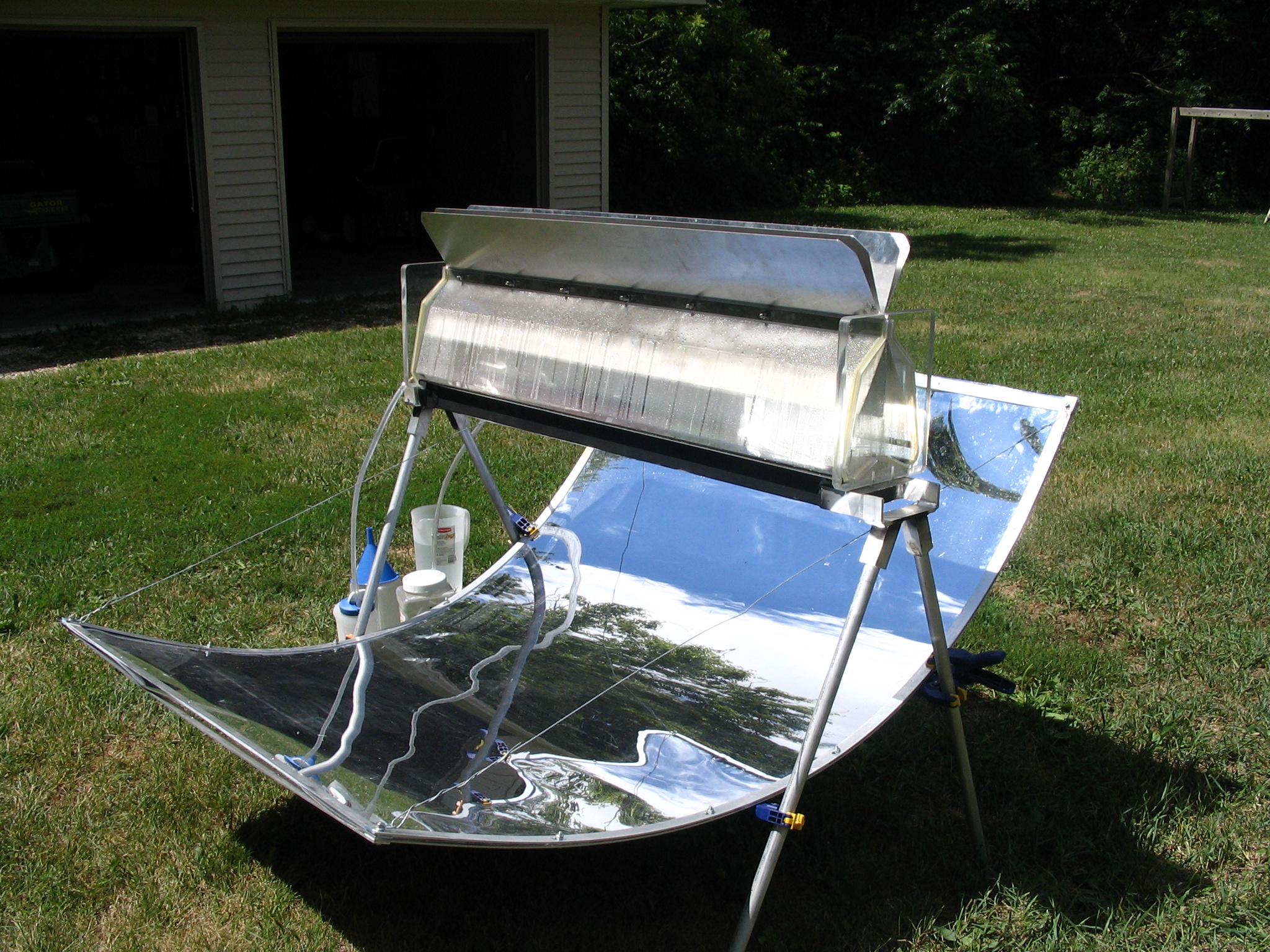
Using this design you can take filthy dirty salty water and end up with drinkable water. Amazing!
Make sure to check out the whole project here, and use this space to leave comments about the project.
That’s a nice implementation of a great ancient invention.
I’m curious about the patent application. Since solar water distillation has been in (recorded) use since mid sixteenth century, there have been a lot of prior-art variations on the technology (reflectors, film-capture methods and the like). I even remember a Hardy Boys novel from the 60s? where they built a reflective solar still from a hubcap and saran wrap.
What do you see as new and (hopefully) patentable with your particular still?
Hi Maxwell,
Thank you for the question.
I agree that solar stills have a long and innovative history. The physics are well proven, and nearly any method to capture evaporated water (like your Hardy Boys example) will yield some amount of purified water.
Nevertheless, solar stills are and will continue to be more of a hobby than a business until the cost per liter distilled fall, or the value per liter distilled rises. I believe that my design improves both the cost and value aspects of the equation.
Once you start investigating the specifics of this design, there are not that many solar stills that use a parabolic trough to concentrate sunlight (most are box stills)…principly because making a large parabolic mirror is usually expensive. My mirror is cheap.
1) I believe that my method of forming a parabolic mirror is unique. The clear aperature of the mirror is entirely unobstructed (aside from the frame) and uses a stable tension/compression balance of forces to maintain its parabolic shape. The combination of wire and strip/frame form a natural parabola.
2) The two piece evaporator design allows one to flush/clean out the water evaporation pan to prevent scale/salt buildup (even using “dirty” water) without compromising/contaminating the condensing cover.
3) The device is lightweight, portable and can be stored easily.
4) I could not find anything like this anywhere, including a careful search of previous patents.
Ultimately, I lose nothing (aside from the application fee) by applying since I will either get a patent or I won’t. And I’ve spent a lot more on numerous dead ends before arriving at this design. If I don’t get a patent, I will be highly confident that a large company cannot prevent me from making my solar still.
I believe that clean water supply is a critical issue for this planet, and feel this is one area where a clever design and some persistence could create a solution that many people already need.
Physics is not my strong suit but I have often wondered if you could set up some kind of system at a coastal region to cause solar energy to heat sea water to vapor, warm the air and allow it to follow an insulated pipe up a gradient to a region where the pipe was not insulated, allowing the water to condense and flow down a second stretch of pipe to some location. The cooler (now more dense) air and water running down the pipe would hopefully create a draft pulling more warm moist air up from the sea. It would effectively be a version of the water cycle but directed to a more specific location. Instead of a reservoir in this device, it might be a pipe running through a series of similar apparatuses. Several in a “farm” could be hooked to one large pipe.
In many cases, deserts are caused or aggravated by a “rain shadow” of mountains. Might such a system provide a means to not only desalinate but also transport water to such areas? Does anyone know if the feasibility of such a scheme ever been examined?
Hey–if you could figure out a particularly efficient or space-saving way to hook this up to a rain barrel (see http://www.aquabarrel.com), I bet you could get that combo itself patented!
Saul Wall,
I don’t know about any projects on the scale you describe. A couple years ago I heard about a small firm (I believe they were at U of I Champaigne) using physics related to your idea in reverse (i.e. input warm/humid ambient air into a series of pipes that go into the cool ground such that the moisture condenses and runs down to a storage area–you can then pump the water out as needed).
While I have no idea about what has been studied for feasibility in the past, my greatest concern with your idea is how far along a pipe you expect the evaporated moisture will travel before in condenses. 10-100 meters (30-300ft) seems possible. 1000meters seems unlikely. Greater distances very unlikely…not saying it couldn’t be done, just doesn’t sound that feasibile.
Lara,
Neat idea for collecting rainwater…are you thinking that a person might use the aquabarrel to feed water into the distiller or to store the distilled water?
Would you be willing to draw up a diagram of how this works? I’m not clear on what part is what and how it all fits together. I’d like to try making one.
This is very cool. Thanks for reporting on this idea. I’m planning on linking to this article from my website. (www.innovateenergy.com)
just an idea, if you used glass as your collecting trough instead of plastic, the temp on the walls should be a bit less or if you attached the cooling pipes from the back of an old broken fridge to the plastic trough box and put some dirty water in there with engine coolant it might make the plastic a little cooler for you.
I believe that some kind of solar distiller would be great for producing cheap biofuel — ethanol. The most expensive part of producing ethanol is distillation, if one could use solar energy instead of biomass / fossil fuel, that would make ethanol even more renewable. :)
The idea is simply good. I am from India from a region where pure drinking water is scarce and costly, Madras now renamed CHENNAI.
Basically i am a mechanical engineer doing my master in Thermal engineering. Currently i am pursuing my project work.
and yes i have the same topic of ur intrest as my project topic
and i would like to have ur guidance in this topic as u have already a vast experience in this area.
Great idea, Daniel, wishing you all the best with it.
Assuming no lack of dirty water, it occurred that you might enhance the cooling effectiveness of your condenser with the dirty water flushing over a thin evaporative mat attached to the exterior of it, thus providing evaporative cooling to it. The overflow from that, what’s not evaporated, might then next be routed into the unit to keep it topped off or feed a trickle flow chamber that would regulate the flow. A bonus may be found in that this overflow feed water might then also be pre-heated somewhat, especially if regulating flow chamber is blackened, reducing the net solar heat gain required later inside the unit. A small solar powered pump could be used to move this dirty water or simply a gravity feed with a larger barrel of dirty water positioned higher near by.
would you sell one or three of these units
Thanks for all the helpful suggestions.
Krzysztof: A significant fraction of the public that I explain this idea to always wants to make booze (lol). At least in the case of ethanol people (shouldn’t) drink it, so the fact that you expose it to all kinds of sunlight maybe won’t stop the conversation.
Ramanathan: please contact me (or post on my blog) with any questions or problems that I might be able to help you.
Tom G: I appreciate your suggestion. Glass would transmit heat better than plastic, and any way to flow water over the plastic cover should also increase cooling & condensation.
One objective I had was to make a light-weight and portable distiller…I am a little afraid of using glass since it heavier than plastic and more liable to break in transit.
Flowing water through some piping or tubing is certainly an idea I’m considering. I will have to add complexity in terms of adding a pump, a power source to drive the pump (a couple solar cells?), and decide what fluid to circulate. I would hesitate to add engine coolant to a water distillation system…just too much (user) education and liability issues if someone put water where the coolant goes or vice versa.
Shane Connor: Excellent idea. I’ve been thinking about flowing dirty water (through a tube) over the fins/cover to lower the condenser temperature (and preheat the water), but had not considered letting some of it evaporate or using a mat/spongelike surface to increase evaporation on the outside of the device (i use sponges inside to increase tha air/water surface area-and hence water evaporation rate).
Mark M: Yes I’m interested in selling units. I feel that this is still an R & D project at the moment. I believe I can implement some tricks to increase output markedly, but if a gallon/day is enough water for your application we should talk. I’ll send you an email off-line to discuss.
Hi,
This is indeed a very interesting product.
Would also like to test a couple of units.
Working for a charity in Kenya.
Please drop me a line.
Cheers,
JC
Try to cover the distiller zone (upper transparent plastic) with a mirror or white paint, to avoid the direct sun light and decrease the temperature, and I think that some vibrations in the distiller zone will help to join the water cells and help it to fall.
That’s a good project.
It will be usefull in the future…
CL
Hi Daniel! Finally found someone working at a scale that seems reasonable. In the U.S. it seems that most products are either on the cheesier end of the spectrum or hopelessly complicated and expensive. If this one can be scaled up to two gallons to four gallons a day and kept simple to operate, I think it would be marketable in this country in the near future. One suggestion that would up the cost but might help the concept: An interchangable glass cylinder inside a darkened glass sleeve for a condensate chamber. The darkened sleeve would be out of contact with the purifying water and could be rotated on its axis around the glass cylinder. Rotation might be able to accomplish two things. First, the amount of light coming into the chamber could be altered and change the temperature of the chamber. This could extend the seasonal usefullness of the device. (hotter in winter, cooler in summer) Second, If the sleeve were rotated all the way down, the glass tube could be pulled out without dripping water onto the reflector. A second tube could then be placed in the device while the first tube was being cleaned and sterilized. Just an Idea. Good luck!
Hi
My name is Arseeneh from Armenia , now I am studying in Yerevan State University .My research is about water (Physical chemistry properties and reactions in diffrent grade of water ).I need to large information about water ,for example What kind of reactions can ocurr in diffrent water(drinking water,……………..).
Can You help me ?
Would it be possible to post more photos of the actually distiller? I would like to experiment with this idea, but I am confused as to how to actually put that part together.
hey daniel
neat idea…that was really very impressive
could you suggest some more methods for water distillation that you think are feasible on a small scale???
i am an engineering undergraduate and have taken up a similar topic for my projectwork.
i’d be grateful to you if you could guide me in my endevour…
thank you…
Hi Daniel
Congratulations on a beautiful distiller. Water evaporates from about 50 C, so lower temperatures from a smaller trough not a problem. If the distilled water collection point has some zeolite in it, or other hydrophilic material such as coconut fibre, then the amount of water drawn off is slightly increased because these materials attract and hold water molecules on their surface, and drip. Even some coarse grain sand might help. A black pipe on the surface of a tidal zone can capture water at high tide and ‘steam off’ to a water tight container thats buried under the sand. Ofcourse this relies being stuck on a desert island with nothing else to do except float black plastic pipes around a rockpool…… Good luck with the project.
how do you construct the sea water solar desalination step by step
Great post. Just a thought on tracking – rather than use a motor, which would require electricity and complicate things, couldn’t you take advantage of the transfer of water from the “in” container to the “out” container to slowly rotate the mirror over the course of the day, at a rate that roughly tracks the sun?
Use the cool incoming water to cool your condenser. This will slightly pre-heat the incoming water and help raise evaporation rates, which should increase efficiancy.
Hope this helps
Tom
very interested in having one we live in the florida keys we drink bottled water now and we live in a hurricane zone and the fresh water is pumped in about 90 miles and doesent tast to great would really like to have one or two of your systems. i hate to rely on piped in water since it has broke a couple of times and water sells out of stres very fast . please help us out mark from the keys 305 394 0987
Excellent Idea! I to have got some projects under way. Email me if you want to discuss applications.
hi daniel,
great idea ,i didnt understand how the evapourated water is collected .will u please explain?
can u plz send mea scatch diagram of solar water distilation for desalination?
yours thankfully,
abhinav(INDIA)
Thanks for being willing to share this info online. I also was going to write about possibly using this idea on a larger scale for seawater purification, but greater minds than mine have already expanded the idea far more than I could have. There have been major droughts on both coasts in recent years and that seems like quite a shame in a country that we like to consider *so advanced.* I’d suggest that as well as selling the patented device you could also patent and sell plans. I’d hope you’d make it a nominal fee so people like me (the ones who really need to make one) could afford it. But in that case you wouldn’t have as much access to other people’s input as you have in this forum. And one question: is there any significant danger of the mirror being a danger to lower flying air traffic — such as the medical helicopters — that seem to be becoming more prevalent these days? I can’t help but wonder if a mirrored gadget pointed at the sky would scare the neighbors and/or Homeland Security.
I have been thinking of this kind of thing for years. I have thought of a version that floats on water, perhaps floating in tidal electricity power generation pools.
Would love to see the plans.
CONGRATS DANIEL. REALLY IT WILL BE A GOOD SOURCE OF WATER FOR A WATER SCARCE COUNTRY LIKE INDIA. I WOULD BE VERY HAPPY TO SEE THE PLANS…….
This method certainly separates water from solids, germs and contaminants with am evaporation temperature much higher than water but, how do you let volatile contaminants escape? Some of them will condense back together with the water, as it happens with the solar stills.
I would like to learn more on the science of distillation columns to see how this could be applied to a solar system. May be your mirror invention’s high temperatures will work better than a solar still, but you will need to find a way to let volatile solvents to escape so that only water condenses back.
please tell me where this plastic mirror material is avaliable..great article
tom black
Great invention! I´m Nicolas from Argentina. I´m a teacher and I´m planning to teach my students how to build energy-smart devices such as yours (a lot simpler, of course) in order to teach high-school students about green energy. Could you send me more detailed information about it? (no commercial use guaranteed).
Besides: Do you think a larger scale device (say truck size) could power a small stirling engine with the extra heat? that would solve the “extra heat” issue, the water pump needs to circulate water, and maybe power a small energy generator, needed in most water-scarce areas. It would take the simplicity out of the system, tough…
thanks, and congrats!
Increase the surface area on which the water condenses, and you could eliminate the cooling fins
Hi, neat project.
You may want to look into heat pipes to aid in condensing. Butane or a common refrigerant would work well for the temperature range you’re operating in. Also, aluminum instead of acrylic might be workable, just wouldn’t be able to see inside that well :)
I second (or third) the comments about using cooler incoming water to aid in heat rejection. Running a thin (1/4″?) pipe from a cool, dirty water reservoir through the condensing area and then into the evaporation tank would increase efficiency. The cold would aid in water condensing, and the heater wouldn’t have to heat up the water as much.
Here’s a website that shows a plan to do something similar on a commercial scale:
http://www.solardesalination.com.au/
I like your low-budget alternative! One possible improvement of your design would be to focus the rays on a smaller, black metal pipe (which draws in dirty water) and then collect the resulting water vapor in a distiller off to the side of the collector. A tube travels upwards a short distance from the far end of the heated dirty water pipe, and then you spiral the tubing down into a collector. As the water vapor cools, it condenses into pure water. You may have to clean out the heating pipe occasionally, especially if using salt water. If you had a long line of mirrors, like in the photo, the brine could flow down as the water vapor travels up, and the brine is then discarded or allowed to evaporate in the sun to collect the salt.
Great project. I have been developing a few solar distillers and encounter the problem with cooling the condensation coil without the use of a fan or cooling water. How are the VOC’s in your unit released?
peace & love,
ariel
I see a design flaw that if you fixed would add that missing capacity that you should be getting in theory.
the cooling fins are exposed to the sun and if my math is right they are actually adding heat to the condensing section. a simple fix would be to add a sun shield around the fins and condenser to encourage them to radiate heat even goin as far as adding a solar powered fan to blow air between the sun sheild and fins/ condensing unit
I concur with my compatriot Nicolas from Argentina: great invention!
I live in a small village with an unreliable and non-potable water system. Municipal government couldn’t care less. I built a super-insulated straw bale house here, and now, three years later, the viIlagers are starting to show some interest, though they are still skeptical. I would greatly appreciate plans that would make it possible for me to build a “home” version of your invention with the hope that interest can then be generated for a community-scale project. No commercial use intended.
It’s wonderful design than I ever seen, Daniel. By the way, can I get your design to complete my research reference ? Thanks a lot
Hi Daniel,
Have you ever thought of using this device or a similar device to simply speed up an evaporation process? We have a commercial tank truck wash at a property that has no municipal sewer system meaning, all of our waste water ends up in our “sewage lagoon.” We have been looking for ideas on how to get our lagoon to evaporate at a quicker rate because it fills up to quickly. I think there is a market for this right now.
Hi Daniel,
Congratulations on a beautiful portable distiller. I want to know how exactly the distiller unit works. Please send me some markups or info.
Regards,
Sandesh
DANIEL – Thanks for showing us this great design for a concentrated solar still. It is along the lines of what I have been thinking, but it is nice to be able to see this model that actually works, rather than one in theory. A big advantage of the concentrating reflector is the higher temperatures, which have the potential of killing bacteria. Many passive designs are not distillers at all but are merely low-temperature evaporators and are not capable of neutralizing bacteria. I like Ed Stamm’s idea of using a black pipe, with water travelling toward a separate condensing unit. This might result in even higher working temperatures. I am grateful to Eric for bringing up the problem with VOCs. He is thinking of using distillation columns to further purify the end product. I really like your idea of using Mylar film to form the parabolic reflector. There is another technique for making inexpensive parabolic reflectors, which I read about while researching Sterling Engines and refrigerators. One old design was to stretch a mylar skin over a framework like a drumhead. Then, if it is sealed off and a vacuum pump used to suck out some of the air, a paraboloid results in the surface(s). So, this is another inexpensive way to make a solar concentrating reflector. Your design might even be simpler than this, especially in smaller sizes.
Here is an angle that has not been addressed yet. I noticed that several comments are posted from other countries that have a contaminated water problem, including India, Argentina, Kenya. As a matter of fact, much of the world has a contaminated water problem. One thing many people in the U.S. do not consider is that there is a potentially serious problem here that much of the rest of the world does not have. The problem is just now getting recognition, as a primary cause of hypothyroidism in the U.S. It has reached epidemic proportions and the leading suspect is fluoridated drinking water. Iodine and fluoride compete for the same space in the thyroid gland, and fluoride is more common that iodine in many people’s diets, with 4ppm fluoride included into our drinking water at the purification facility. Fluoridation solves an important disposal problem for the fertilizer and aluminum industries, since they can charge the water treatment plants for the waste product, which used to be an expensive byproduct for them to dispose of. The first company to experiment with fluoridation of water was I.G. Farben, for the purpose of crowd control in prison populations during WWII. The original purpose was as a “soft lobotomy” to the prison population’s brains, rather than strengthening dental enamel. The real victim is the thyroid gland. There is another reason why your design of a concentrated distiller is so timely. The internet is full of information on the fluoride/thyroid connection and here are some links. There might be a large market for this distiller right in the U.S., until fluoridation is ended.
http://thyroid.about.com/od/drsrichkarileeshames/a/fluoridechange.htm?nl=1
http://thyroid.about.com/cs/toxicchemicalsan/a/flouride.htm
http://thyroid.about.com/cs/shames/a/fluoride.htm
Gary
Great idea and well thought out.
Just 2 points:
I would forsee the length of the trough not always being in direct sunlight, thus cooling part of the dirty water.
Surely you could extend the black base to either side thus preventing light being reflected onto the clear cooler plastic parts (condenser). This black base could be made of a conductive copper thus increasing the heat generated at the base.
Dear Mr.Daniel
Have a Nice Day
i would like to say COGRATULATION, and to Thank you for your Faithful Efforts.
This is your Friend Mr. Mahmood S. Majeed from IRAQ, Basrah City.
As we have a Big problem of the High salinity Water and need to do a Big disalination wrk to achieve a huge quantity of Drinking Water for Human , Irrigation of our Small Garden ,
I am studing your Idea/ project and try to apply the same practically.
So i need to recieve your ACCEPTANCE to do That as it is you idea / Patent and i will not start unless i recieve you Reply
Thnaks again, Best Regards
yours
Mahmood S. Majeed
Basrah, Iraq Alfaw District
E mail: annajah1989@ayhoo.com
Mobile: +964 – 7801390939
This looks like a fun project.
This is a very important area of research since significant amounts of distilled water is a key component of home made hydrogen production. Some things that may be usefull to know:
+ The lower the atmospheric pressure is within the chamber the more easily it boils / evaporates the water with the same amount of energy.
+ A cheap place to get large sheets of milar for the mirror is from emergency space blankets (which can be bought in the USA for USD $5 each).
+ A cheap way to make a folding frame for the mirror is to make a cup shaped dome with hooked metal wire hangers with taped pocketed corners like a tent (you can buy a pack of 10 metal hangers for about USD $3-$5). FYI: domes are a more efficient shape for collecting heat / distillation.
+ Not sure if you already have one there, but something to test the efficiency of the design with for the mirror would be an attached thermometer which should be built in to ensure manual positioning of the mirror would be optimal.
+ Air born bacteria can still live through the distillation, the water should be boiled before adding it to the trap/reservoir.
+ A tiny solar cell array (like that on a solar calculator running electricity to a silver / copper plated diode/ring within tube running to the clean water reservoir would help kill any bacteria that may be present.
Here are some things to consider that I do not see addressed here:
+ Pre-filtration to remove large chunks of dirt/rock from the trap.
+ Cleaning the heated trap of sediment.
+ Adding more water to the heated trap without dismantling.
+ Why do you have a heat sink that is outside the container, this would probably create more heat waste then efficiency. (it should be fully contained.
Hi Daniel –
I see that there is not a posting from you here in many months. Are you still working on this?
I am very interested about the project. As i am from Bangladesh and you know, for a long period some parts of Bangladesh become flood affected. Then, it becomes very tough to get the pure water. I want to help those people by providing this technology. Could you please share me with the making of the whole project? Because i can’t understand fully.
Hi Daniel
Very nice design, simple and fast when you needed it. Above all I like the design of the mirror.
I’m helping a friend who wants to desalinate water in Mocambique.
Researching the project on the web, I found out that the simplest systems get up to 3 litres per sqm and day, so yours is already pretty good. Big industrial installations seem to have a top performance of 20 litres per sqm and day, but then using high-tech materials, engineering and vacuum-tube collectors.
I think to have understood, where the key to performance lies, although the realisation of these key elements are not always easy or realistic, depending on available surface, budget, skills, materials, etc.
But if I get this right, your system is what is called a solar still, inproved with a reflector, which intensifies the irradiation.
What it distiguishes from a so called a MEH (multi effect humidifiicationsystem) is the fact, that the evaporator and condensator are not seperated, means your reflector and the direct sun are also heating the condesator (plastic film), although this is counterproductive but system inherent. Further, the condensator covers the evaporator, preventing radiation from reaching the evaporator.
It seems then, that an important increase in performance can get gained by seperating these two. so maybe in your case, a pipe could bring the humid, hot air to the side of the construction and there you bring it to the condenser. condenser means surface because of necessary heat transfer to ambient or any media, so if it happens in front of the mirror it has undesired negative effect.
Another key factor I think to have understood could solve your other problem of the plastic getting to hot and increase performance at the same time: cool the condenser with the incoming water (which is usually ambient temperature or less), like this you recover already heat from your distillate and add it to your process.
It’s probably not easy to add such modifications to your system and keep it simple and cheap at the same time, but I get the impression you are the kind of guy to come up with some clever solutions :-)
I’m still not clear about the system I’ll recommend my friend in Mozambik, as there it should be largely maintenance and manipulation free, operate entirely without any electricity, but at the same time produce at least 100 litres a day … and cost next to nothing, of course, not use any high tech materials which might be locally unavailable etc.
But your solution has certainly given me some more inspirations!
Thanks a lot and good luck for the furture project(s).
Andreas (Switzerland)
Hello Daniel
I would really like to know *exactly” how you made your parablic reflector. How you managed to stretch the mylar without wrinkles and without it tearing.
Could you please tell me this please?
Hi;
Youy have a great idea here. Sure, the process od distilling water has been around for a milliania, but you’ve clearly created something far more efficient.
I too would like to see your distiller used on a grand scale. In these times, any way to get off the grid helps. Like you stated in your article, it could be used in remote environments where distilling water is difficult.
Best of luck manufacturing your idea. It is truely unique!
Mike
Hi Danielm
That is fantastic what you you did here. I saw the designe and read about it, is very nice but i was shocked about the amount of distilled water and i think because you have a very high heat loses :) and the funny this is that you installed metal sheets to lose more of energy thats is not good. you build up the mirror to collect the heat which you want to lose. I think we can work together to improve the designe and to get the best results our of it as i think it is really nice one. I think emailing whill be more effecient for communication. catalase2001@hotmail.com
all the best,
Ussama
Can you guide on a high definition review website. I got this from my friend looks ok
High definition camera
Bob
I am interested in learning more about the project, since I go to a fishing village in the Sea of Cortez( Golf of California) where there is no potable water.
Does your distiller works with sea water? is the trough removable? why using acrylic in the ends?
Is the distiller for sale?
Thank you
Ezequiel
Hi,
Very good work.I am very much interested in knowing more about the project.
I stay in India and there is large shortage of clean water in some parts.
I want to build it here.Can you tell me all the details??
Thank you.
doesn’t look like daniel is responding to posts, but his invention is worth more discussion. anyone, please feel free respond to the posts.
remarkable ingenuity. is the problem of the plastic overheating caused by direct sunlight from above or from reflected sunlight from the mirror? on the unit i am going to build from your pictures, i am planning to:
1. replace the plastic condensing sheet with mylar (space blanket)
2. wrap/insulate the upper unit with a blanket of mylar
3. as daniel implied, reduce weight of skeleton as much as possible
will post the results.
thanks, john
irvine, ca
hi Daniel
interested and fun project
congratulation to came up to this simple,costless project for parabolic trough water distillation.
I am from Ethiopia (Mekelle university ) from a place where pure drinking water is scarce and expensive to buy specially in rural areas.
I am 4th year mechanical engineering student (graduating student),
I motivated by your design and wanted to do my final year project research concerning this.I see your project, it is interesting and simple in construction.But i didn’t understand the collecting mechanism for the condenser cover.if possible please e mail me a bout the detail content of the project which help me to guide my project and i request to you to advise me through out my design.
thank you
kibrom
Hi Daniel, I hope you are still actively reading this thread. I am working to make a hostel in Colombia more green. I understand that this is a small scale – portable distiller but I would be interested in providing a larger mirror and having several – a way for maybe 20 to 30 gallons a day. I would be honored if you would send me some of the plans, just so I can take a better look. In colombia, I will have lots of dirty water, tons of sunlight and HEAT. I will continue to follow this thread and I hope to hear from you. I have been researching designs and this seems to be the only real viable option. Great work, thanks for sharing!!
Jason
There is a technique for the resolving the condensation problem. It is a solution that is used in our country, Bangladesh for keeping the water the cool during the hot season. It is just that you will have to add a simple thing within inside the tank.
Patents can waste your money, so consider consequences!
I have given away, known as put into the public domain, my apparent new patentable ideas I invented like my Parabolic Discone antenna because it can cost far more to defend a patent from being stolen or re-patented as seeming to be different when functionally it is not.
An uncle and the engineer/owner of Tosh Electronics which went out of business in Ohio, which I assisted in engineering new designs, had both obtained patents. The uncle never found a buyer for his automatic VW bug lubricator before the patent expired. Mr. Tosh claimed to have wasted over ten thousand of additional money defending his patent only to have a judge claim it was obvious and not patentable. His lawyer suggested wasting thousands more in an appeal because he might win… Instead he cut his losses because the invention did not make enough profit to pay for protecting it.
The really winners in these examples are patent lawyers who make money no matter who is right or wrong. If you look up patents on Google or other methods and carefully analyze them then it is possible to find many seemingly undefendable ideas like using a laser pointer as a cat toy (Duh!)
Many ideas I had turned out to be patented up to 70 years ago! More interesting is new patents today which appear almost identical to some of the patents from decades ago. The patent office and lawyers keep making money so they appear to have little incentive to clean up the system. I am only one of many critics who say enough is enough.
Perhaps I will patent a solar power or antenna idea someday but only if it is something so far outside the box as they say to make it worth it. Then it must also be worth manufacturing and marketing quickly or the patent will be wasted.
My best ideas I keep in my head until it seems they will produce the greatest profit, even for ideas I plan to give away for free public use like the Parabolic Discone. When the FBI contacted me once based on false information they were given about my activities, they apparently found out afterwards that my time in military intelligence electronics repair inspired me to both invent and protect my real secrets (duh again!).
However I do not claim perfection because I appear to be autistic and have symptoms suggesting some of many autoimmune issues screwing up my nervous system, perhaps even the politically debated golf war syndrome. Handicaps only make me push harder to invent, or at least keep living because it annoys my enemies.
The sad thing is that I grew up being bleeding heart liberal optimistic happy go lucky but learned to be extreme critical selfish conservative as necessary. Your views of life mean little to the criminals of the world who may pretend to be anything necessary to obtain their goals. Hell, nothing says the devil himself could not be a hero by saving the world then enslaving it. Patents get me worked up because some people have lost everything over honest efforts to protect their original ideas. If honest patents and lawyers can bankrupt you then what if criminals get involved?
Put your time and money into deciding if ideas are worth protecting before swimming with the sharks. Even giving away ideas to the public domain has risks to consider, like someone claiming you are violating a trademark or that you are giving out dangerous ideas. Search the internet because many people do complain about getting punished for their attempts at good deeds.
PS: I forgot to say that I was looking for the least expensive way to make distilled water, mainly for filling a solar water heating system. The minerals and chemicals in treated city water can cause problems in a closed loop solar water heater that I am looking to build. Since the heating system may still need to be flushed and replaced with new distilled water at times, I am considering a small distiller next to the solar heating panels. In an emergency this could also provide backup drinkable water.
well done! it seems to me that if the condensation chamber had a double wall within which the cold salt water circulated…
Is the plastic food safe?
Hi,
My name is Amarjit Rajkumar, I hail from India and drinking water is one of the most prominent issues with our households. Especially because the most of the ground water has salt, magnesium or arsenic content. Drinking water supply hasn’t been any helpful. A little tweek in your idea could be a boon for millions in India.
I myself have been looking for something very similar for my home. Every household has three kinda of water wastes:
1. Toilet water
2. Washing and Cleaning
3. Kitchen
Of all these, water used in kitchen still has some chances that it might not kill us :). Nonetheless, I had a few questions for you:
1. Can water of any sort be used and distilled through this system? Although, I understand a few more set ups and processes would be needed to purify the water content?
2. Once the water gets distilled the solid particles that are left behind, how are they to be disposed. Any idea for disposal?
Also, what if your condensation chamber is situated at a distant point, recently heard of something called solar freezer. Check out the link below.
http://www.sundanzer.com/Home.html
If your condensor is built on the same principle, is connected to the distiller and the rest of the body through maybe a pipe, but itself is located in a more cooler place. The condensation would work better.
Just vague thought, I’m not much of scientist myself, but I wish u luck for your patent and would love to get my hands on your invention once patented and it hits the market.
I would like to use your water purification technology in our company (India-mumbai).please send me the necessary details for the same.
Very creative
and so much important!
Congrats!
Dear Daniel
I would like to consult some things to you:
Do I read any very interesting comments, I have read on the building materials and you ask for help why is the mirror very powerful for the size of the still?, do you want to patent the mirror? Do you offer your technology to be proved in other ecosystems? I live in Iquique through Chile and we are preparing a project to realize a plants vivarium with solar sea water distillation, and I am interested in your technology.
Estimado Daniel
Quisiera consultarte algunas cosas:
Yo leo algunos comentarios muy interesantes, Yo he leído sobre los materiales de construcción y pides ayuda por que el espejo es muy potente para el tamaño del destilador?, quieres patentar el espejo? Ofreces tu tecnología para ser probada en otros ecosistemas? yo vivo en Iquique Chile y estamos preparando un proyecto para realizar un vivero de plantas con destilación solar de agua de mar, y me interesa tu tecnología.
Hi Daniel,
Would your solar still be pratical for use on a sailboat while under sail?
Ray
Possible crazy idea here…
Would it be feasible to add a small Stirling engine as a blower to cool the heat sink/condenser side? The same air flow might also be able to help cool the “cold sink” on the Stirling.
Interesting that this is still getting comments five years later – BTW, how did the patent application work out?
Hi
Daniel
I am a Energy Scientist in MGIRI, Govt. of India. Very happy to see a geniune design after quite some time, must have spend lot of time on this . Congratulations for the success.
In other designs I have seen them use water to cool the condensation device.
Could you possibly use a double layer of plastic for the condensation screen and run your trickle of water to the evaporation surface through it?
This would cool the condensation surface some, while preheating the dirty water, and requires no additional energy if you use a gravity feed on the water source.
It sounds exciting. Have you tested the water that comes out? I live in Hawaii near the volcanoe and have very acidic water which we catch off the roof. I’m looking for an affordable way to get safe drinking water from that. I read solar distillers don’t kill virus’, as we also have lepto I’m concerned there too. What do you think?
wonderful idea. did you get your patent in the end? i have thought for a long time like the person above that we should use the energy of the sun to desalinise sea water. particularly in parts of the world where fresh water is scarce and they have plenty of sunshine. use the sun’s energy instead of solid fuel. i hope you are in the middle of doing business with companies in india. well done!
Nice clean looking job. You do good work!
excellent concept.
You could replace your plastic construction by using a 4″ SS304 cylindrical pipe (horizontal) with a black coating on the outside for heat capturing.
you could use a espresso coffee pump to pump water ( 400 ml /minute capacity). pump is on for 1 minute and off for 5 minutes. for every 6 minutes you will get 400 ml. The mirror has to be 8 feet x 4 feet
You could increase output by exhausting the water vapor and pass it and pass it through a coil of copper tube from top to bottom and collecting the water in a bubble water tank.
I would go for a simpler design with a much larger pan capable of storring grey water from the house and gradually distill it. Important issues to make sure the plastic and paint is not poisoning the water. For example you could make the tank from concrete with a layer of black sand on the surface and have a glass covering and use a copper pipe passing underground to a collection tank in the shade. So not a movable unit but it would enable you to reuse water collected from the roof over and over and kill the water bill. After distillation the drinking water could go thru an additional filter and have some minerals added to it like even just some good salt.
To address the overheating of the condensing chamber you could use the water to be purified as a heat sink. Use one or more faces of the storage vessel (water not yet purified) as the condensing surface, ideally this tank would be insulated from the sun and could also make use the cooling fins on the current design.
Additional by having the tank above the system it could be gravity fed, replacing water in the chamber as it is distilled. This would of course require a float valve or other simple means of preventing the storage tank from siphoning off.
I live in a rural area of Hawaii w no grid available. I’m solar powered & use rain catchment. I have to haul in propane & drinking water. Love to make both a solar distiller & water heater. Altho your instructions are detailed, I need visual pictures of the actual assembly. Are plans available? Hope to hear from you soon! ;))
Would be nice to have a plan ( to scale), and a very detailed list of materials.
Coming from an area were moon shinners in the past were common, I would suggest making your evaporating chamber a closed container with the only outlet a coil for the final condensation. Should make your system more efficient with little extra cost or weight. Enjoyed your project, and I think your Mylar mirror idea is so simple it makes you wonder why everyone is not using it. Best wishes.
Les White
i appreciate your innovative design but i can’t find how you remove the salts from the tube after the evaporation so,would you please explain that to me because i am working on making solar distiller as a school project.
Daniel,
A very innovative and excellent design, and a similar concept (but also very different from) a design I just received a US patent for (#8,935,922). I wish you the best of luck in your patent application efforts.
I believe if you incoporate a solar tracking device, you can optimize the solar radiation that is collected by the device, and thus increase your water output. There is a guy that has some reasonably priced tracking devices – Konza solar trackers. Certainly the ‘focus’ of the parabolic mirror needs to be optimized in every possible manner to increase the heat and radiation absorbed by the ‘heating chamber’, and the shape may need to be altered at different times of the year to account for the change in angle of the sun. Good luck with your endeavor, and your patent. It took me 5 years from the filing date to get a patent.
if it is a distilled water then how can we drink it?
We have been trying for some three years now to come up with a solar hot water heater. We have a design, loosely based on a Canadian’s design as well as other internet-derived ideas.
The size of the apparatus is about 8′ x 4′ (sorry about the U.S. measurements) and the collector tube is a 1 1/2″ copper tube.
Anyway, we don’t seem to be getting the amount of hot water that we’d like and are interested in your design in order to increase the efficiency of our collector.
We are interested in this in order to provide small groups here in Mexico with the ability to manufacture them so that they will be able to increase the income for their families. We put up the “plans” for our project under OpenSource license (see Website)
We would be interested in your ideas about this project. We would think that these types of heaters would be suitable not only for homes (something our large unit is really not suited for) but for hotels, restaurants and industry in general through the addition of more units.
We realize that you are probably very busy but hold out the hope of hearing from you in the near future.
With warmest greetings,
fred frazelle
I was wondering how hot you can get this water. I am attempting to make a steam engine run off of solar power and I need a method of turning water to steam in large quantities. I need to produce about 740 watts of energy or about 1 HP for my small steam engine. So how hot can you get water with this particular method?
Hi!
I found your project pretty interesting but I have no idea how is the water pickup system and how is designed the inlet of the contaminated water.
Have you made a significant improvement in the device?
I Hope to get an answer. Good bye, and take care.
Hola Daniel. Te escribo desde Ecuador.
Quería felicitarte por el proyecto ” Solar Water Distiller” y saber cuál es el status (avance) del mismo ?
Cómo te puedo contactar para conversar .
Estoy interesado en dar apoyo a desarrollar proyectos sociales .
Saludos
Jorge Augusto Jaramillo J.
How to manage all these responses!? That’s the only question I’ll ask reading down the list of seemingly unanswered question (perhaps fittingly with too ambigious or too focussed questioning)… how to solve all this and get a nice process for you and others… hmmm…
About me > I’m building that starts of a small free school or education place in a village and perhaps this is more of a fad for me than actual need (we have water) BUT I’m really into REPLACING EVERYTHING into DIY VERSIONS so that’s WHY I’m here!!
Hiya da Ni el
Congrats ? . You’ve achieved one great step up the ladder.
I live in the southern part of India in a city where the language is famous for its sweet ? accent and a water that is one of the sweetest in the world. The city is Coimbatore, in southern India.
I was wondering if you could share your idea and earn some monetary rewards apart from giving people a good technology for clean safe drinking water.
I bet we can invest the same in developing it further.
I work in my NGO to assist people support themselves lead a good life, many states of india go dry or has has less access to good drinking water in summers. Shall we reach out to the seas with your project, its gonna do a bigger deal of work in here.
I know people with similar thoughts who can help us get this project across all the needy.
Got a great deal of work, summer has already hit India.
Lets get to work
All the best
It looks complicated as fuck just to let you know
Many solar stills use use either a clear plastic or a glass pane for both a window (to let light in), and a condenser surface (that releases heat). Doing so keeps designs simple but condensed water drops on the window reflect a significant portion of light entering, thus limiting its effectiveness at collecting the solar energy shining on it.
Keep up the good work. You’ve just started. What needs to be done is to have a heat-exchange system to maximise the use of the heat collected.