jump to navigation

Never Forget 1-31-07

Written by The Naib

thisisnotawarning.jpg

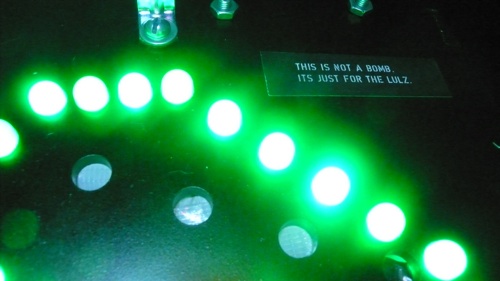
So if you are not from Boston you might not have caught this story (warning fox news link), but last year around this time, a couple of crazy hippies were out putting up LED light up signs for a silly movie based on the Aqua Teen Hunger Force characters the Mooninites.

Now besides being highly energy efficient, (LED”s are an excellent way to produce low power consumption light), these signs were harmless. The Boston police department however FREAKED OUT. They actually shut down large parts of the city, got the bomb squad out, and BLEW UP several of the signs. A myopic idiot could have figured out from looking at the things that they were, harmless, and based on a cartoon show. The incident cost the city MILLIONS of dollars, and in general made the city look silly.

To commemorate this fine waste of public resources a couple of jokesters have gone and put up some more signs this year. 1-31-07, never forget (ha ha)

Vist them:

A Beautiful Lie

Written by The Naib

Jared Leto whos only claims to fame is that his last name is a Dune reference, and he was the blond guy that got his face rearranged in fight club seems to have formed himself a band, and they got themselves a song. Now he has teamed up with NRDC to promote action on climate change.

Sort of reminds me of AFI, but very nice scenery. It’s a half way decent song (sorta) and the video has a nice message. What do you think? Do celebrities influence your view on issues? Does dream boat Jared Leto’s face make you care more about your carbon foot print? Can it hurt to have green issues being the cause celeb? Do we run the risk of making this a trend, when really it needs to be a culture shift? Let me know in the comments.

(via)

British Gas Greenwash Banned

Written by The Naib

Blimey! Some good news - it’s not a company that have decided to stop greenwashing (that would surely be something significant) but it does seem that people are waking up to the sins of Greenwashing. British Gas (or BG, as they like to be known around the world) tried to convince the British people that they were selling gas that was “carbon neutral”, as well as claiming that their electricity (yes, they sell electricity too, produced mainly with gas) was the greenest around.

Wrong on both counts, really wrong…

“A TV and press ad campaign for British Gas has been banned by the advertising watchdog for making false green claims about an energy tariff. The ad regulator ruled that the TV commercial was misleading and should not be shown again in the same form.”

“A second ad - a national newspaper advertorial, for the same ‘green’ tariff - was criticised by the ASA for making the claim it was the ‘greenest domestic energy tariff’. The company admitted that the [Energywatch] website did not rank tariffs in order of “greenness” and that there was no industry-wide methodology.”

(from The Guardian)

With a history of energy exploration in the Amazon, and interests in drilling for gas in the pristine Arctic wilderness, BG (or Bad Greenwashers) have felt the first slap from the increasing number of people who won’t tolerate hypocrisy. Keep it up readers - don’t let them get away with it.

Original post by keith

Putting The Freeze On Ozone Depletion

Written by The Naib
mr freeze

I would just like to start by apologizing for that title. It sounds like something Arnold Schwarzenegger’s character would say in that horrible batman movie. That being said, in a positive turn of events, two supermarket chains that are either based in or with a major presence in New England have joined with EPA to show that protecting the stratospheric ozone layer is cool — literally! (again sorry, the shame is overwhelming).

The two supermarket chains, Hannaford Brothers (based near Portland, Maine and with more than 160 stores throughout the New England region) and Whole Foods (with more than two dozen stores in New England states) have joined EPA’s GreenChill Partnership.

EPA and the supermarket, refrigeration equipment and chemical refrigerant industries launched the new GreenChill Advanced Refrigeration Partnership - a voluntary program to promote green technologies, strategies, and practices that protect the stratospheric ozone layer, reduce greenhouse gases, and save money.

Whole Foods and Hannaford Brothers are two of the ten founding partners nationwide who have pledged to go above and beyond regulatory requirements by establishing an inventory of current refrigerant emissions that may affect climate change and the stratospheric ozone layer, and then setting reduction targets for these emissions. Partners will also participate in an industry/government research initiative to assess the performance of cutting edge “green” technologies in terms of energy efficiency, reduction of ozone-depleting refrigerant charges, and minimization of refrigerant leaks.

The EPA estimates that widespread adoption of advanced refrigeration technologies, best practices, and improved equipment design and service could reduce refrigerant emissions by one million metric tons of carbon equivalent per year, the equivalent of taking 800,000 automobiles off the road every year. I will of cource be more impressed when they reach these numbers, but it does show you that there are lots of way to reduce greenhouse gas emissions besides cars and power plants, and that it is worthwhile to pursue them.

To counteract the depletion of stratospheric ozone, which protects earth’s hapless citizens from the sun’s evil skin charing UV rays, partners guarantee to use only ozone-friendly alternatives and advanced refrigeration technologies in all new and remodeled stores.

The EPA believes that GreenChill partners’ adoption of advanced refrigeration technologies will lead to increased energy efficiency and reduce operating expenses to the industry by over $12 million annually. The stores save a bunch of cash, can brag about how green they are being, and we reduce greenhouse gas emissions and ozone depleting nasties. Hurrah!

So right about now you are saying “well thats great, how can I help?” Before I tell you how you can help I think it’s time for another “Sietch Science Moment!” You might not know this, but glass, it is transparent, that means that you SEE THROUGH IT. So the next time you are at the grocery store in the frozen food isle, don’t open the door and spend half an hour looking at all the food, instead look through the glass find the food item you want, THEN open the door and select it. This will keep all that cold air from spilling out into the store, meaning that the cooler will work less hard, and the ice cream isle door wont be all frosty from the condensation freezing keeping me from being able to see what ice cream is on sale this week…just saying.

If that snarky bit of sarcasm wasn’t helpful enough you can find more information about the EPA’s GreenChill Partnership here.

Wanna See What Gold Atoms Look Like?

Written by The Naib

Me too! Well until a couple weeks ago I would have had to take some shrooms and imagine up some images of gold atoms. Not anymore.

gold atoms

Where these two gold crystals meet they are joined by a complex arrangement of atoms, forming a nanobridge that accommodates their different orientations. The atoms are 2.3 angstroms apart. TEAM 0.5's unprecedented signal-to-noise ratio makes it possible to distinguish individual atoms and, at the edges of the two crystals, deduce their position in three dimensions.

Thanks Science! What wonderful machine done brought us these fine images? This beast.

awesome microscope

TEAM 0.5, the world’s most powerful transmission electron microscope — capable of producing images with half-angstrom resolution (half a ten-billionth of a meter), less than the diameter of a single hydrogen atom also known as really freaking small — has been installed at the Department of Energy’s National Center for Electron Microscopy (NCEM) at Lawrence Berkeley National Laboratory.

These guys don’t just look at stuff that is small, they run the operation like the it is some sort of battle ship, or space ship. “We have beam down the column,” announced Uli Dahmen of Berkeley Lab’s Materials Sciences Division, when the TEAM 0.5 microscope first delivered its ultrabright electron beam at Berkeley Lab in late December. How cool would that be to be able to scream things like “WE HAVE BEAM!!!” I love science.

The TEAM Project (TEAM stands for Transmission Electron Aberration-corrected Microscope) is led by Berkeley Lab in a collaboration with DOE’s Argonne and Oak Ridge National Laboratories, the Frederick Seitz Materials Laboratory of the University of Illinois, and two private companies specializing in electron microscopy, the FEI Company headquartered in Portland, Oregon, and CEOS of Heidelberg, Germany.

Now that TEAM 0.5’s basic systems are operational, additional components and facilities are being completed and tuned, including a state-of-the-art control room display that shows the sample under the microscope on a flat panel resembling a wide-screen, high-definition TV. After a long series of rigorous tests and adjustments, TEAM 0.5 will become available to outside users by October, 2008.

Atom by atom in 3-D

In preliminary tests at the FEI Company, before the TEAM 0.5 was shipped, NCEM’s Christian Kisielowski tested the microscope’s ability to resolve individual atoms and precisely locate their positions in three dimensions. He made a series of images of two gold crystals connected by a “nanobridge” only a few dozen atoms wide. From each exposure to the next, individual gold atoms could be seen changing positions.

He watched atoms wiggle, its like watching your DNA wiggle. There is something so profound about being able to SEE atoms wiggle. I would feel like some sort of super being if I got to do that. “Hey what did you do today?” pause “Oh I ran som errands, then spent the rest of the day staring raptly at the building blocks of matter!!!”

To achieve this extraordinary resolution, TEAM 0.5 embodies technical advances that have only recently become possible, including ultra-stable electronics, improved aberration correctors, and an extremely bright electron source. In short, they are the new techno-gods of looking at small things.

Spherical aberration degrades images, making points of light look like disks, and correcting it can make dramatic improvements to image resolution. (This was famously demonstrated in 1993, when spherical aberration in the Hubble Space Telescope’s optical lenses was corrected in a special space mission.) In the case of electron microscopes, a series of multipole magnetic lenses of varying geometries shapes the electron beam.

“Correcting spherical aberration in an electron microscope has long been possible in theory,” says Dahmen. “But only recently has it become practical,” because today’s stable electronics reduce drift and fast computers allow continuous adjustments in real time. Corrector technology has even become available commercially, says Dahmen, “but no off-the-shelf corrector can match TEAM 0.5’s ability to compensate even higher-order aberrations.”

Correcting spherical aberration makes it possible to use the TEAM 0.5 not only for broad-beam, “wide-angle” images but also for scanning transmission electron microscopy (STEM), in which the tightly focused electron beam is moved across the sample as a probe, capable of performing spectroscopy on one atom at a time — an ideal way to precisely locate impurities in an otherwise homogeneous sample, such as individual dopant atoms in a semiconductor material.

Aberration correction is also essential for another advanced feature of TEAM 0.5: its ability to maintain high resolution with lower electron beam energies.

“Low-energy electrons have longer wavelengths, so they are harder to focus,” Dahmen explains. “Aberration correction allows better than one-angstrom resolution with excellent contrast even at 80 kilovolts. This is important when you don’t want to damage the sample with a high-energy beam — in biological studies, for example.”

It’s not just high resolution that makes TEAM 0.5 the world’s best microscope, Dahmen says. When all the electrons in the beam focus at the same plane, image contrast and signal-to-noise ratio improve tremendously.

“It’s because the signal-to-noise ratio is so good that you can adjust focus atom by atom, with enough sensitivity to obtain information about the three-dimensional atomic structure of a single nanoparticle.” Dahmen adds, “This brings us within reach of meeting the great challenge posed by the famous physicist Richard Feynman in 1959: the ability to analyze any chemical substance simply by looking to see where the atoms are.”

I am sorry to geek out here, but HOLY CRAP, like you know you look at a tree and you go “ohh thats an oak tree” cause you know what oak trees look like, imagine if you could look at something and go “ohh thats hydrochloric acid” cause you know what hydrochloric acid looks like at an atomic level.

The position of individual atoms in a structure can be determined by taking images at different angles, from which the computer reconstructs a 3-D tomograph of the sample, as in a CAT scan. To make this possible an innovative system capable of tilting and rotating the sample, and moving it up, down, or sideways under the electron beam, is also being developed at NCEM.

Much smaller than sample stages now in use, the new TEAM stage will be housed entirely inside the microscope column. Manipulating the sample by such methods as minute piezoelectric “crawlers” that change shape when electricity is applied, the new stage will be able to control and reproduce the sample’s position and attitude with an accuracy of less than a billionth of a meter.

Installation of the new stage must await the next phase of the TEAM Project: the TEAM I microscope, due to be set up at NCEM early in 2009.

While TEAM 0.5 corrects spherical aberration in both the “probe” beam (the electron beam before it strikes the sample) and the image beam (after it exits the sample, but before it reaches the detector), TEAM I will also correct chromatic aberration in the image beam, which has never been accomplished before. Spherical aberration is caused by the shape of a lens; chromatic aberration results when a lens refracts light or electrons of different wavelengths (different colors or energies) at different angles.

“Correcting chromatic aberration is harder and takes more space,” says Dahmen. “The chromatic aberration corrector will add two feet to the height of the TEAM I column. But the new configuration will also allow us to enlarge the gap between the pole pieces, into which the sample fits. In TEAM 0.5 this gap is only about two millimeters, so we have to use traditional outside-mounted sample stages, with limited space to manipulate the sample. In TEAM I the gap will be five millimeters; the sample stage will have much greater freedom of movement.”

New vistas in the realm of the small

TEAM 0.5 and TEAM I will be housed side by side at NCEM for some time, occupying the two multistory “silos” that until recently were the homes of the historic High-Voltage Electron Microscope and the Atomic Resolution Microscope, the most powerful microscopes in the world when NCEM was established in the early 1980s.

Ambitious as those microscopes were in their day, says TEAM’s Project Manager, Peter Denes of the Engineering Division, “when the TEAM Project was launched in 2004, it was not quite clear if the goals could even be achieved. The electron microscopy community had never done a collaborative project like TEAM before, and certainly not with full DOE project-management rigor.”

Says Denes, “Perhaps the biggest contributor to success was a series of scientific workshops that contributed to forming a converging opinion on what the next steps would be, and what would constitute success. That helped in getting everyone — if not quite on the same page — at least in the same book.”

Dahmen agrees. “This is a big jump for the microscopy community. TEAM’s success will open the door to other ambitious developments around the world.”

Dahmen suggests at least two broad categories of researchers who will benefit from the powerful new electron microscopes: experts with sophisticated microscopy problems to solve, and scientists less familiar with electron microscopy but with a particular problem for which microscopy can provide the answer.

“For example, Jim Zuo at the University of Illinois is doing studies of electron diffraction from the surface of single nanoparticles,” Dahmen says. “He sees evidence of surface contraction. But when we at NCEM do imaging of similar nanoparticles, we find that the surface is expanding. Jim looks forward to using the TEAM microscope because it can do diffraction and imaging of the same particle at the same time — a grand experiment, and the only way to solve the apparent contradiction.”

An example of a problem-solving nonspecialist, says Dahmen, might be a materials scientist who has created a new kind of nanostructure, such as a tetrapod semiconductor, and needs to know exactly where in this complex, three-dimensional shape the impurity atoms reside. “TEAM’s ability to image the structure in 3-D through tomography and its ability to do spectroscopy with single-atom sensitivity can identify each kind of atom at each position in the structure. That has never been possible before.”

The basic TEAM components of aberration correction, enhanced signal-to-noise ratio, single-atom sensitivity, and an ultrabright beam that can be used in both TEM and STEM modes — all the while manipulating the sample in the beam — are goals that until recently seemed at the very edge of technological daring. All are on track, and some have been solved ahead of schedule. The TEAM Project’s continuing success, signaled by the installation of TEAM 0.5 at NCEM, has opened the possibility of numerous future advances in electron microscopy that were barely conceivable when TEAM was launched.

I can’t wait to see what they come up with next.

Presenting BostonBiker.Org

Written by The Naib

A while ago I mentioned that I have been working on a bicycle related project, well I am proud to announce the official Sietch launch of BostonBiker.org (doo do do dooooo!)

BostonBiker.org is a place for Boston area cyclists. You can sign up get your own site, swap stories, post rants, sell parts, advocate for better cycling conditions, or just hang out. It is quickly growing, and has lots of fun features. If you like to cycle, and live in Boston or around Boston I highly recommend you check it out.

bb header image

It’s free, easy to sign up, and I am very open to working with anyone who wants to do something a bit more custom. Contact me if you have a special bike related project.

There is a lot of bike culture in Boston, but it is fractured into a lot of little groups. My goal is to bring them all together and create a clearing house for information, events, and stories. Boston has the potential to be a world leader in cycling, we just need to build a big enough group of people who are interested in transforming the city.

If that wasn’t enough here are some of the many fine features that you will be able to enjoy:

If you are interested in giving it a go you can sign up here. I would love your feedback, feel free to leave comments here with anything you liked/hated about the site.

Land Rover Save Planet, Stop Making Cars

Written by The Naib

Land rover screwed

Sorry about the big image, I did my best reducing it from the broadsheet newspaper advert I stumbled upon last week, but it’s got to be big, hasn’t it? Land Rover are taking out adverts in all the newspapers, they are so concerned about the planet that they’ve decided to jack it all in: yes, it’s true, Land Rover are no longer making or selling cars. No more Freelanders, no more Range Rover Sports, no more Defenders, nothing. It’s all going on the scrap heap because they have finally realised, after years of marketing vehicles that do 18 miles per gallon (that’s just over 14 MPG in North America) or even worse, that the planet is frying and they are partly to blame. So, in deference to our only reason for existing, they are giving up the motor trade.

Great!

If only it were true.

Sadly, that’s just in my dreams. In reality, Land Rover - owned by our old friends, Ford - are just splattering the pages of newspapers and magazines around the world with the same old rubbish about carbon offsetting, sustainable vehicles, new technology and, that old favourite, supporting green projects. Good old Land Rover - masters at pretending they actually care. Good old Land Rover - masters at the greatest mass-mobilisation PR campaign we are ever likely to see in our lifetimes: the motor industry going “green”.

What a load of greenwash.

Original post by keith

Monday Confessional

Written by The Naib

Bah, how bad was that state of the union. I will tell you, bad. Bush talks in circles, uses so many half truths, half lies, and outright lies. Support coal power, support nuclear power!?! What? Talk about lame duck, maybe just lame. No vision, no legacy, worst president ever. Seriously how did we ever end up with this guy as our president?

In other much better news, I am almost ready to roll out my next little web project, something that has been making me very happy as of late, and something I have been putting a lot of work into. Tomorrow I will be unveiling it, just sort of wetting the whistle now. Here is a hint, its got to do with bicycles.

Speaking of which, cycling has been more and more fun as of late. It seems that I have caught the bike bug pretty badly. I find myself using my car less and less, and not missing it at all. Not to mention the pleasing side effects of having great legs, a trim waste and feeling better than I have in a long time.

When we blunder into peek oil unprepared (thanks in no small part to our clueless leaders) the cycle will rule the road. I for one welcome our new bicycle overlords. You might as well get yourself one now, and start riding it all over the place, that way you will be ready for the switch over. Just planting seeds.

Here is a little “mini-poll” if you are an adult (over the age of 18) when was the last time you rode a bicycle?

What To Do With That Old Cell Phone

Written by The Naib

How often do you get a new cell phone? Once a year, once every two years? A better questions might be, how often does your cell phone break and require that you buy a new one (I am amazed at how poorly most cell phones are put together). If you are like the average American you go through a new cell phone about ever 1.5 years. Considering the amount of toxic metals and chemicals in each and every cell phone what do you do with it when it’s time to get a new one?

We have talked about cell phone recycling before, what I want to see is a type of phone that is built from the ground up to be durable, reusable (in the way that you can put new innards in it when it becomes old, or update the software), and biodegradable. But until that happens be sure to check out Secret Life to figure out how to recycle your cell phone.

Warm Showers: Better For Me, Better For The Environment

Written by Laura

I’m the kind of person that fights off the cold morning chill with a scalding hot shower.  However, I’ve learned that taking showers that are too hot actually cause your skin to be dryer and less healthy.  In addition, although shower length is generally how carbon output is reduced, shower temperature also effects the amount of energy needed.  So by dropping my shower temperature a few degrees I can not only help reduce my carbon output, but improve the health of my skin.  Tricks like this, which improve quality of life while helping the environment, are my favorite kind of green living. 

So how much can we save?  My residence hall shower isn’t new in the least, so I can safely assume that a 10 minute shower uses about 25 gallons (200lbs) of water.  Heating it to scalding, about 120 F, from 60 F takes 12000 BTU.  But heating the same amount of water to just 110 F uses only 10000 BTU.

(200lb)(120-60)=12,000 BTU       (200lb)(110-60)=10,000 BTU     12,000-10,000=2,000 BTU

That difference of 2000 BTU is equivalent to .586 kWh a day.   As my university uses coal power, it means 1.227 lbs less carbon released each day.  Over a year, that’s 447.86 lbs of carbon.  Putting this in perspective, with the energy and carbon savings you could instead keep 5 10w CFLs (40w equivalent) on for 10 hours a day.  All for giving up just 10 extra degrees of heat in my shower, ones I likely won’t even notice.

Now this is just one specific way to reduce the carbon impact of your shower.  As I live in a residence hall it’s really the only aspect I can control, besides with the length of my showers.  If I were to reduce that time by even a minute, that’s an extra .36 lbs of carbon saved per day.  But if you want to do more, here are some easy tricks you might be able to use that are even easier:

-Install a low-flow shower head and use 50% less water (1.8lbs of carbon a day with a 10min shower).  Also look for one with a stop valve so you can soap up without wasting water.

-get an insulating blanket for your old water heater

-turn down the heat on your water heater

-get a tankless water heater

-and for the really ambitious, install a solar hot water heating system (no more carbon guilt!)

Good luck and happy showering!!

(data for calculations found here and here)

like this? read more at Greendweller

older posts »


Recent Comments:

Archive:


Authors: