This Is Getting Old, Cape Wind Supporters Win Yet Another Legal Battle

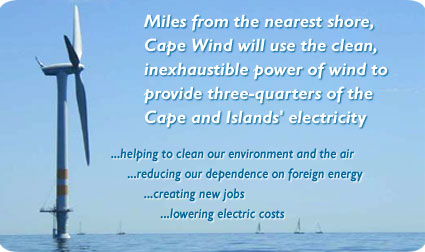
In what is, by my count, the 6th (more here here here and here) legal victory against rich NIMBY landowners and their ilk, courts have approved the transmission cables for Cape Wind.
The Pawa law firm and the Global Warming Legal Action Project have scored a major victory in the Cape Wind case. Today the Energy Facilities Siting Board (”EFSB”) rejected nearly all of the arguments by the opponents of Cape Wind to dismiss the EFSB case filed by Cape Wind. The Pawa firm represents citizens group Clean Power Now in the case. Cape Wind filed the case seeking a certificate of environmental compliance after the Cape Cod Commission had denied Cape Wind a permit for its electric transmission line.
The EFSB ruled today, in favor of Clean Power Now and Cape Wind, that
(1) the Cape Cod Commission’s procedural denial of the permit was in fact a denial;
(2) the Commission’s denial was a final decision and therefore reviewable by the EFSB;
(3) that it would not remand the case to the Commission given the extensive evidence already submitted on the Cape Wind project;
(4) that the EFSB case would be limited to the transmission line, which crosses state waters - and would not address any impacts of the wind farm itself, which lies beyond state jurisdiction in federal waters; and
(5) that its review of the Commission’s decision would not be limited to the record developed by the Commission.(via)
You can read more about this here. While this is a fairly esoteric ruling about transmission lines and who gets to say what about them, the fact of the matter is that every single time the NIMBY (not in my back yard) rich yacht owners try to stop this project, the courts rule against them. The opponents of this environmentally sound, clean, and renewable energy project, have spent millions of dollars to make sure that the nations first off shore wind farm doesn’t happen. It looks to me like that might turn out to be a big waste of money.
Normal people understand the need for clean renewable sources of energy, the courts understand that Cape Wind is on sound legal footing, and politicians are quickly learning that global warming is the biggest threat to this nation that we have ever seen. All in all I see this as a very good sign for Cape Wind.
Project Food And Farm Retreat
| August 8, 2008 | to | August 11, 2008 |
August 8-11 Families Welcome
Reconnecting to the Land
Work. Connect. Learn.
Connect to the Local Source of Your Food
-Nutrient-Dense Workshops
Sprouting and Soaking / Introduction to Fermentation
-Traditional, Whole Foods-Based Cooking Class
-Hands-On Experience
On the Farm and In the Kitchen
Donations Accepted
Cost: $140-$180, Sliding Scale / Scholarships Available
For more information about the retreat please call Meg at 415-350-8561
or email her at wecansustain@yahoo.com
http://www.projectfoodandfarmretreat.blogspot.com
Blue Planet Run Foundation Brings Hope and Health to Kenyan Hospital
Long Term Success Implementing Water Projects Can Be Tricky.
Blue Planet Run Foundation is pleased to share a success story thanks to the Peer Water Exchange.
Annette Fay visited Blue Planet Run’s project in Kisii, a crowded town nestled on top of a hilly, green part of the Kenyan countryside. The news from the completed water project demonstrates just how immense the impact of safe drinking water can be on a community. Annette shares her story:
I met with the Hospital Superintendent Dr. Otomu, the District Water Engineer Mr. Orangi and the Head Nurse Mrs. Monayo, the latter two walked me through the project.
The 200 bed Kisii District Hospital serves 525,000 people directly and is a referral facility for an additional 2,430,000, as far south as the Tanzanian border and west as Lake Victoria’s south-eastern shore. The Kisii area has a high density of HIV/AIDS victims and is known for the prevalence of the deadly highlands malaria after the rainy season. The hospital’s water needs are 180,000 litres per day. Before the water project, if all systems were functioning properly, the hospital had 40,000 litres of water per day from the following sources: 15,000 from a borehole, 10,000 litres from rainwater harvesting and 15,000 litres from the municipal water system.
The system installed by the municipality, whose supply is shared with the rest of the community, was put in place 30 years ago when the the population of the area was a fraction of what it is today. Not only does the overtaxed municipal water system usually run dry, but the equipment frequently breaks down and the hospital goes long periods of time with only enough water to use for essential services. Outdoor latrines were used, sheets were not provided for beds, polluted river water was purchased from vendors to use for cleaning, and doctors and nurses had little water to clean their hands after treating patients. People were dying from complications because of the lack of water, patients often had to be referred elsewhere (after traveling long distances on public transportation) because operations couldn’t be performed without sufficient water despite the equipment available; the Hospital was not performing at the level it could because of its water problem.
Eight months ago, the Kisii District Hospital Water Project became functional – running water in the hospital! The project has been an incredible success, both for the hospital and the community. Part of the project was to construct water points at the source for the community and a washing bay for women who come to wash their clothes. Because water is stored and directed to the hospital only overnight, the community still uses the source throughout the day; there’s even an emerging market near the washing bay now. The water pump has functioned with no problems and is easily delivering the 180,000 litres of water the hospital needs daily. Visiting the water source, one can easily see why this is where people were collecting water for the hospital and why there are always so many people taking advantage of the water available: despite the capture of 180,000 litres overnight plus the all-day use of the community, there are still multiple streams all around – you even have to cross through a deep puddle to get to the water pump and storage tank!
Since the water project was completed eight months ago, the Kisii Hospital has been elevated to a Provincial Hospital. That means it is the referral hospital for the entire Kisii District, whereas before special operations would have been referred to a larger hospital. This is a huge improvement for many patients in the area, who already struggle to get to Kisii from their villages as they won’t have to travel any further.
The major roadblocks the project faces at this point are electrification and a piping network. The water pump is currently working on a generator and long-term maintenance will be more effective if it is operating through electricity. Also, water is not supplied to every ward in the hospital, but to the most central wards. In an ideal world, it would be available in every room.
Everyone at the Kisii District Hospital was very grateful for water: telling me how the hospital is better, how people aren’t dying like they were before, how happy they are, how it’s allowed the hospital to save up for renovations. Thank you Blue Planet Run! For a full report, please visit www.peerwater.org/projects/61. You can also click on the link back to the Project Application to read more about the initial situation and the dialog during the Review of the project.
Microloans Breaking The Cycle Of Carbon Dependancy
The number of ”microborrowers” worldwide—people participating in the rapidly growing field of microfinance—increased by 17 percent in 2006, benefiting both communities and the environment, according to the latest Vital Signs Update released by the Worldwatch Institute.

“By helping individuals and villages replace firewood, oil, and kerosene with solar, wind, hydro, and biofuels, microfinance institutions help to improve the local environment while expanding access to electricity, boiled water, and refrigeration, dramatically improving the quality of life of the poor,” said Worldwatch Senior Researcher and Update author Gary Gardner.
Microfinance refers to financial services, including loans, savings accounts, and insurance products, that are designed to serve people with very low incomes. The 17 percent increase seen in 2006, the latest year for which data are available, continued a trend of double-digit growth that averaged some 29 percent annually between 2001 and 2006.
The global loan portfolio of the 340 microfinance institutions tracked by the Microfinance Information Exchange (MIX) also grew rapidly in 2006, increasing by 34 percent to $13.5 billion dollars. The average microloan size worldwide is now $1,026 and the average savings account balance is $1,126. Globally, the loan write-off ratio was 3.1 percent in 2006, lower than that of many commercial banks.
The sudden and significant success of microfinance is increasing pressure on many microfinance institutions to become more commercially oriented in their operations. Some analysts fear that this shift may cause microfinance institutions to raise interest rates or distribute profits to shareholders rather than reinvesting them in microfinance activities, hindering their original mission of poverty reduction. Proponents of private investment counter that commercializing microfinance is needed to attract the large sums of capital that will allow the practice to spread rapidly.
Regardless, the potential for expansion of microfinance remains significant. Today’s 133 million microborrowers represent only 5 percent of the people who lived on $2 or less per day in 2001. The Microcredit Summit Campaign, which helped spur the surge in microfinance with its goal of recruiting 100 million borrowers between 1997 and 2005, is now working to expand the number of microcredit recipients to 175 million by 2015.
Women are the most common benefactors of microfinance programs, accounting for 98 percent of borrowers in Asia and some two thirds of clients in Africa, Latin America, and the Middle East. As the birthplace of microfinance, Asia leads the world with 113 million borrowers, or roughly 85 percent of the global total. Latin America reported the fastest growth in borrowers in 2006, at 53 percent.
“Long ignored by mainstream financial institutions, microfinance is now a hot investment opportunity,” notes Gardner. “The poor have proven themselves to be a good investment bet. The challenge now lies in spreading and deepening that investment to bring widespread opportunity and prosperity to the world’s poor. “
Tubes Now Clogged With Indictments: Ted Stevens Charged With Corruption
Remember Ted Stevens, the idiot poor misguided old fart that was in charge of regulating the internet but couldn’t really figure out how it worked?
You may also remember him as the dick sadly out of touch senator from alaska that tried to introduce legislation to kill the Cape Wind Project. Turns out he just got charged with seven counts of corruption…go figure, a moron who is implicated in shady back room dealings to stop a perfectly good project also guilty of corruption, well bless my nippers who woulda thunk it!
Senator Ted Stevens of Alaska, the longest serving Republican in the U.S. Senate, was indicted by a federal grand jury in Washington on charges of hiding hundreds of thousands of dollars in gifts he received.
Stevens, 84, was charged with seven counts of making false statements on his Senate financial disclosure forms from 1999 to 2006 about gifts and renovations on his house.
Stevens’s indictment boosts Democratic chances of winning an Alaska Senate seat for the first time in almost three decades, if he remains a candidate. “If Stevens is on the ballot I would expect Democrats to win the seat,” said Nathan Gonzales of the Rothenberg Political Report.
Stevens “knowingly and willfully engaged in a scheme to conceal” his receipt of “hundreds of thousands of dollars” of gifts from Veco Corp., an oil-field engineering firm, and its chief executive officer, the indictment said. (via)
So it seems he was on the the take from a big oil giant…I am sure this has nothing to do with why he tried to stop Cape Wind…nothing at all.
older posts »


