No really, 50% of the food that is grown, gets wasted before it ever gets to anyone’s mouth (or an ethanol factory, or a cows mouth). It’s no wonder there have been food riots, rising prices, and record shortages. To meet the challenge of feeding growing populations and the global hungry, massive reductions in the amount of food wasted after production are needed. The Stockholm International Water Institute (SIWI), the Food and Agriculture Organization of the United Nations (FAO) and the International Water Management Institute (IWMI) will today, release a policy brief “Saving Water: From Field to Fork – Curbing Losses and Wastage in the Food Chain,†that calls on governments to reduce by half, by 2025, the amount of food that is wasted after it is grown and outlines attainable steps for this be achieved.
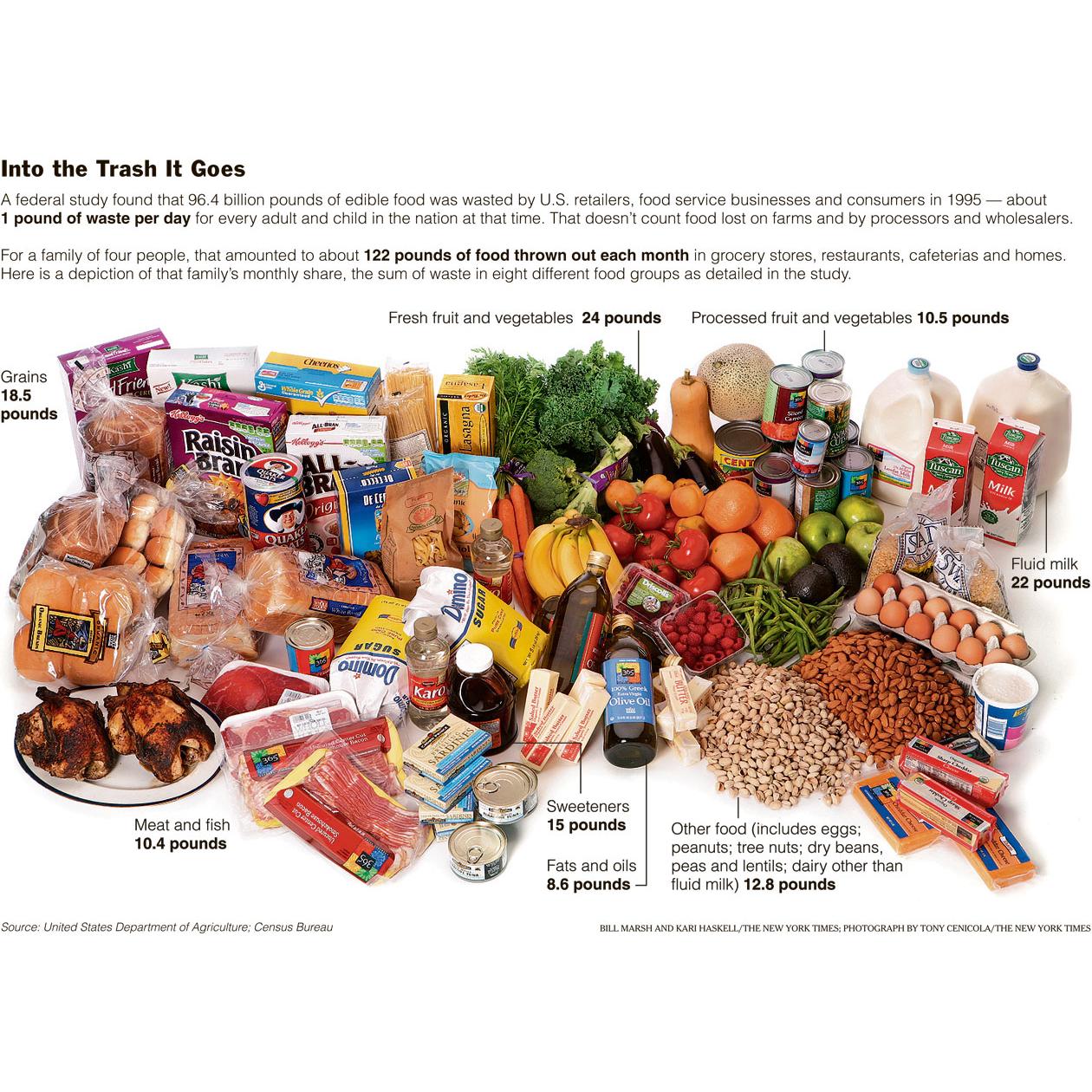
Tremendous quantities of food are discarded in processing, transport, supermarkets and people’s kitchens. This wasted food is also wasted water. In the US, for instance, as much as 30 percent of food, worth some USD 48.3 billion (!!!), is thrown away. That’s like leaving the tap running and pouring 40 trillion liters of water into the garbage can – enough water to meet the household needs of 500 million people. Besides being horrifically inefficient, through international trade, savings in the US might benefit communities in other parts of the world.
More than enough food is produced to feed a healthy global population. Distribution and access to food is a problem – many are hungry, while at the same time many are stuffing themselves, becoming fat and unhealthy in the process. The Report highlights an often overlooked problem: we are providing food to take care of not only our necessary consumption but also our wasteful habits.
“As much as half of the water used to grow food globally may be lost or wasted,†says Dr. David Molden, Director of Research at IWMI. “Curbing these losses and improving water productivity provides win-win opportunities for farmers, business, ecosystems, and the global hungry. An effective water-saving strategy requires that minimising food wastage is firmly placed on the political agenda.â€
Food production is constrained by the availability of water and land resources. An estimated 1.2 billion people already live in areas where there is not enough water to meet demand. And with rising demand for water-intensive agricultural products, such as beef and bioenergy, pressure mounts. According to the Comprehensive Assessment of Water Management in Agriculture 2007, these trends will lead to crises in many places, particularly in Sub-Saharan Africa and South Asia. “Unless we change our practices, water will be a key constraint to food production in the future,†said Dr. Pasquale Steduto of FAO.
Water losses accumulate as food is wasted before and after it reaches the consumer. In poorer countries, a majority of uneaten food is lost before it has a chance to be consumed. Depending on the crop, an estimated 15-35 percent of food may be lost in the field. Another 10-15 percent is discarded during processing, transport and storage. In richer countries, production is more efficient but waste is greater: people toss the food they buy and all the resources used to grow, ship and produce the food along with it. The Report stresses that the magnitude of current food losses presents both challenges and opportunities. “Improving water productivity and reducing the quantity of food that is wasted can enable us to provide a better diet for the poor and enough food for growing populations,†says Prof. Jan Lundqvist of SIWI. “Reaching the target we propose, a 50 percent reduction of losses and wastage in the production and consumption chain is a necessary and achievable goal.†The report is available here (pdf).
Here are some stats to get you thinking:
- 777 million people in developing countries do not have access to sufficient and adequate food. Source: UNESCO
- 27 million people in countries in transition suffer from under nourishment, and 11 million in industrialized countries. Source: UNESCO
- Pasture and crops take up 37% of the Earth’s land area. Source: UNESCO
- To produce a kilogram of meat takes anywhere between 5,000 to 20,000 litres of water per kilogram, depending on the type of animal and the way they are raised (for example livestock grazing on rain-fed pasture consumes less water than industrial feedlots supported by irrigation). Source: Stockholm International Water Institute (SIWI)
- Under current practices, certain liquid bio-fuels may contribute as much to the greenhouse effect as fossil fuels as they require large amounts of fossil resources to make fertilisers, run agricultural machinery, and refining. Source: SIWI
- Reducing food wastage by 50 % – including post-harvest losses, losses in transport and handling, and losses in the household – might vastly reduce or even negate the need for additional water to grow more food, which will ensure sufficient water is available for food in the future. Source: SIWI
- With current levels of water productivity, the additional consumptive use of water linked to food security by 2025 and 2050 is estimated at 3800 and 5600 km3/year, respectively. Source: SIWI
- Based on today’s water productivity and a projected diet of 3000 kcal/day, an additional 5600 km3/year of water needs to be appropriated by 2050 to eradicate undernutrition and feed an additional 3 billion world inhabitants. This is almost three times as much as the present global consumptive water use in irrigation. Source: SIWI
- Currently, farmers often pay devastatingly high rates of interest for credit. In some African countries it is in excess of 40%. Source: SIWI
- Trade in food is literally also trade in water. Since food production uses large volumes of water, a certain volume of consumptive water is used when producing each food item. The total amount of water resources used to produce a crop is referred to as “virtual water.†Source: SIWI
- In OECD countries, farmers receive more than one-third of their income from government subsidies, in total over USD 300 billion every year. The value of total agricultural support in OECD countries is more than five times higher than total spending on overseas development assistance and twice the value of agricultural exports from developing countries. Source: SIWI
- Producing 1 kg of meat requires as much water as an average domestic household does over 10 months (50l/person/day).
This is disgusting but not surprising. We really need to find ways to stop waste on all levels of food production, transport, and consumption. I wonder how many employees at all level would steal a box of food or whatever every once in a while and claim it was “expired” or that it “fell off the back of the truck”.
This is a subject very close to my heart – food waste in the UK is horrific and I think a great deal of the problem lies in the fact that my parent’s generation were seduced by the supermarket culture, take-aways and affordable convenience, then forgot how to cook and completely forgot to teach their kids what little they remembered!
The Love Food Hate Waste Campaign is excellent and I think it’s really helping to make a difference to what ends up in landfill.
All the best,
Respect!
TS