Desert Dust Does Damage
It would seem that desertification caused by water shortage, or poor land usage hurts more than the immediate area around the environmental degradation. Accelerated snowmelt–precipitated by desert dust blowing into the mountains–changes how alpine plants respond to seasonal climate cues that regulate their life cycles, according to results of a new study reported this week in the journal Proceedings of the National Academy of Sciences (PNAS). These results indicate that global warming may have a greater influence on plants’ annual growth cycles than previously thought.
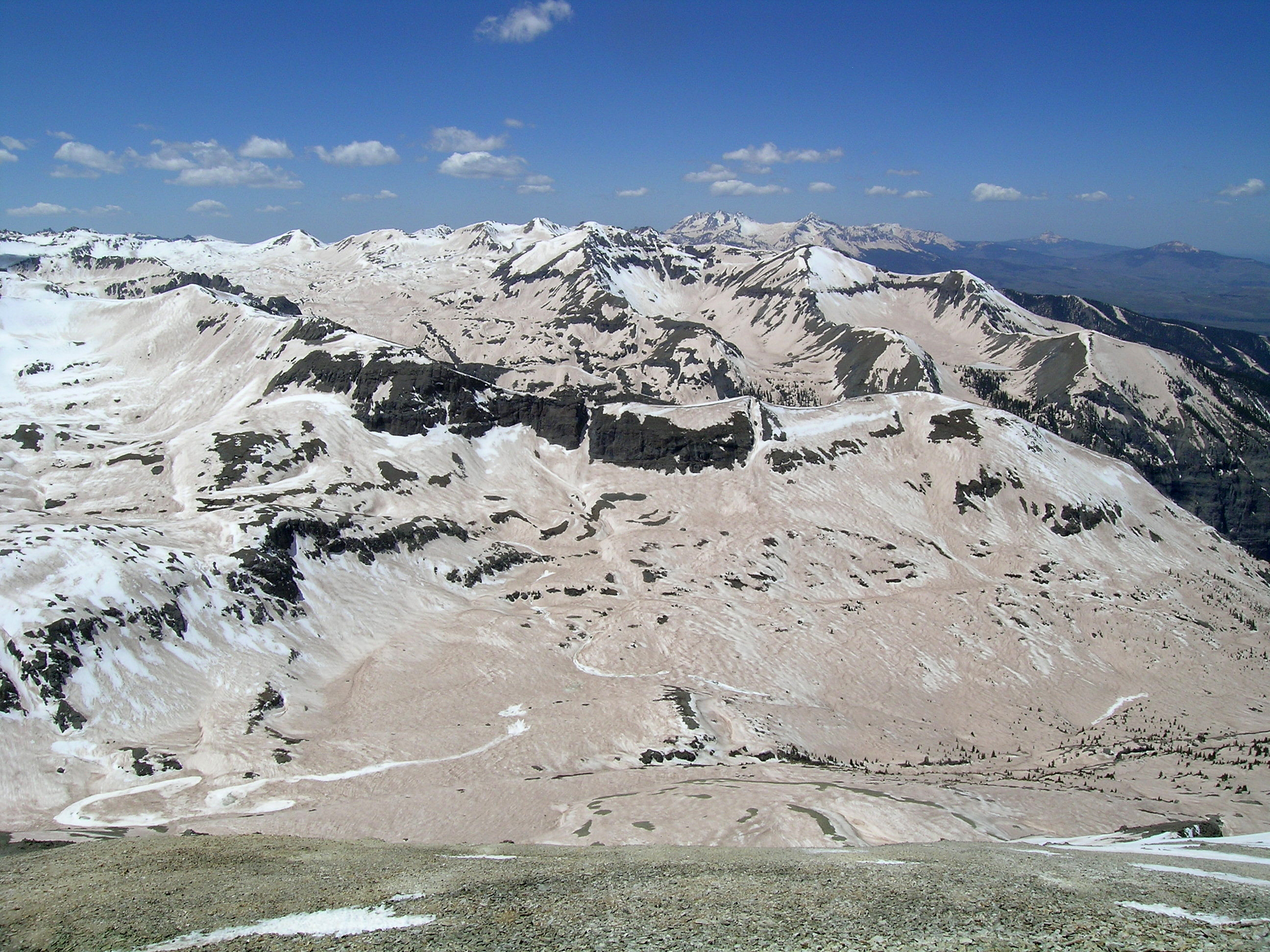
Current mountain dust levels are five times greater than they were before the mid-19th century, due in large part to increased human activity in deserts.
“Human use of desert landscapes is linked to the life cycles of mountain plants, and changes the environmental cues that determine when alpine meadows will be in bloom, possibly increasing plants’ sensitivity to global warming,” said Jay Fein, program director in the National Science Foundation (NSF)’s Division of Atmospheric Sciences, which funded the research in part.
This year, 12 dust storms have painted the mountain snowpack red and advanced the retreat of snow cover, likely by more than a month across Colorado.

“Desert dust is synchronizing plant growth and flowering across the alpine zone,” said Heidi Steltzer, a Colorado State University scientist who led the study. “Synchronized growth was unexpected, and may have adverse effects on plants, water quality and wildlife.”
“It’s striking how different the landscape looks as result of this desert-and-mountain interaction,” said Chris Landry, director of the Center for Snow and Avalanche Studies (CSAS) in Silverton, Colo., who, along with Tom Painter, director of the Snow Optics Laboratory at the University of Utah, contributed to the study.
“Visitors to the mountains arriving in late June will see little remaining snow,” said Landry, “even though snow cover was extensive and deep in April. The snow that remains will be barely distinguishable from the surrounding soils.
Earlier snowmelt by desert dust, said Painter, “depletes the natural water reservoirs of mountain snowpacks and in turn affects the delivery of water to urban and agricultural areas.”
With climate change, warming and drying of the desert southwest are likely to result in even greater dust accumulation in the mountains.
In an alpine basin in the San Juan Mountains, the researchers simulated dust effects on snowmelt in experimental plots. They measured dust’s acceleration of snowmelt on the life cycles of alpine plants.
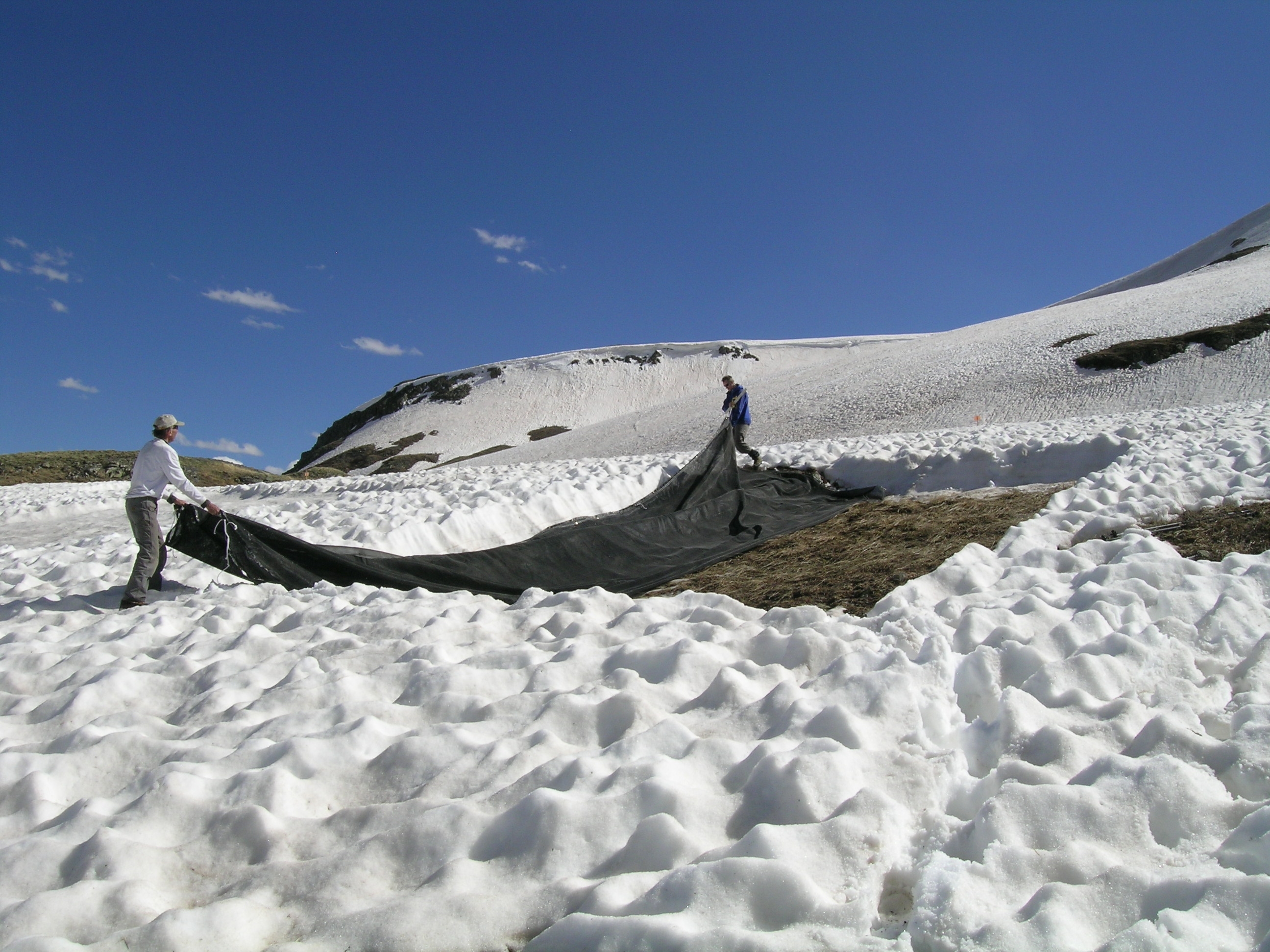
The timing of snowmelt signals to mountain plants that it’s time to start growing and flowering. When dust causes early snowmelt, plant growth does not necessarily begin soon after the snow is gone.
Instead, plants delay their life cycle until air temperatures have warmed consistently above freezing.
“Climate warming could therefore have a great effect on the timing of growth and flowering,” said Steltzer.
Competition for water and nutrient resources among plants should increase, leading to the loss of less competitive species. Delayed plant growth could increase nutrient losses, decreasing water quality.
Similarity in flowering times and plant growth will result in abundant resources for wildlife for a short time rather than staggered resources over the whole summer, Steltzer believes.
“With increasing dust deposition from drying and warming in the deserts,” she said, “the composition of alpine meadows could change as some species increase in abundance, while others are lost, possibly forever.”

Peer Pressure Is Good For The Earth
Sure peer pressure can be used to get people to buy cheap crap, or to make them drive some huge gas guzzling land tank, but peer pressure can be used for good things as well. People are more likely to enroll in conservation programs if their neighbors do–a tendency that should be exploited when it comes to protecting the environment, according to results of a new study.
The research, to be published in the journal Proceedings of the National Academy of Sciences (PNAS) this week, is the first to focus on the phenomenon of social norms in the context of China’s conservation efforts, said scientist Jianguo “Jack” Liu of Michigan State University (MSU).
The study focused on a mammoth government initiative called Grain-to-Green that pays Chinese farmers to convert cropland back to forest.
“Much of the marginal cropland in rural communities has been converted from agriculture to forests through the Grain-to-Green Program, one of the largest ‘payment for ecosystem services’ programs in the world,” said Alan Tessier, program director in the National Science Foundation (NSF)’s Division of Environmental Biology.
“Results of this study show that a community’s social norms have substantial impacts on the sustainability of these conservation investments.”
Liu’s research was funded through NSF’s Coupled Natural and Human Systems (CNH) Program. CNH is co-funded by three NSF Directorates: Biological Sciences; Geosciences; and Social, Economic & Behavioral Sciences.
While money is a key factor in whether people sign up for the voluntary program, peer pressure also plays a surprisingly large role, Liu said.
“That’s the power of social norms,” he said. “It’s like recycling. If you see your neighbors doing it, you’re more likely to do it.”
A representative survey of households in China’s Wolong Nature Reserve for giant pandas found that both government payments and social norms had “significant impacts” on citizens’ intentions of re-enrolling in the Grain to Green program.
“In other words, people’s re-enrollment intentions can be affected by the re-enrollment decisions of their neighbors and tend to conform to the majority,” says Liu.
Xiaodong Chen, a doctoral student at MSU and lead author of the paper, said government officials should leverage these social norms along with economic and demographic trends when deciding how to support conversation programs such as Grain to Green.
“We found that, without considering the social norm factor, conservation payments may not be used efficiently,” Chen said.
“But if the government considers social norms as it decides where to invest money, it could obtain more environmental benefits in communities that are supportive of these programs than in those that aren’t.”
Added co-author and MSU scientist Frank Lupi: “Simply by taking account of the social norms, more conservation can be obtained from limited conservation budgets.”
The moral of this story is, do good for the planet, and make sure your neighbors know you are doing it. Peer pressure them into changing their ways. It’s science, and it’s good for the planet.
House Passes Climate Change Bill
Sure it wasn’t perfect, and sure it wasn’t aggressive enough, but The House of Representatives has just passed a landmark bill that will propel our nation toward a clean energy future…if the Senate also passes it.
The vote was close. Know that all of your efforts — whether a signed petition, a donation, or a call — made a difference in the outcome. Together, we are truly showing the power of government by the people and for the people.
It’s not over though. The debate moves on to the Senate where our opponents will redouble their efforts. There will be more distortions and foot dragging, but the momentum is on our side. We must not only have the senate pass the bill but TOUGHEN IT. Call then now and tell them that they should be MORE AGGRESSIVE with the carbon reduction efforts, investment in green jobs, and new standards for efficiency.
Today, we have something to celebrate. For the first time in decades, we have taken bold action to help solve the climate crisis.
Call Up Your Rep And Make Them Pass Climate Change Legislation
Call 877-9-REPOWER (877-9-737-6937) and we’ll connect you to your Representative right after providing you with talking points. (We’re expecting high call volume, and if you are unable to be connected please use our secondary line, 866-590-0971.)
When connected to your Representative’s office, just remember to tell them your name, that you’re a voter, and that you live in their district. Then ask them to “vote ‘yes’ on comprehensive clean energy legislation.”
——
Today the U.S. House of Representatives will vote to determine the fate of the American Clean Energy & Security Act (H.R. 2454). Please contact your Member of Congress to ask him or her to vote in favor of this legislation.
A renewable electricity standard (RES) is a policy to ensure that a growing percentage of electricity is produced from renewable sources, like wind power. To create a long-term commitment to renewable energy, the U.S. needs to adopt a strong national RES. This policy would foster a sound investment climate for renewable energy manufacturers to invest billions of dollars in new facilities and employ hundreds of thousands of Americans in high-quality jobs.
Although the current RES provisions aren’t reaching President Obama’s campaign goal of 25% renewable energy by 2025, passing this bill out of the House of Representatives is an important step in the legislative process. We also ask that you contact your Senators and ask them to help strengthen the RES in their version of the bill that will come up for a vote in the near future.
When you talk to your senator tell them:
Here’s what’s WRONG with the legislation:
- The Nobel-prize winning Intergovernmental Panel on Climate Change says that to avoid the worst climate impacts such as intense droughts, super charged hurricanes and increased heat waves, the U.S. and other industrialized countries must cut their emissions by 25-40% below 1990 levels by 2020. This bill, as it’s currently written, only calls for a 4% reduction by 2020. And there’s very little chance those targets will be improved.
- These weak targets are made even worse by 2 billion tons per year of allowable offsets. Offsets allow polluters to put off for more than a decade real cuts in their emissions The offsets are so high that they will exceed the actual pollution reductions required until at least 2026 — that’s time we don’t have!
- Coal-fired power plants are the single largest source of global warming pollution in the U.S. In order to tackle climate change, we need to begin phasing out coal immediately. But instead of phasing-out coal plants, ACES will actually encourage the growth of a new generation of coal-fired plants! To add insult to injury, tens of billions of taxpayer dollars would be spent on the myth of carbon capture and sequestration — an untested and unproven technology that is decades away from full-scale deployment even by the most optimistic estimates.
Toilet Made Of Poo, Creates Power, Awesome
more info here
older posts »


