
Ask The Sietch: Adding Solar Panels To Your Home
Do you have a question you would like to Ask The Sietch? Contact us or post your question in the Forums, and we will do our best to answer it. Got this one from the contact form.
Ryan asks:
Hello
I am an on the grid user. I was thinking about getting some solar panels to off set some of my electrical use. I contacted the local building department to find out more regarding the hookup of these to your existing home. They have no clue. So I ask you is it possible to add solar panels to a homes existing power system. Would I need batteries or can I hook it directly to my electrical box and put energy back onto the grid? My thought is it would at least lower my bill.Thanks
Ryan
Hi Ryan. I used to work for a company that installed solar panels, and I can tell you that you have the exact same questions that just about everyone else has. Even in this modern world of wonderful technical advances in renewable energy it seems that a lot of local building resources are woefully under informed about how to go about using and installing these systems.
I will try to answer your questions in the order you asked.
Q “Is is possible to add solar panels to a homes existing power system”
A You bet it is! In fact it’s pretty simple. First you need to know a little about solar panels, and home electric systems. Solar panels produce DC power (the same kind you get from batteries), your home most likely runs on AC power. That means that they can’t “talk” to each other without a little help. To get around this problem you need a little box called an inverter. An inverter converters DC to AC. The solar panels go on the roof, or in a suitable sunny location, and the inverter goes next to the fuse box. See the image below.
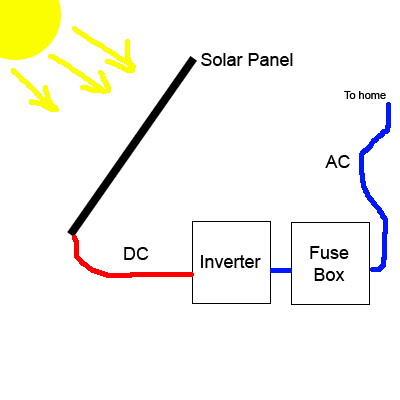
Q “Would I need batteries or can I hook it directly to my electrical box and put energy back onto the grid?”
A Yes, both, one or the other. You can build a system with batteries, a system without batteries, a system connected to the grid, a system not connected to the grid, and any combination of the two (grid connected with battery backup). So why would you do one or the other?
Why add battery systems?
If you want to be disconnected from the grid you are only going to be able to use power when the sun is out, so if you add batteries to the system you can store up some of that energy for use later. This is a good setup for people who want to live way out in the middle of nowhere, or who want to be completely independent from the grid.
Why connect to the grid?
Most modern inverters allow you to be “grid tied” that means connected to the grid. When your solar panels are making more energy than you are using (you’re at work during a nice sunny day) then you send that energy to the grid and your power meter spins backwards, at night when you get home and start using more energy than your panels are putting out your meter will spin forward. At the end of the month if it spun backwards more than it spun forwards you won’t have a bill, in fact you will get a check from the power company. Neat.
Why connect to the grid AND use a battery system?
When the power goes out, your grid tied inverter is going to shut down your solar system. The reason it does this is because if the power goes out then its a good chance that someone will be out working on what they think is a dead line. It would be a nasty surprise if they picked it up and found a lot of electricity pouring out of it from your solar panel system. So contrary to popular belief the simple act of having a solar system doesn’t protect you from blackouts. What you need is is a solar system and a battery system. Inverters have sophisticated switching systems in them, if you have a battery backup system when the power goes out your grid tied inverter can switch over to your battery system and your power keeps going like nothing happened.
Why wouldn’t you need a battery system?
Most people don’t experience enough blackouts in a year to justify the very high cost of a battery backup system. Batteries are expensive, have to be taken care of, and eventually wear out. If you live in a place where the grid is pretty stable, you probably don’t need a battery backup system.
Q “My thought is it would at least lower my bill”
A I know this isn’t technically a question, but I am going to treat it as one. Yes it will lower your electric bill. For every watt of energy you produce from your solar system that means one less watt you need to buy from the grid. Plus if you make more than you produce you can sell the extra back to the electric company. Not to bust your bubble, but most electric companies pay you wholesale prices for the energy you sell to them, and then charge you retail prices when you buy the electricity, meaning you are not going to get rich that way.
It is more than possible to put enough panels on an “average” American home (read really big suburban home) to completely offset all your electric use. The limiting factor will be how much money you have to spend on your solar panel system. The nice thing about renewable energy is that eventually the systems pay for themselves. Through savings by not using energy from the grid, or from making money by selling the energy back eventually you will pay off your investment.
Some people will hem and haw about the fact that it can take 25 years to pay off your investment but here are a couple of things to keep in mind.
1. Solar panels when installed properly can easily last 50+ years
2. Non-renewable energy systems NEVER EVER EVER pay themselves off, they have an infinite payback period, you always have to shovel more oil/coal/gas into them, at an ever increasing cost.
I hope this has answered your questions. If you have anymore questions feel free to leave them in the comments.
Further reading:
Google talk on installing solar panels
getting money for your renewable energy system
Ask The Sietch : How Can I Keep My Animals Warm Using Solar Power
Do you have a question you would like to Ask The Sietch? Contact us or post your question in the Forums, and we will do our best to answer it. Got this one from the forum
Got this one from the contact form a couple of days ago.
Kim has sent me this interesting question.
I am trying to find a simply explained (I’m inexperienced) & inexpensive way to build a solar heated small animal shelter. Would you have any suggestions? I am wondering if I could somehow adapt your plans (#2) for a solar thermal panel to provide a source of warmth and / or way to keep drinking water from freezing. I am hoping you can give me some guidance about whether this is logical, technically feasible….safe, etc. Your thoughts on what might work would be greatly appreciated.
Thank you.
Hi Kim. Yes you can safely and simply heat a small space (dog kennel, rabbit hutch, chicken coop, goat pen, etc) and/or keep water from freezing with solar power. There are basically two ways to do this, passively and actively.
If the animal you are trying to keep warm is a relatively hearty (aka its not some sort of rare tropical lizard that never experiences cold weather in its native habitat), like a dog or a goat or even a chicken and you can add a lot of heat to an enclosure with some passive methods.
First off you will want to think about changing seasons, in the summer time you are not going to want your animals as warm as the winter, and most animals have natural ways to stay warm, so you don’t want to make their homes so hot that they overheat (which can happen with animals with fur, even in the depths of winter). I would suggest that a good layer of insulation, and a shelter that keeps the animals out of the wind can go a long way towards keeping animals warm. A good sized dog, with a well insulated dog house will stay nice and toasty on even the coldest nights.
If you need a little more heat, you could try and build a passive solar enclosure. This would basically be a small greenhouse like structure that is attached to the insulated structure. See the image below.
The idea is that during the day the sun shines in (the heat is trapped by the glass) and heats up a thermal mass (bricks or a cement floor), then during the night you place an insulated cover over the glass (a big sheet of insulated foam, or insulation) and the animal can sit on the nice warm floor all night.
During the summer you might want to leave the insulated cover on all the time to keep the sun from heating up the inside. Chickens that get too warm can easily die.
You can enact this sort of insulation/passive solar way in a million ways. But the basic idea is to insulate, and heat a thermal mass (something that soaks up the heat during the day to release it at night).
If you need a little more “kick” you can try some active solar methods.
If you really need to heat something I would go and buy yourself a solar thermal panel. You can find dealers all over, and you can get one or two panels for less than 1000 dollars (most likely much less). You point the panel at the sun, and pump water through it, this water gets very warm, then you run this warm water through a thermal mass. See picture below.
Your solar panel collects heat from the sun, it is in essence a tiny greenhouse that concentrates and traps the infrared radiation (heat) from the sun. A series of small tubes in the panel allow you to pump water (or a glycol mix to prevent freezing in the winter) and transfer this trapped heat someplace else. In this case we would pour a small concrete slab with a network of tubes placed into it. The warm water flows through the system all day, and the concrete slab absorbs the heat. At night when the sun goes down the pump turns off and the warm concrete radiates the heat all night long. Combined with a very well insulated enclosure, and the animals own adaptations (fur, feathers, etc) you keep your critters warm.
You could also use a system like to keep water from freezing. Instead of running the network of tubes into concrete you would use a small copper coil of pipes and place it into the bottom of the water tank, in this way the water itself acts as your thermal mass. You would be heating up the water all day, and at night it would be warm enough not to freeze. During the summer you would detach this system because the water would get really warm.
So to answer your question, yes you can do this with solar. Yes it is safe, and yes it is feasible, even easy. You will still need to monitor your animals to make sure they are ok on really cold nights, but you would have done that any way. If you contact a renewable energy contractor in your area (especially one that has experience with solar thermal) they could help you whip up a system like this pretty easily.
I hope this helps, if you have any follow up questions feel free to contact me or leave a comment.
Ask The Sietch: Can My Compost Pile Catch On Fire?
Do you have a question you would like to Ask The Sietch? Contact us or post your question in the Forums, and we will do our best to answer it. Got this one from the forum
Yesterday there was a local news story here about some nearby schools’ playgrounds being closed due to concerns about spontaneous combustion from “manufactured wood chips†that cover those areas. A security camera showed this stuff catching fire. (I assume this has to do with the fact that our temperatures this week are around the 104-degree mark.) Of course, the manufacturers say this is hogwash, but the firemen said they’ve been worried about this for some time. Have you heard anything about a problem with this product?
Anyway, during the story, they mentioned that compost piles can have the same problem if the compost isn’t turned. Is this true? I’ve inherited a house that came with a nice compost pile, but I haven’t turned it in the year since I’ve lived here.
I found this story, most likely the one Candance is talking about. So can a big pile of mulch and compost catch fire. You bet they can. And if they do, and the pile is big enough, it can be a big mess.
Read the rest of Ask The Sietch: Can My Compost Pile Catch On Fire?
Ask The Sietch – Where Can I Get Solar Cells For DIY Projects?
Do you have a question you would like to Ask The Sietch? Contact us or post your question in the Forums, and we will do our best to answer it. Got this one from the contact form the other day
I’d like to do the “Build your own solar battery charger” project, but I’m new to this. Can you suggest places to get the solar cells?
Thanks,
Jimi
I get this question a lot. Finding bulk or “raw” solar cells can be a bit tricky. With the very high cost of pure silicon, and the fact that even “bad” solar cells (ones with small defects, or small color issues) still work very well, most companies no longer will give away the “rejects.” However there are still ways to get cells to work with. Below are a couple of ways you can try to go about getting them.
Read the rest of Ask The Sietch – Where Can I Get Solar Cells For DIY Projects?
Ask The Sietch – Jobs In Renewable Energy
Do you have a question you would like to Ask The Sietch? Contact us or post your question in the Forums, and we will do our best to answer it.
Got this from a comment yesterday.
My Name Is George and I think that wind power is the answer…
I would love to learn how too get a good paying job in this industry. The future is open too this tech… and we as people of the earth need to see that it happen’s so our kids and they’er kids have a world that is clean and the power they need to live.
Well George now is a good time to get a job in the renewable energy industry. Wind, solar, and other renewable companies are growing like crazy. Getting a job with the renewable energy industry is pretty much the same as getting a job with any industry. They are looking for passionate people who have the skills. If you don’t know the inner working of a wind turbine or the physics of solar cells don’t give up. The renewable industry needs people from every skill set in every education level. There is a lot of opportunity for people who are committed and driven to move up and learn as you go.
Jobs in RE can range from entry level internships to high paid engineers. Depending on your level of skill you can enter at any point. The hardest part (in my opinion) is finding the job listings with that in mind I will be collecting this uber list of renewable energy job posting locations. Good luck.
Below you will find an ever growing list of job sites in the renewable energy field, I have also taken the time to create a custom search engine for renewable energy job sites.
If you know of any other good renewable energy job listings boards be sure to leave a reply. The more we find the better this resource will be.
Read the rest of Ask The Sietch – Jobs In Renewable Energy

