jump to navigation

Monthly Undermining Task, January 2010: The Great TV Turn-Off

Written by

“Out-of-Home impact plus the power of television to a captive audience. Reach 5.8 million monthly Atlantans, commanding attention during the entire ride.”

You don’t really notice it, but it’s there, filling your subconscious with a thousand different messages; broadcasting its commercial dominance to an entrapped population. Television is the primary method by which civilized humans are manipulated into carrying out the instructions of the industrial machine; this is no Orwellian fantasy, it is now and it is real, and don’t you feel pissed off that you can’t go anywhere without having your eyes and ears assaulted by this garbage?

The Unsuitablog’s Monthly Undermining Task was instigated in order to remove greenwashing from the world, but because television propagates so much more than just the greenwashing messages of the industrial world, taking down the commercial public television network also removes all sorts of other insidious messages: promises of material fulfillment; political spin; embedded journalism; commercially sponsored “education”. By switching off a television you do nothing less than give people back their ability to think for themselves.

So, are you up for it?

From today, throughout 2010, I would like you to switch off televisions and other electrical hoardings whenever you get the chance. As I explained in the opening article, the risk you take is up to you; you can do this in an almost risk-free environment, or you can take a few chances and do something more permanent. Risk is relative, of course, and the first time you do something like this it always feels a bit dangerous – as though someone is about to walk up behind you and say, “Excuse me, what do you think you are doing?” before escorting you away from the premises.

Not that it really matters if you are asked to leave; but in all my time switching sets off I have never once been escorted away or even caught. The point is: no one expects anyone to switch these damn things off!

Low Risk

You see these everywhere now: plasma or LCD screens littering the walls and ceilings of shops, pubs, railway stations, libraries, schools. So insidious yet so fragile. With a wave of the hand you can switch these off. I’m going to recommend a product to do this; if you don’t want to buy it then you will need to take a little more risk (see later).

TV-B-GONE is the product you need; it is available in kit or ready-made form. The link for the ready-made versions is below:

https://www.tvbgone.com/cfe_tvbg_buy.tvbg.php

Check it works, attach it to a keyring or just hold it in your hand, and when you see a television that is in a public or commercial place – keeping the LED pointed at the screen – just press the button. It’ll take a while to get used to the order in which televisions are switched off, but in general the most popular models (like Sony, Toshiba and Samsung) go first.

I had great fun sitting on a bench outside a Sony Store, eating a sandwich, while switching off all the televisions within range; I have walked past shops with huge screens inside and knocked them out much to the incredulity of the staff; and I even walked around a music store, “shooting” the TVs off which were situated above the salepeoples’ heads. Great fun and, as I say, I have never been suspected: who would dream of switching televisions off?

Medium Risk

The next level of risk is essentially doing the same as for the Low Risk, but without the remote. Obviously there are fewer opportunities to do this, you being limited to what you can physically reach, but there are a few reasons why this might be a better option: first, you don’t have a remote control; second, the display is a computer monitor or other custom display that doesn’t respond to remote controls (these are often in small stores or office-type areas); third, you might want to just make a point of switching the screen off, as described by a correspondant:

My dentist recently instituted an *enormous* widescreen telly in their previously very lovely Georgian house conversion waiting room. It had some trashy Hollywood comedy playing on it when my partner and I were there last year. In fact, it had finished so it got stuck in the irritating sound loop that DVDs go into when they are in their menu screen.

Anyway, later on, we were both back in the waiting room while our xrays and so forth were being attended to, and there was one other middle-aged woman there too reading a magazine and sitting where she couldn’t see the screen. So I switched the TV off. A while later someone who worked there stormed in and switched it back on. I explained that we’d switched it off because noone wanted to watch it and was told off.

The reason for the telling off, I suspect, was not because anything had been damaged, but because the employee of the dentist had the idea in her head that THE TV MUST STAY ON! Why? Because it must. That’s it. Talk about brain death!

You might simply just say to the people in the room: “Is it ok if I turn the TV off?” Chances are no one will object, even if they were blankly staring at the screen. While we’re on the subject of reaction, the thing I have noticed most is that when an “ambient” (a.k.a. subconsciously brainwashing) television goes off, people don’t react at all; if anything they simply switch back into communication mode, and get on with their lives.

See, you are freeing people up. Well done!

High Risk
Now we’re getting into voluntary territory: if you want to take the high risk options then you need to follow the basic rules of Sabotage, as explained in this article:

- Carefully weigh up all the pros and cons, and then ask yourself, “Do the benefits far outweigh the costs?” Only act if the answer is “Yes”.

- Plan ahead, and plan well, accounting for every possible eventuality.

- Even if you value the worth of your actions, don’t get caught.

For legal reasons, I have to write that I don’t condone any breaking of the law nor anything that could potentially harm a living being.

Now, in the case of the displays that you can’t switch off remotely or by pressing a button, more drastic action has to be taken. You really have two options that are practical.

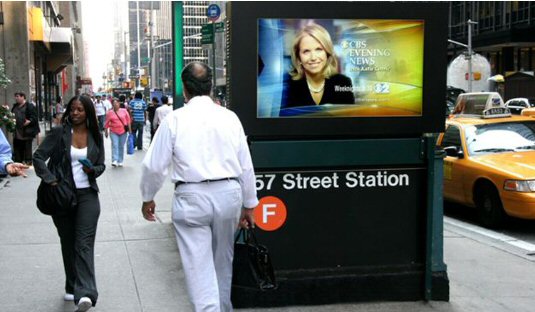
In the case of units that are immobile, like in the image above, it’s not generally practical to simply obscure the picture, so you will need to find the power source. I’m not going to go into any details, and it is highly inadvisable to mess around with breakers and wires if you don’t know precisely what you are doing; nevertheless, if there is a plug socket or obvious rocker switch connected to the unit, then you could just disconnect it. Whether you go further is up to you; but if you can disable a very large display, such as those in major railway stations, then you are a bit of a hero in my eyes.
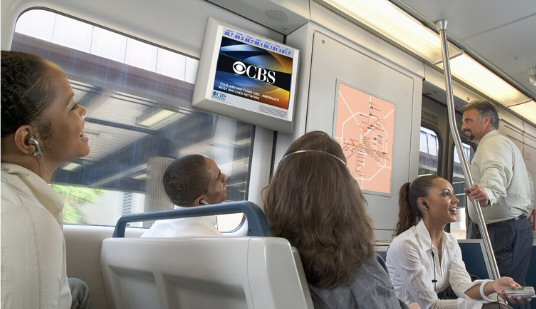
For display units on public transport, like the really creepy one in the image above, you will need to be more up-front. Don’t mess around with the power unless there is a switch on the back – you won’t find the source anyway because it has to be hidden well away – I would suggest covering the screen up, perhaps using a professional “Out Of Order” sign or something like this one:


(click for large version)

If you have a high visibility jacket or smart suit then you can probably get away without anyone saying anything. You may raise a smile from some of the people who didn’t even realised their eyes were glued to the set. You might even give someone the motivation to do something similar themselves.

And speaking of which; make sure you pass this article to your own networks, Facebook friends, Twitter feeds and put it on your blogs – here’s the link:

http://thesietch.org/mysietch/keith/2010/01/15/monthly-undermining-task-january-2010-the-great-tv-turn-off/

I have a funny feeling we will be seeing fewer usable televisions in 2010…

[Originally published on The Unsuitablog]

How To Investigate Greenwash

Written by

The Unsuitablog has gone to the next level, with a major article to help all aspiring greenwash investigators get far more information out of environmental liars that they ever thought possible. The article has a host of useful information on preparation, “casing the joint” and carrying out The Sting, including lots of useful tools and techniques.

Greenwashers don’t want to be exposed; exposure is dangerous because they no longer control the message, and if they cannot control the message then they cannot control what people think and do. My job, as the author of The Unsuitablog is to wrest control of the message from the greenwashers, and free us from the lies that are relentlessly paraded before us. In the light of truth, we are free to make our own minds up, rather than being made to see these purveyors of harm in the way they would like us to see them.

I want you to be able to do this as well: not only recognising the hypocrisy and the greenwash, but taking part in exposing the liars for yourself. It’s not always easy, but with a bit of help we can really take them on.

Critical to the act of Exposure, however you do it, is Investigation. Without investigation you have little or nothing to back up any claims you make, nor will you be sure of the accuracy of the information you present. Investigation is also critical because it can often lead to the discovery of far worse things than you may have initially expected, giving your effort far more justification, and potentially preventing extremely destructive activities. Feel free to, like I sometimes to, have a cheap shot at your Target, but if you want to do something really worthwhile, you need to investigate.

So, come over to The Unsuitablog, and read the entire article.

You never know, it may be you that exposes the next great environmental crime.

Use The Web To Go Green

Written by

Using the Web to Go GreenThere are many ways to use the web for good. If you’re creative, or if you read a lot web posts that do the creative research for you, there’s a whole universe of information out there that can help you learn ways to live a more sustainable lifestyle and find the resources to follow through. Let’s go through a 3-step process together.

Step #1 You’re Buying A Home

Congratulations, buying a home is a big and beautiful endeavor. To give you a head start on your commitment to the environment, Listed Green is a multiple listing service (MLS) exclusively for green homes and properties. The best part is, it’s open to the public, unlike other MLS services that are only accessible to real estate agents. The prescreened homes listed have qualities such as low-VOC interior paint, efficient heating and cooling equipment, water conservation equipment, etc. Also, the company itself is a sustainable business that does everything from utilizing solar power to donating to Global Green USA.

Step #2 You’re Looking for Resources to Green Your New Home

Now that you’ve got your new home, you want to learn more about sustainable design and find manufacturers that sell green building products. The Green Building Pages have all of this. An online tool designed for building industry professionals and socially responsible consumers such as yourself, the website’s offerings include:

Step #3 You’ve Used Your Resources, Now It’s Payback Time

For being so web savvy and environmentally conscious, the government wants to give you money. Go to the Database of State Incentives for Renewables and Efficiency (DSIRE) to find state, local, utility, and federal rebate information. Incentives that promote energy efficiency and renewable energy can be isolated by state, to help facilitate your search.

My Stupendous Steamer

Written by

Steamer

A simple device that saves energy and cuts the risk of cancer. It must be the highest tech piece of high-tech known to humanity, and surely something we don’t have yet, mustn’t it?

Nah! It’s a steamer. Something that my mum had, and her mum before her, and that we seem to have forgotten how to use in the face of Stalinist saucepan rule. Well, not quite, but it does seem like the humble steamer has gone out of favour because it just seems too complicated to set up and use. Actually, it’s a piece of cake.

Here’s what you do. Say you are boiling some potatoes, rice or pasta – basically anything that has to be immersed in water to cook properly. Put boiling water in the bottom section of the steamer, then put the lid on. When the water starts bubbling, and it is time, put the next section on containing the vegetables that take longest to cook, and put the lid on this bit. If you have more vegetables that take less time to cook, wait until they are due to go on and place them in the next section. Take the lid off, place this section on and put the lid on the top of the whole thing. Voila! You are cooking three lots of food with only one burner.

Because the steam is constantly recirculating then the water level in the bottom stays the same as it would if you only had a saucepan. Better still, steamed vegetables actually take less time to cook than boiled vegetables – something to do with dry heat being more intense – and they also taste better. So with you using about a third (or a half, depending on the number of layers) of the energy than you would use with saucepans, and extra-tasty food you would think that would be enough. But it’s not.

Steamed vegetables can prevent cancer. Yes, it’s true. The phytochemicals present in brassicas, such as cabbage, cauliflower, brocolli and Brussels sprouts are not lost during steaming as they are when the same foods are boiled. In fact, all foods that are boiled lose vital nutrients – nutrients that protect against bowel and other forms of cancer, as well as being important for maintaining a healthy immune system and general wellbeing. Steaming preserves these nutrients.

So, readers, get yourself a steamer, and use it. Not only will you cut your energy consumption, you will also make your food tastier and healthier – now that’s low-tech magic!


Keith Farnish
www.theearthblog.org
www.greenseniors.org

Ask The Sietch – Jobs In Renewable Energy

Written by

question markDo you have a question you would like to Ask The Sietch? Contact us or post your question in the Forums, and we will do our best to answer it.

Got this from a comment yesterday.

My Name Is George and I think that wind power is the answer…
I would love to learn how too get a good paying job in this industry. The future is open too this tech… and we as people of the earth need to see that it happen’s so our kids and they’er kids have a world that is clean and the power they need to live.

Well George now is a good time to get a job in the renewable energy industry. Wind, solar, and other renewable companies are growing like crazy. Getting a job with the renewable energy industry is pretty much the same as getting a job with any industry. They are looking for passionate people who have the skills. If you don’t know the inner working of a wind turbine or the physics of solar cells don’t give up. The renewable industry needs people from every skill set in every education level. There is a lot of opportunity for people who are committed and driven to move up and learn as you go.

Jobs in RE can range from entry level internships to high paid engineers. Depending on your level of skill you can enter at any point. The hardest part (in my opinion) is finding the job listings with that in mind I will be collecting this uber list of renewable energy job posting locations. Good luck.

Below you will find an ever growing list of job sites in the renewable energy field, I have also taken the time to create a custom search engine for renewable energy job sites.


If you know of any other good renewable energy job listings boards be sure to leave a reply. The more we find the better this resource will be.

read moreRead the rest of Ask The Sietch – Jobs In Renewable Energy


Recent Comments:

Archive:


Authors: